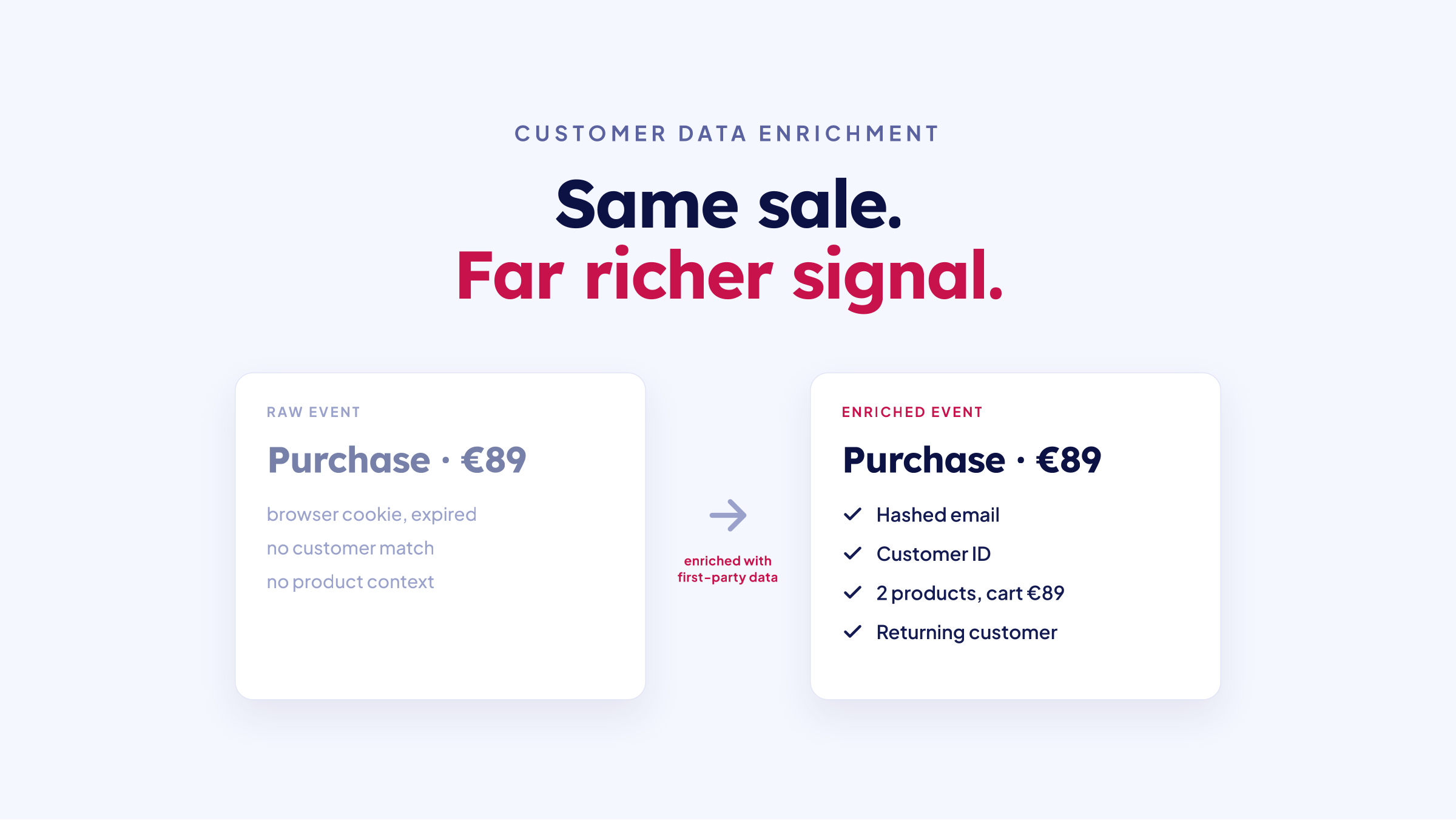
Short answer: Advantage+ hands targeting to Meta's algorithm, so the conversion signals you send back become your most important lever. Most stores send incomplete, low-match data and the algorithm optimises toward the wrong people. Feed it complete server-side events enriched with first-party data and a high match rate, and Advantage+ learns faster and improves ROAS.
Meta Advantage+ Shopping Campaigns have changed the way ecommerce brands run paid social. Instead of manually selecting audiences, placements, and creative combinations, you hand the keys to Meta's algorithm and let it figure out who to target, where, and with which ad.
For many Shopify brands, this shift has been a relief. Less time in Ads Manager, fewer audience tests, and often better results out of the gate.
But there is a catch that most advertisers overlook: Advantage+ campaigns are entirely dependent on the quality of your conversion data. When the algorithm makes every targeting decision for you, the signals you send back to Meta become the single most important lever you have.
Send incomplete or low-quality data, and Advantage+ will optimize toward the wrong people. Send enriched, high-match-rate conversion signals, and the algorithm gets smarter with every purchase.
This guide breaks down exactly what data Advantage+ needs, why most Shopify stores are sending insufficient signals, and how to fix it.
What Advantage+ Actually Does (and Why It Matters for Data)
Traditional Meta campaigns give you control. You pick the audience, set the placements, choose the optimization event, and manage creative rotation. The algorithm optimizes within the constraints you define.
Advantage+ Shopping Campaigns remove those constraints almost entirely. Here is what Meta's AI handles on its own:
-
Targeting: No audience selection. The algorithm decides who sees your ads based on conversion patterns.
-
Placements: Automatic across Facebook, Instagram, Messenger, and the Audience Network.
-
Creative selection: The algorithm tests and rotates creatives, allocating budget to top performers.
-
Budget allocation: Spend shifts dynamically based on real-time performance signals.
This is not a minor tweak to how campaigns work. It is a fundamentally different model - one driven by the same AI evolution behind Meta's Maximize Interactions goal and Meta's AI-driven ads personalization. In a manual campaign, your targeting knowledge compensates for gaps in data. If your pixel misses some conversions, you can still reach the right people because you defined the audience yourself.
With Advantage+, there is no safety net. The algorithm learns exclusively from the conversion events and audience signals you provide. If 30-40% of your conversions are invisible due to iOS restrictions, ad blockers, or consent decline, the algorithm is training on a partial picture. It does not know what it does not know.
This is why data quality is not just a "nice to have" for Advantage+. It is the foundation the entire campaign model is built on.
The Four Data Inputs That Drive Advantage+ Performance
Advantage+ relies on four categories of data to make its decisions. Understanding each one helps you identify where your current setup might be falling short.

1. Conversion Events
These are the core signals: PageView, ViewContent, AddToCart, InitiateCheckout, and Purchase. Every time a shopper completes one of these actions, Meta uses it to build a profile of who converts and what paths they take.
The more complete your event coverage, the better the algorithm understands your customer journey. When events are missing (because a browser blocked the pixel, or iOS stripped the click ID, or the shopper declined cookies), the algorithm has blind spots.
For a deeper look at how server-side event delivery works with Shopify, see our complete guide to Meta's Conversions API.
2. Audience Signals
Advantage+ accepts "audience suggestions" as a starting point. These are not hard targeting rules. Instead, they tell the algorithm where to look first before expanding. Custom audiences, lookalike sources, and customer lists all serve as signals that help the algorithm find high-value prospects faster.
The richer these signals, the faster Advantage+ exits its learning phase and starts delivering efficiently.
3. Customer Value Data
Not all conversions are equal. A first-time buyer spending $200 is a very different signal than a returning customer buying a $15 restock. When Meta can distinguish between these, it optimizes for the outcomes that actually grow your business rather than just maximizing raw conversion count. For strategies on building this distinction into your campaigns, see our guide on optimizing conversions for new customers.
4. Creative Performance Data
Advantage+ tests creative variants automatically. But creative performance measurement depends on accurate attribution. If the algorithm cannot connect an impression to a conversion (because the conversion event was lost), it misjudges which creatives drive results.
How Incomplete Data Degrades Advantage+ Campaigns
Here is what happens when your data pipeline has gaps:

The algorithm undertargets high-intent shoppers.
If a shopper browses three products, adds to cart, and purchases, but the AddToCart and Purchase events were blocked by Safari ITP, Meta never learns that this shopper profile converts. The next time someone similar appears, the algorithm does not bid aggressively enough.
Budget shifts to low-value segments.
When the algorithm cannot see enough real conversions, it optimizes toward the signals it can see. These tend to be easier-to-track actions like link clicks or landing page views. The result: your budget drifts toward people who click but do not buy.
Learning phase takes longer.
Advantage+ campaigns need approximately 50 conversions per week to exit the learning phase. If your tracking misses 30-40% of conversions, you need significantly more actual sales to hit that threshold. Some campaigns never exit learning, and performance stays volatile.
ROAS reporting becomes unreliable.
When you cannot trust reported ROAS, you cannot make confident scaling decisions. Brands end up cutting campaigns that are actually profitable or scaling campaigns that are actually bleeding money.
The core problem is simple: when platforms get less data, they generalize more aggressively. You end up paying for the wrong prospects more often.
Why Event Match Quality Matters More for Advantage+
Event Match Quality (EMQ) is Meta's score (1-10) for how well your conversion events can be matched back to Meta users. A higher EMQ means Meta can connect more of your purchase events to the people who actually saw or clicked your ads.
For manual campaigns, EMQ matters. For Advantage+, it is critical.
Here is why: Advantage+ makes targeting decisions based entirely on matched conversions. An unmatched conversion event is essentially invisible to the algorithm. It knows a purchase happened, but it cannot connect that purchase to a user profile, a browsing pattern, or an ad interaction. That data point is wasted.
The difference between an EMQ of 6 and an EMQ of 9 is not incremental. Real-world data shows that improving EMQ from 8.6 to 9.3 delivered:
-
18% reduction in CPA
-
24% increase in match rate
-
22% lift in ROAS
Those numbers make sense when you understand the mechanics. A higher match rate means more of your conversions feed the algorithm. More matched conversions mean faster learning, better lookalike modeling, and more precise bid optimization.
To learn how EMQ scoring works and what drives it up or down, read our guide to improving Meta's Event Match Quality.
How Server-Side Tracking Fixes the Data Gap
The root cause of most data quality issues is straightforward: browser-side pixels are increasingly unreliable. iOS 14+ strips click IDs from URLs. Safari and Firefox limit cookie lifetimes. Ad blockers prevent pixels from firing entirely. Consent banners gate tracking for a significant portion of visitors.
Server-side tracking through Meta's Conversions API (CAPI) solves this by sending events directly from your server to Meta, bypassing the browser entirely. Events are not blocked by ad blockers, are not affected by cookie restrictions, and are not gated by JavaScript execution.
But raw server-side events are only part of the solution. The real Advantage+ performance gains come from what you send with those events.
Data Enrichment: The Advantage+ Multiplier
When TrackBee sends a purchase event to Meta, it does not just send "Purchase, $150." It sends the event enriched with:
-
Hashed email address of the buyer
-
Hashed phone number
-
Hashed first and last name
-
Hashed physical address (city, state, zip, country)
-
External ID for cross-session matching
-
Click ID (fbc) when available, including recovery on iOS
These hashed identifiers are what Meta uses to match events to user profiles. The more identifiers you send per event, the higher your match rate, and the higher your EMQ score.
TrackBee's persistent shopper profiles make this possible even for events that would normally be anonymous. Because TrackBee identifies returning visitors across sessions and devices, it can attach enrichment data to events that a standard pixel would send with zero identifiers.
The result: TrackBee customers see EMQ improvements of 3-4 points on average, with significantly more conversions matched and fed into Advantage+ optimization.
New vs. Returning Customer Signals for Advantage+
One of the biggest budget wastes in Advantage+ campaigns is spending acquisition dollars on people who already bought from you. Because Advantage+ handles targeting automatically, you cannot simply exclude past purchasers the way you would in a manual campaign.
TrackBee solves this by sending two distinct purchase events to Meta:
-
NewCustomerPurchase: first-time buyers
-
ReturningCustomerPurchase: repeat buyers
This gives you three powerful capabilities within Advantage+:
-
Optimize for new customer acquisition. Set your Advantage+ campaign to optimize toward NewCustomerPurchase events, and the algorithm learns to find people who look like first-time buyers, not repeat purchasers.
-
Build exclusion audiences. Use ReturningCustomerPurchase data to exclude existing customers from acquisition campaigns, ensuring your budget goes toward growth.
-
Measure true acquisition cost. When you can separate new and returning revenue, you finally know your real CAC instead of a blended number that looks better than reality.
For a detailed breakdown of this strategy, see our post on how to stop wasting Meta ad budget on returning customers.
Custom Audience Sync as an Advantage+ Input
TrackBee automatically creates and maintains a "TrackBee - All Customers" custom audience in your Meta Ads Manager. This audience syncs every 5-15 minutes with your full customer base.
For Advantage+ campaigns, this audience serves as a high-quality signal input. When you add it as an audience suggestion, you are telling the algorithm: "These are my actual customers. Find more people like them."
Because this audience is built from server-side data (not just pixel-tracked visitors), it is more complete than any audience built from browser-side tracking alone. It includes customers who purchased via iOS, customers who never accepted cookies, and customers whose orders were processed through channels the pixel never saw.
A more complete seed audience means better lookalike modeling, which means Advantage+ finds high-value prospects faster.
What This Looks Like in Practice
The impact of better data on Advantage+ is not theoretical. Petrol Industries implemented TrackBee's server-side tracking and enrichment and saw a 100% increase in ROAS on Meta campaigns.
That kind of result comes from compounding improvements:
-
More events reach Meta (server-side delivery bypasses blockers)
-
Events carry richer matching data (hashed identifiers lift EMQ)
-
The algorithm trains on more matched conversions (better targeting)
-
New vs. returning signals prevent budget waste (cleaner optimization)
-
Custom audience sync provides stronger seed data (faster learning)
Each improvement is meaningful on its own. Together, they transform how Advantage+ performs because you are fixing the data at the source rather than trying to compensate with campaign structure tricks.
For more on how better data drives AI bidding performance across platforms, that post covers the broader principle. And if you are looking at how these data improvements translate into scaling without losing ROAS, we have covered that as well.
Getting Started
If you are running Advantage+ campaigns on a Shopify store, here is the priority checklist:
-
Ensure server-side event delivery. Browser pixels alone are not sufficient for Advantage+. You need Conversions API coverage for all key events.
-
Check your EMQ score. In Meta Events Manager, look at your Event Match Quality. If it is below 8, you are leaving significant Advantage+ performance on the table.
-
Enable data enrichment. Raw events without hashed identifiers produce low match rates. Enrichment is what turns a basic event into a high-value signal.
-
Activate new vs. returning customer signals. Without these, Advantage+ cannot distinguish acquisition from retention, and your reported CAC is unreliable.
-
Set up Custom Audience Sync. Give Advantage+ a complete customer list as an audience suggestion to accelerate learning.
TrackBee handles all five of these automatically for Shopify stores. Setup takes less than five minutes, requires no developer, and starts improving your data from the first session.
When you give Advantage+ better data, you are not hoping the algorithm works. You are giving it proof.


.png)