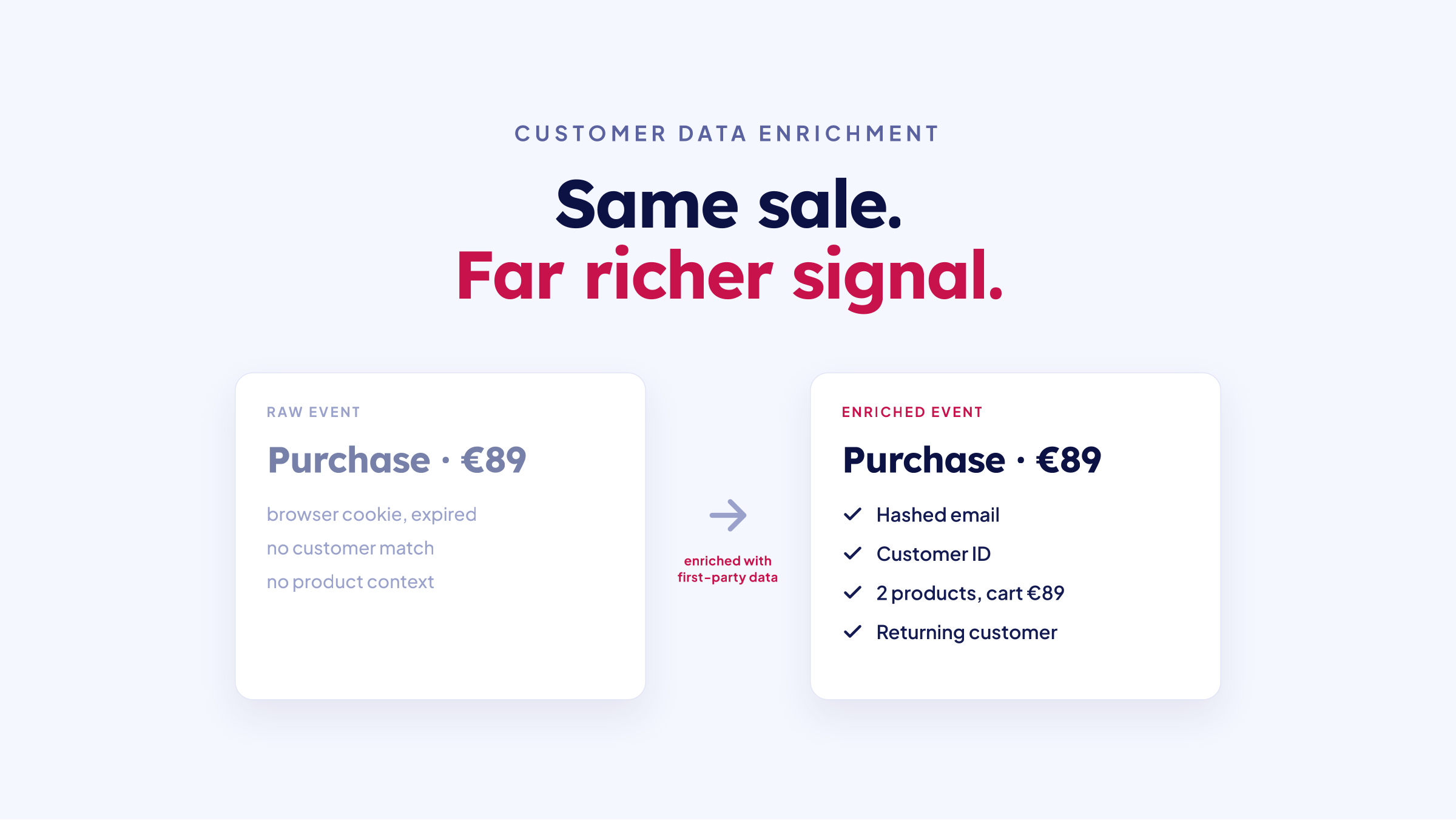
Short answer: Meta's Advantage+, Google's Smart Bidding and TikTok's Smart Performance all build their model of your ideal customer from the conversion data you feed them. Incomplete data means worse targeting no amount of creative testing can fix. Sending complete server-side events enriched with first-party data is the single biggest lever on ROAS.
To compare the tools that close this data gap, see the best ad tracking software for Shopify.
Every major ad platform now runs on machine learning. Meta's Advantage+, Google's Smart Bidding, TikTok's Smart Performance Campaigns - these systems make thousands of bidding decisions per second based on the conversion data you feed them.
Most advertisers spend their time optimizing creatives, audiences, and campaign structures. Those things matter. But they're all downstream of a more fundamental question: how good is the data your algorithms are learning from?
If the answer is "incomplete," no amount of creative testing or audience refinement will compensate. The algorithm is building its model of your ideal customer from a partial picture - and every decision it makes reflects that gap.
This post breaks down how AI bidding actually works, why data quality is the single biggest lever most advertisers ignore, and what happens when you fix the input.
How AI Bidding Algorithms Actually Work
Understanding why data quality matters requires understanding what these algorithms are actually doing - stripped of the marketing language.
Meta's Advantage+ delivery system
Meta's algorithm operates in two phases. First, it builds a conversion model: a statistical profile of which users are most likely to take your desired action (purchase, add to cart, initiate checkout) based on the conversion events it has received. Second, it uses that model to make real-time bidding decisions - evaluating every available impression opportunity and deciding how much to bid based on the predicted conversion probability for that specific user.
The model is continuously updated. Every new conversion event refines the algorithm's understanding of who your buyers are and what behavior patterns precede a purchase. More events, with richer data attached, means a more accurate model. A more accurate model means more efficient bidding. Meta's recent upgrade to its ad retrieval engine, Andromeda, makes this data dependency even more pronounced - deep neural networks now scan millions of eligible ads per impression, and the quality of your conversion signals determines how well your ads compete.
Google's Smart Bidding
Google's bidding algorithms (Target CPA, Target ROAS, Maximize Conversions) use a similar principle but operate across a different signal set. Google evaluates contextual signals - search query, device, location, time of day, audience lists - and predicts conversion probability for each auction.
The critical input is your conversion data. Google's system needs to know which clicks led to conversions, the value of those conversions, and ideally, the identity of the converter (via Enhanced Conversions). The more complete and accurate this data, the better Google can predict which future clicks will convert at what value.
TikTok's Smart Performance Campaigns
TikTok's algorithm optimizes for conversions using signals from the Events API. It builds user profiles based on in-app behavior and matches them against your conversion data to find patterns. TikTok's system is newer and more data-hungry than Meta's or Google's - which means incomplete data has an even larger proportional impact on performance.
The common thread
All three platforms share the same fundamental dependency: they optimize based on the signals you send them. The algorithm doesn't know about the conversions it doesn't receive. It can't factor in customers it never saw. It builds its entire model - who to target, how much to bid, when to show your ads - from whatever data arrives in its event stream.
Better input data means you don't have to hope the black box figures it out. You give the algorithm evidence.
The Garbage In, Garbage Out Problem
"Garbage in, garbage out" is a principle from computer science that applies directly to ad platform algorithms. If your input data is incomplete, biased, or inaccurate, the output - your targeting, your bids, your ROAS - will be too.

Here's what incomplete data looks like in practice:
Missing conversions.
iOS privacy restrictions, ad blockers, cookie consent rejection, and browser limitations prevent 25–40% of conversions from reaching ad platforms via client-side tracking. The algorithm never learns about these purchases.
Missing identifiers.
When conversions arrive without hashed email addresses, phone numbers, or other customer identifiers, platforms can't match them to user profiles. The conversion counts, but the algorithm can't connect it to the behavioral signals that preceded it. The pattern goes unlearned.
Missing funnel events.
If your PageView and ViewContent events fire but AddToCart and InitiateCheckout events are blocked or misconfigured, the algorithm sees interest but can't model the full purchase journey. It loses the ability to identify mid-funnel intent signals that predict conversion.
Missing value data.
Conversion events without accurate order values prevent value-based bidding strategies from working. Google's Target ROAS and Meta's value optimization both require accurate purchase values to prioritize high-value customers over low-value ones.
The result: your algorithm is learning from a biased, incomplete sample of your actual customers. The model it builds doesn't represent your real buyer base - it represents the subset of buyers whose data made it through your tracking infrastructure. If you're evaluating attribution and analytics platforms to address this, understanding the alternatives to TripleWhale can help clarify the difference between attribution dashboarding and upstream data quality.
The Compounding Effect of Bad Data
Incomplete data doesn't just produce a slightly worse model. It creates a negative feedback loop that compounds over time.

Stage 1: Incomplete data arrives.
Your ad platform receives conversion events for 60–70% of actual purchases. The missing 30–40% are disproportionately iOS users, European visitors who declined consent, and privacy-conscious shoppers.
Stage 2: The model learns the wrong patterns.
The algorithm builds its buyer model from the conversions it can see. It overweights the characteristics of trackable users and underweights the characteristics of untrackable ones. If your best customers are iPhone users in Germany, but those conversions are invisible to Meta, the algorithm will deprioritize that exact audience.
Stage 3: Targeting degrades.
Based on its biased model, the algorithm targets users who resemble the trackable converters - not your actual best customers. Budget shifts toward audiences that were easier to track, not audiences that were more likely to buy.
Stage 4: Worse data feeds the loop.
As targeting degrades, the algorithm shows ads to less relevant audiences. Conversion rates drop. The smaller volume of conversions that does arrive continues to be biased in the same direction. The model becomes more confident in its wrong conclusions.
Stage 5: Performance declines.
CPA rises. ROAS falls. The advertiser responds by changing creatives, restructuring campaigns, or reducing budgets - none of which address the root cause. The algorithm was never broken. The data was.
This loop is why some advertisers feel like their campaigns "hit a ceiling" or that Meta's algorithm "isn't learning anymore." The algorithm is learning fine - it's just learning from the wrong data.
What Algorithms Actually Need From You
Ad platform algorithms need four categories of data to build accurate conversion models:

1. Complete conversion events
Every event in the customer journey matters: PageView, ViewContent, AddToCart, InitiateCheckout, Purchase. Missing events at any stage means the algorithm can't model the full funnel. It can't distinguish a window shopper from a high-intent buyer if AddToCart events are missing.
The Purchase event is the most critical - it's the primary signal for conversion optimization campaigns. Every missed Purchase event directly degrades the algorithm's understanding of who buys from you.
2. Customer identifiers
Hashed email addresses, phone numbers, names, and physical addresses enable platforms to match conversion events to user profiles. This matching is what connects the conversion to the behavioral signals that preceded it - the ad views, the website visits, the engagement patterns.
Without identifiers, the conversion is counted but not attributed to a user profile. The algorithm sees that a purchase happened but can't learn from the journey that led to it.
3. Accurate purchase values
Value data enables platforms to distinguish between a $30 order and a $300 order. Without it, both conversions are weighted equally. With it, the algorithm can optimize for revenue rather than just conversion volume - finding the users most likely to place high-value orders.
4. Funnel progression signals
The sequence of events - PageView → ViewContent → AddToCart → InitiateCheckout → Purchase - gives the algorithm a model of purchase intent. It can identify users who exhibit early-stage behavior patterns that historically lead to conversion and bid more aggressively for them.
When funnel events are missing or arriving out of sequence, the algorithm loses this predictive capability. It falls back to broader, less efficient targeting signals.
Platform-Specific Data Quality Signals
Each platform has its own metric for measuring how good your data is. These scores directly correlate with ad performance.

Meta: Event Match Quality (EMQ)
EMQ is Meta's 1–10 score measuring how well your conversion events can be matched to Meta user profiles. Higher EMQ means Meta can connect more of your conversions to user journeys - enabling better modeling and more efficient bidding.
Key factors that drive EMQ: hashed email, hashed phone number, external ID, client IP address, user agent, click ID (fbc). Sending all of these with every event maximizes your match quality.
Real impact: brands that improved EMQ from 8.6 to 9.3 saw an 18% reduction in CPA, a 24% increase in match rate, and a 22% lift in ROAS. Those aren't marginal improvements - that's the difference between a profitable campaign and one that breaks even.
For a deep dive on improving your EMQ score, read How to improve Meta's Event Match Quality score.
Google: Enhanced Conversion Coverage
Google measures how many of your conversion events include Enhanced Conversion data - hashed first-party identifiers that improve Google's ability to measure and optimize conversions.
Higher Enhanced Conversion Coverage means better Smart Bidding performance: more accurate predictions, more confident bids, and better ROAS at the same spend level.
The average impact of Enhanced Conversions: +17.1% increase in measured conversions. That's not inflated reporting - those are real conversions that Google's standard tag missed, now feeding the bidding algorithm.
Learn more: The ultimate guide to Google Enhanced Conversions.
TikTok: Events API match rate
TikTok's Events API match rate measures how many server-side events can be attributed to TikTok users. Higher match rates - driven by the same customer identifiers (hashed email, phone, external ID) - give TikTok's algorithm more signal to optimize against.
Brands using enriched server-side events through TikTok's Events API see an average of 19% more captured events and 15% CPA improvement. For a platform where the algorithm is still maturing, that additional signal makes a measurable difference.
How Data Quality Impacts Every Part of Your Funnel
Data quality isn't an abstract infrastructure concern. It affects specific, measurable business outcomes.
Audience modeling
Meta's Lookalike Audiences and Google's Similar Audiences are built from your conversion data. If your conversion data represents only 65% of your actual buyers - and a biased 65% at that - your lookalikes will find users who resemble the trackable subset, not your full customer base.
Better data means better source audiences, which means better lookalikes, which means lower CPAs on prospecting campaigns.
Bid optimization
Real-time bidding decisions are made based on predicted conversion probability. More complete conversion data → more accurate predictions → more confident bids. When the algorithm is confident a user will convert, it bids aggressively. When it's uncertain, it bids conservatively or passes entirely.
Incomplete data creates uncertainty. The algorithm hedges. You pay more per conversion because the algorithm isn't confident enough to bid efficiently.
Retargeting precision
Retargeting depends on knowing who visited your store, what they looked at, and how far they progressed through the funnel. Missing ViewContent, AddToCart, or InitiateCheckout events mean smaller retargeting pools and less precise segmentation.
Server-side tracking captures these events regardless of ad blockers or browser restrictions, maintaining full retargeting pools and enabling precise segmentation (e.g., cart abandoners vs. product viewers vs. checkout dropoffs).
ROAS measurement and optimization
If 30% of your conversions are invisible, your reported ROAS is 30% lower than reality. This leads to underinvestment in channels that are actually performing and incorrect budget allocation decisions.
Worse, the algorithm itself optimizes against the incomplete ROAS it sees. It pulls budget away from audiences and placements that are actually converting - because it doesn't know those conversions happened.
For a complete look at tracking across the full funnel, see Full-funnel tracking for Shopify.
What Happens When You Fix the Data
When complete, enriched conversion data reaches your ad platforms, the improvement isn't just in reporting accuracy - it shows up in actual campaign performance.
More conversions visible = better model training
Server-side tracking captures 30–40% more conversion events than client-side tracking alone. Those additional events aren't noise - they're real purchases by real customers that your algorithms were previously blind to. Every recovered event improves the conversion model.
Higher match quality = more efficient bidding
Enriching events with hashed customer identifiers (email, phone, name, address) increases platform match rates. The algorithm can connect conversions to user profiles and learn from the full customer journey - not just the final click.
Real results from real brands
saw a 100% increase in Meta ROAS after implementing server-side tracking with data enrichment. The ads didn't change. The audiences didn't change. The data feeding the algorithm changed - and performance doubled.
Across TrackBee's customer base, EMQ improvements from 8.6 to 9.3 produced consistent results: 18% lower CPA, 24% higher match rate, 22% higher ROAS.
For Google Ads, Enhanced Conversions delivered a 17.1% average increase in measured conversions - giving Smart Bidding significantly more signal to optimize against.
These aren't edge cases. When the algorithm receives better data, it makes better decisions. The relationship is direct and predictable.
Why Data Quality Matters More at Scale
Here's the part that most advertisers miss: data quality problems don't just persist as you scale - they amplify.
At low spend, your campaigns target narrow, well-defined audiences. The algorithm has a small search space. Even with incomplete data, it can find converters within that limited pool through sheer repetition.
At higher spend, the algorithm is searching across a much larger, more diverse audience. It needs a strong model to identify high-value users within millions of candidates. An incomplete model - built from 65% of your actual customers - becomes progressively less useful as the audience expands.
This is why brands that scale aggressively see disproportionate ROAS declines. The tracking gap that was tolerable at $5K/month in spend becomes the limiting factor at $50K/month. The algorithm doesn't have enough signal to maintain efficiency across a larger audience.
Fixing data quality before scaling is the highest-leverage thing you can do.
It means the algorithm enters the scaling phase with a complete, accurate model of your buyers. It can expand reach into new audiences with confidence because its predictions are based on full data - not a biased subset.
For a detailed breakdown of how this applies to Meta specifically, read Scaling Facebook Ads without losing ROAS.
Frequently Asked Questions
How quickly do algorithms improve after fixing data quality? Most brands see measurable changes within 7–14 days. Ad platform algorithms continuously retrain based on incoming data. Once enriched server-side events start flowing, the algorithm begins incorporating them immediately. Meta's learning phase typically stabilizes within a week. Google's Smart Bidding adjustments can take slightly longer - up to 2–3 weeks for the full effect. The improvements compound over time as the algorithm's model becomes more accurate with each conversion event.
Does better data mean my ad costs will increase? No. Better data typically reduces costs. When your algorithm has a more accurate conversion model, it bids more efficiently - winning the right impressions at lower costs and avoiding overpaying for low-value users. CPA decreases because the algorithm targets more precisely. The total spend stays the same (or increases if you choose to scale), but the return per dollar improves.
Can I fix data quality without changing my campaigns? Yes. Data quality is an infrastructure issue, not a campaign structure issue. Server-side tracking and data enrichment work at the tracking layer - feeding better data to your existing campaigns, ad sets, and creatives. You don't need to restructure anything. The same campaigns perform better because the algorithm receives more complete signals.
What's the minimum EMQ score I should aim for? An EMQ of 8.0+ is generally considered good by Meta. Scores above 9.0 indicate excellent match quality. Most Shopify stores running only client-side pixel tracking sit between 4.0 and 7.0. Adding server-side tracking with enriched identifiers typically pushes scores into the 8.5–9.5 range. Every point of improvement translates to measurably better campaign performance.
Does this apply to all campaign types? Data quality affects every campaign type that uses conversion optimization - which is most of them. Advantage+ Shopping, Conversion campaigns, Smart Bidding, Performance Max, TikTok Smart Performance Campaigns - all depend on conversion data quality. The only campaign types unaffected are those optimized for reach or impressions, which don't use conversion signals.
How is this different from just adding Meta's Conversions API manually? Adding CAPI is a necessary step, but CAPI alone sends the same data server-side that your pixel captures client-side. The difference is what happens to that data before it's sent. Data enrichment adds hashed customer identifiers, persistent shopper profiles, new vs. returning customer signals, and cross-session context to every event - giving platforms significantly more signal than raw CAPI forwarding provides.


.png)