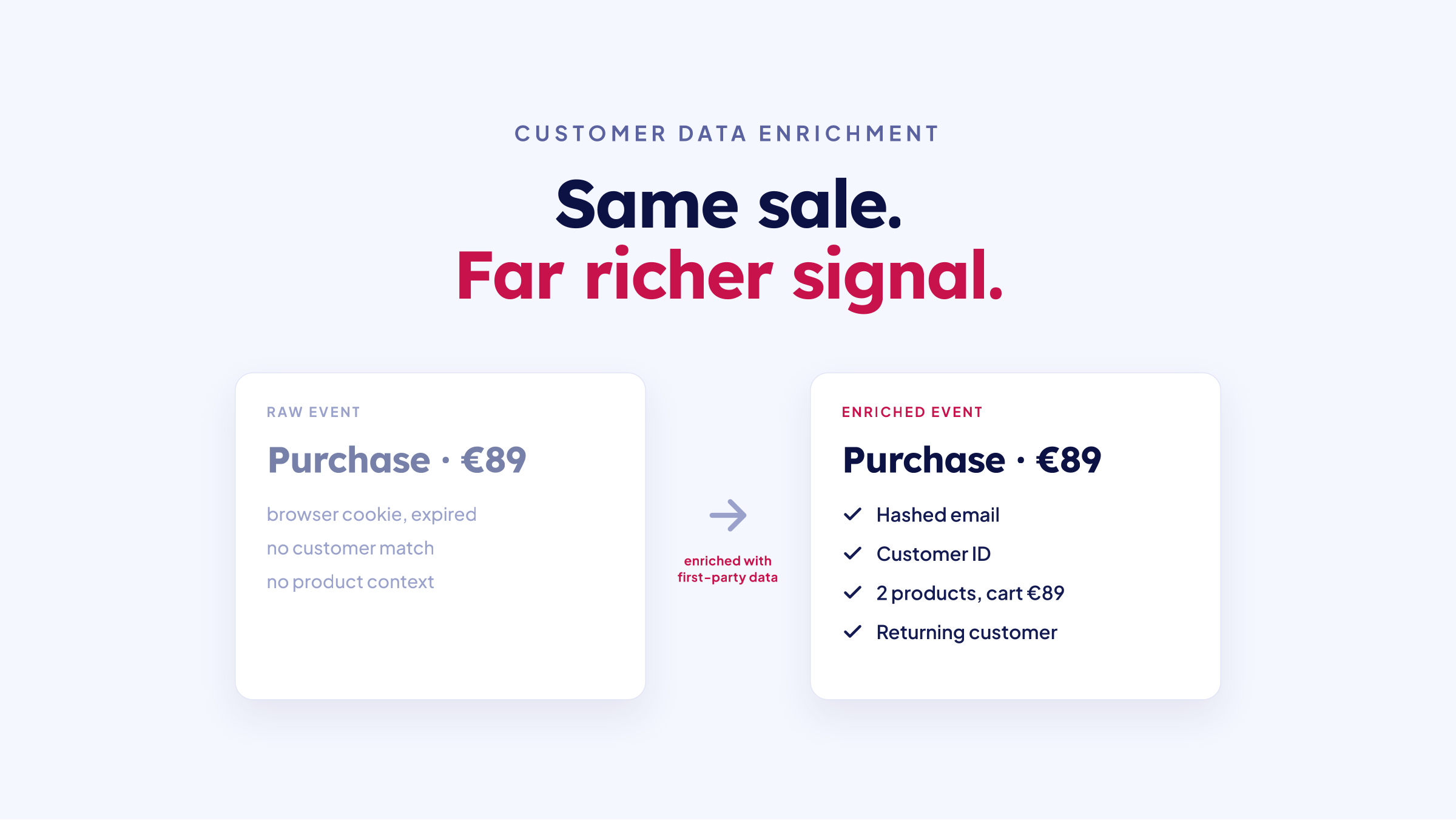
Short answer: Most Shopify stores lose 25 to 40 percent of conversion data to ad blockers and iOS restrictions, which shows up as a gap between Shopify revenue and what your ad platforms report. That gap is real revenue your ads earned but never got credit for. Calculate it from the two numbers, then close it with server-side tracking.
Your Shopify dashboard shows the truth: every completed order, the correct revenue, the real conversion rate. Your Meta Ads Manager shows something different - fewer conversions, lower ROAS, a smaller picture of what's actually happening.
The gap between those two numbers represents real money. Revenue that was generated by your advertising but never attributed to it. Conversions that happened but that your ad platforms couldn't see.
Most Shopify brands accept this gap as inevitable. It's not. This guide shows you how to calculate exactly how much revenue your tracking gaps are costing you - and what fixing them does to your business.
What Causes Tracking Gaps on Shopify
Tracking gaps aren't caused by one thing. They're the cumulative result of multiple browser and device limitations that each eliminate a portion of your conversion data:
Ad blockers Browser extensions like uBlock Origin, AdBlock Plus, and Brave's built-in shields block Meta Pixel, Google Analytics tags, TikTok Pixel, and other tracking scripts at the browser level. Any visitor running an ad blocker is invisible to your client-side tracking - regardless of their behavior on your store.
Typical impact: 15–25% of visitors in tech-aware, privacy-conscious, and European audiences. Lower (8–12%) for broad consumer audiences.
iOS App Tracking Transparency Apple's ATT framework requires users to explicitly opt into cross-app tracking on iOS. Most users decline. Meta's own data showed 80%+ opt-out rates in early rollouts. For Shopify brands where 50–70% of traffic comes from iOS devices, this means a substantial portion of Meta ad clicks on iPhone are unattributable via standard Pixel tracking.
Typical impact: iOS traffic share × ATT opt-out rate × attribution weight of iOS conversions.
Safari Intelligent Tracking Prevention Safari limits first-party cookie lifespan to 7 days and blocks many third-party cookies entirely. Any customer who clicks an ad and purchases more than 7 days later - common for considered purchases above ~$50 - is unattributed in browser-based tracking. The conversion happened; the attribution didn't survive.
Typical impact: proportional to the percentage of your audience that uses Safari (approximately 30% of global web traffic) and your purchase consideration window.
iOS 17+ Link Tracking Protection (expanding in iOS 26) iOS 17 introduced Link Tracking Protection, stripping fbclid, gclid, ttclid, and msclkid parameters from URLs. iOS 26 expands this further, applying click ID stripping in more browsing contexts across the operating system. Click-level attribution in Meta, Google, TikTok, and Pinterest is broken for any URL affected by LTP. Purchase events arrive without the click context that enables attribution.
Typical impact: significant and growing for brands with high iOS traffic and multi-touch journeys.
Shopify checkout restrictions Shopify's checkout environment limits third-party script access. Events that should fire at checkout - InitiateCheckout, AddPaymentInfo, Purchase - are frequently missing or firing incorrectly for browser-based implementations. This is particularly pronounced after Shopify's checkout extensibility updates.
Consent banner rejection GDPR and CCPA compliance requires non-essential cookie consent in the EU and California. Users who decline cookie consent generate zero client-side tracking events. In EU markets, rejection rates of 30–50% are common. Since July 2025, Google's Consent Mode V2 enforcement means advertisers without a compliant consent setup lose remarketing and audience signals entirely for EEA users.
Cumulative effect These mechanisms don't stack additively - they partially overlap - but the combined tracking loss typically falls in the 25–40% range for most Shopify brands. For brands with high European traffic, iOS-heavy audiences, or privacy-conscious buyer demographics, the gap can reach 45–50%.
How to Calculate Your Tracking Gap
You can estimate your tracking gap without any advanced tools. You need two numbers:

Number 1: Shopify purchase events in your analytics platform Go to your Meta Events Manager (or Google Analytics 4, or TikTok Events Manager) and find the total Purchase event volume for a defined period (last 30 days).
Number 2: Shopify actual order count In Shopify Admin → Analytics → Dashboards, find the actual order count for the same period.
Simple gap calculation:
Example:
-
Shopify orders (last 30 days): 847
-
Meta Purchase events (same period): 531
-
Tracking gap: 1 - (531 ÷ 847) = 37.3%
This calculation has nuances - some Shopify orders won't be attributable to Meta regardless (organic, direct, Google traffic) - but as a directional measure, it tells you what percentage of your Shopify orders your ad platforms can't see.
A more precise calculation using first-party attribution: Compare your Klaviyo "Placed Order" event volume to your Shopify order count. Klaviyo events should fire for every order placed by a known Klaviyo profile. If Klaviyo is missing a significant portion of orders, your tracking infrastructure has gaps beyond just ad platform attribution.
For abandoned cart flows specifically: Compare your Klaviyo "Started Checkout" event volume to your Shopify "Reached Checkout" metric (Shopify Analytics → Sales → Checkout). The ratio tells you what percentage of checkout initiations are reaching Klaviyo - which determines how many abandonment flow emails actually trigger.
What Tracking Gaps Cost You: The Four Impact Areas
Tracking gaps don't just affect your reporting. They affect your actual business performance across four distinct areas.

1. Algorithm Optimization Quality
Every major ad platform uses conversion data to train its delivery algorithms. Meta's Advantage+, Google's Smart Bidding, TikTok's Smart Performance Campaigns - all of them optimize based on the conversion signals they receive.
When 35% of your conversions are missing, your algorithms are learning from a biased sample. The customers whose purchases were tracked are overrepresented in your algorithm's buyer model. The ones who weren't - typically iOS users, privacy-conscious users, European users - are underrepresented.
The algorithm optimizes toward the wrong buyers. Delivery efficiency suffers. You pay more per acquisition than you should.
The cost: inflated effective CPA
across campaigns that rely on algorithm optimization.
2. Budget Misallocation
Your budget allocation decisions are based on reported ROAS per channel. If Meta shows 3.1x ROAS and Google shows 2.7x, you allocate more to Meta. But if Meta's ROAS is artificially deflated by a 35% tracking gap (many Meta-driven conversions aren't being reported back to Meta), your true Meta ROAS might be 4.8x. You're underinvesting in your best channel based on incomplete data.
This misallocation scales with your ad spend. A brand spending $50,000/month with a 35% tracking gap might be allocating $8,000–$15,000/month to the wrong channels.
The cost: systematic budget misallocation
at the scale of your total ad spend.
3. Abandoned Cart Revenue Loss
Klaviyo's abandoned cart and browse abandonment flows depend on server-side events triggering correctly. When "Started Checkout" or "Viewed Product" events don't reach Klaviyo, the flows don't fire.
An abandoned cart flow that recovers 5% of abandoners delivers zero recovery for the abandoners whose events never triggered the flow. The emails aren't sent. The revenue isn't recovered.
If you have 1,000 checkout abandoners per month and your flow is only triggering for 600 of them (because 40% of "Started Checkout" events never reach Klaviyo), you're recovering revenue from 600 abandoners instead of 1,000. At a 5% recovery rate and $80 average order value, that's 20 additional recovered orders per month - $1,600/month in directly recoverable revenue from fixing the trigger, before any optimization of the email content itself.
The cost: direct abandoned cart revenue loss
proportional to your trigger gap and flow performance.
4. Ad Spend on Already-Converted Customers
When your ad platforms don't know a customer has converted, they keep targeting them with acquisition ads. Without real-time customer suppression audiences, you're paying for impressions and clicks from existing customers who are being retargeted with "first purchase" creative.
This is a double cost: paying for ads that shouldn't be running, and damaging the experience of existing customers who keep seeing acquisition ads for products they already own. See: Why retargeting existing customers is silently killing your ad budget.
The cost: wasted acquisition ad spend
on already-converted customers.
A Real Example: HoneyBalm's Tracking Gap
HoneyBalm, a skincare brand on Shopify, discovered they were missing 74% of their Add to Cart events in Klaviyo. Their abandoned cart flow was triggering for less than 30% of actual cart abandonment events.

They weren't aware of the gap. Their Klaviyo flow was running. They assumed it was working as configured.
After implementing TrackBee's server-side event capture:
-
+171% more Add to Cart events in Klaviyo
-
+220% more abandoned cart flow triggers
-
+213% more abandonment revenue
The email sequence didn't change. The discount strategy didn't change. The copy didn't change. The only change was that the events were now being captured server-side and reaching Klaviyo reliably.
The revenue recovery was purely from fixing the infrastructure - not from optimizing the strategy.
This pattern is consistent across TrackBee's client base. The tracking gap is the problem that looks like a content or strategy problem. Fix the infrastructure and the existing strategy performs significantly better.
How Server-Side Tracking Closes the Gap
Server-side tracking moves event capture from the browser to the server. Events are captured at the Shopify backend level - where every order is recorded regardless of browser conditions.

What server-side tracking recovers:
-
Conversions from customers with ad blockers (server-side calls bypass browser extension blocking)
-
iOS conversions where ATT was declined (server-side events don't require device-level tracking permission)
-
Cross-device conversions where Safari's ITP expired the cookie (Shopper Profiles maintain cross-session identity via email identifiers)
-
Checkout events that client-side scripts miss in Shopify's checkout environment
-
Klaviyo events for customers who browsed with tracking blocked
What server-side tracking can't fully recover: Some attribution gaps are inherent to privacy-first environments. A customer who completely blocks all tracking and uses a private email at checkout will still have limited attribution. Server-side tracking substantially reduces the gap - it doesn't eliminate every privacy-related attribution challenge.
See: What is server-side tracking and how to install it for Shopify.
The Economics of Fixing Your Tracking
The question for most Shopify brands isn't "should I fix my tracking" - it's "what does fixing it cost and what does it return?"
Estimating the return: Using the tracking gap calculation above, estimate:
-
Your monthly revenue
-
Your tracking gap percentage
-
The proportion of that gap that represents algorithmic inefficiency, budget misallocation, and Klaviyo flow failures
A conservative framework: fixing a 35% tracking gap on a brand doing $100,000/month in revenue typically generates:
-
10–15% improvement in ad platform ROAS (from better algorithm optimization)
-
Recovery of Klaviyo abandoned cart flow triggers proportional to your current trigger gap
-
Budget reallocation to better-performing channels once true ROAS per channel is visible
The combination of these effects is worth significantly more than the cost of a server-side tracking platform in almost every case above $30,000/month in revenue. For agencies managing multiple Shopify clients, the ROI multiplies across every account in the portfolio.
TrackBee's pricing starts at $79/month For a brand doing $100,000/month with a 35% tracking gap, the addressable value from fixing tracking - through better algorithm performance and Klaviyo recovery alone - typically exceeds the platform cost within the first month.
Frequently Asked Questions
How do I know if I have a significant tracking gap? Compare your Meta Purchase event volume (from Events Manager) to your Shopify order count for the same period. A gap of more than 15–20% (accounting for orders from non-Meta channels) indicates a meaningful tracking problem. Also compare your Klaviyo "Started Checkout" event volume to Shopify's "Reached Checkout" metric.
Does fixing my tracking gap immediately improve ROAS? Not immediately - the improvement is gradual as ad platform algorithms retrain on more complete data. Typically, meaningful algorithm improvement becomes visible within 2–4 weeks of implementing server-side tracking, as the algorithms accumulate enough complete conversion signal to update their buyer models.
Does better tracking affect my Klaviyo analytics? Yes. With server-side event capture, Klaviyo receives more events - meaning your Klaviyo analytics show higher event volumes, more flow triggers, and more flow revenue. This is accurate data appearing, not duplicate data. Your Klaviyo revenue numbers will likely increase after fixing your tracking - not because more emails are being sent to existing contacts, but because more contacts are triggering flows they should have been triggering all along.
Will I see my ROAS go down when I implement server-side tracking? Possibly, temporarily. When you add CAPI events to Meta, some conversions that were being double-counted (both Pixel and CAPI firing for the same event, without deduplication) get correctly deduplicated - reducing inflated conversion counts. Your actual ROAS improves, but the displayed ROAS in Ads Manager may show a short-term correction as the accurate data replaces inflated numbers. This is the right direction.
Should I fix tracking before or after running A/B tests? Before. A/B test results are only reliable when your baseline conversion data is accurate. Testing on top of a 35% tracking gap means your test results are based on the subset of conversions that were trackable - which may not be representative. Fix the infrastructure, establish an accurate baseline, then run tests.


.png)