Short answer: All three numbers are correct because each measures something different. Meta counts purchases inside its attribution window including view-through, Shopify records every actual order, and TrackBee shows orders it can attribute to a click. Use Shopify for revenue truth, Meta for in-platform optimisation, and match your attribution window to the decision you are making.
You open Meta Ads Manager. It says you had 142 purchases last week. You check Shopify. It shows 118 orders. You look at TrackBee's Accuracy page. It shows 97 orders with click IDs. Three platforms, three numbers, zero confidence in any of them.
This is one of the most common frustrations in ecommerce marketing. But here's the uncomfortable truth: all three numbers are correct. They're just measuring different things, for different purposes, using different methods.
Understanding why the numbers don't match - and which number to use for which decision - is the difference between making informed budget decisions and chasing phantom data.
The Five Common Discrepancies
Almost every Shopify store running Meta ads encounters these five gaps:
-
Meta reports more purchases than Shopify. Meta Ads Manager shows 142 purchases. Shopify shows 118.
-
Shopify shows more add-to-carts than Meta. Shopify analytics says 800 ATCs. Meta says 520.
-
TrackBee Accuracy shows fewer orders than Meta. TrackBee shows 97 attributed orders. Meta claims 142.
-
Revenue totals don't match. Shopify says $47,000. Meta says $52,000. TrackBee shows $41,000.
-
Changing your attribution window changes the numbers dramatically. Switching from 7-day click + 1-day view to 1-day click cuts reported conversions by 40%.
Each has a specific, logical explanation. None means your tracking is broken.
1: Meta Reports More Purchases Than Shopify
Meta doesn't just count direct click-to-purchase conversions. It uses multiple attribution methods:

-
Click-through attribution. Someone clicks your ad and purchases within your attribution window (default: 7 days).
-
View-through attribution. Someone sees your ad without clicking, then purchases through another channel within 1 day. Meta claims that conversion.
-
Modeled conversions. When Meta can't directly observe a conversion (iOS restrictions, ad blockers, consent decline), it uses statistical modeling to estimate conversions that likely occurred.
Shopify counts actual completed checkouts. It doesn't model anything or attribute to ad views.
What to do:
Don't force the numbers to match. The gap tells you how much of Meta's value comes from indirect influence. If Meta reports 2x+ Shopify orders, check your event deduplication setup - duplicate events from running browser-side and server-side tracking without deduplication inflate numbers artificially.
2: Shopify Shows More Add-to-Carts Than Meta
This seems backwards, but the explanation is simple:

-
Shopify counts sessions with an ATC action across all traffic sources - organic, email, direct, paid. It's consent-gated but captures ATCs from every channel.
-
Meta counts ATC events fired by the Meta Pixel or Conversions API. Only sessions with active Meta tracking generate these events.
Shopify counts ATCs from all sources. Meta only counts ATCs it can attribute to Meta ad interactions. Different populations, different numbers. This discrepancy is expected and doesn't indicate a tracking problem.
3: TrackBee Accuracy Shows Fewer Orders Than Meta
TrackBee's Accuracy page shows orders with a verifiable click ID attached. For Meta, that means orders where the session included an fbc parameter - proof that the customer clicked a Meta ad.

Meta Ads Manager includes orders with click IDs plus view-through conversions (no click ID exists), modeled conversions, and cross-device conversions (click ID may not carry across devices).
What to do:
Use TrackBee Accuracy as your ground truth for directly attributable orders. The gap between TrackBee and Meta represents view-through, modeled, and cross-device attributions - not missing data.
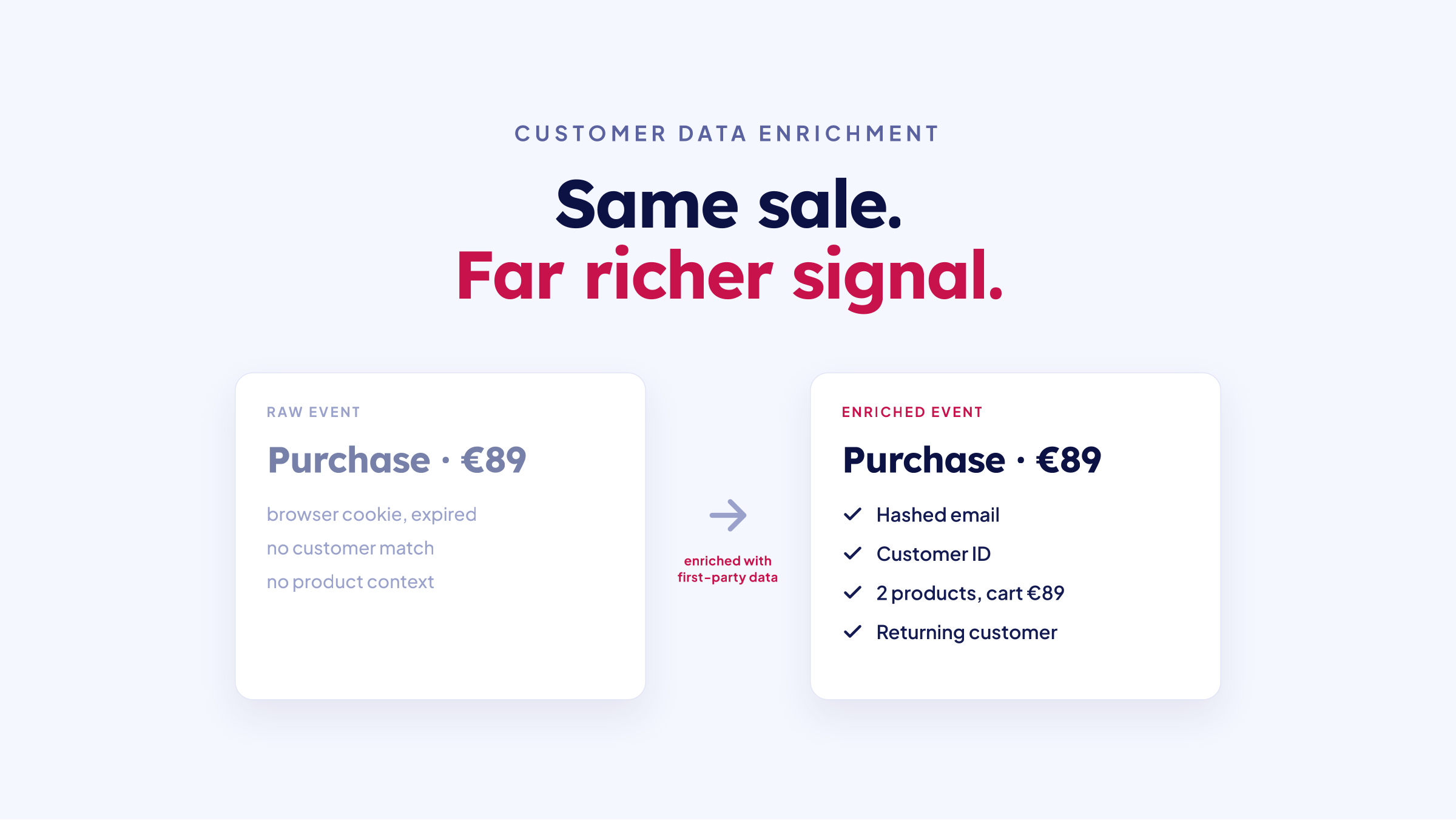
Importantly, TrackBee still sends all orders to Meta server-side, including orders without click IDs. Meta receives enriched event data (hashed email, phone, address) and uses it for attribution modeling. The Accuracy page simply shows which orders had direct, click-based attribution.
4: Revenue Differs Between Platforms
Several factors cause revenue discrepancies:

-
Refunds and cancellations. TrackBee captures revenue at the moment of purchase and does not retroactively adjust. Shopify updates order values when refunds occur. Checking last month's numbers, Shopify may show lower revenue while TrackBee shows original purchase values.
-
Tax and shipping. Platforms differ in whether they include tax, shipping, and discounts. These definitional differences add up.
-
View-through revenue. Meta attributes revenue from view-through conversions that Shopify doesn't label as Meta-attributed. TrackBee only shows click-attributed revenue.
What to do:
Use Shopify as your financial source of truth. Use Meta's figures for understanding Meta's attributed contribution. Use TrackBee for click-based revenue per channel. Never try to reconcile all three to the same number - they measure revenue through different lenses by design.
5: Different Attribution Windows Show Different Results
Switch Meta's attribution window from "7-day click, 1-day view" to "1-day click" and reported conversions drop by 40%. You didn't lose sales - you changed the measurement lens.
The default "7-day click, 1-day view" means Meta claims any purchase within 7 days of a click, or within 1 day of a view. Switching to "1-day click" excludes all purchases 2–7 days after a click and all view-through conversions.
What to do:
Choose an attribution window that matches your product's buying cycle. High-consideration products benefit from 7-day click. Impulse purchases work on 1-day click. The key rule: pick a window and stick with it. Changing settings constantly makes trend analysis impossible.
Attribution Windows and View-Through Explained
Meta offers four main attribution settings:
-
1-day click. Purchases within 24 hours of clicking your ad. Most conservative.
-
7-day click. Purchases within 7 days of a click. Most commonly used. Captures multi-touchpoint buying journeys.
-
1-day view. Purchases within 24 hours of seeing your ad without clicking. This is where numbers inflate most visibly.
-
28-day click. Previously the default before Apple's ATT changes. Captures long buying cycles but attributes very broadly.
The view-through debate.
Someone sees your Instagram ad, doesn't click it, then Googles your brand an hour later and buys. Meta claims that purchase. Google might also claim it. View-through attribution has real value for awareness campaigns, but it inflates direct-response metrics. If evaluating strict cost-per-conversion, compare 7-day click numbers only.
TrackBee's Accuracy page sidesteps this debate entirely by only showing orders with verifiable click IDs - the most conservative, provable baseline.
"Which Number Is Right?" Is the Wrong Question
Each platform's number answers a different question:
-
Shopify answers: "How many orders did my store process?"
-
Meta answers: "How many conversions can I attribute to Meta ad interactions?"
-
TrackBee Accuracy answers: "How many orders had a direct, verifiable click from each ad platform?"
None are wrong. They serve different purposes. The right approach is to understand what each number tells you and use the appropriate one for the decision you're making.
How Server-Side Tracking Reduces the Gap
Server-side tracking doesn't eliminate the discrepancy - but it significantly reduces unnecessary gaps caused by data loss:
-
Ad blockers can't intercept server-side events sent directly to Meta's Conversions API.
-
iOS restrictions strip click IDs; server-side tracking captures and preserves them through the session.
-
Consent gaps stop client-side pixels; server-side events still reach Meta within consent frameworks.
-
Cookie expiration fragments journeys; TrackBee's persistent shopper profiles maintain identity across sessions.
The result: Meta receives more complete data, reducing modeled conversions and improving Event Match Quality. Proper event deduplication ensures each event is counted once.
After server-side tracking, the remaining gap reflects genuine measurement differences (view-through, cross-device, attribution models) - not data loss.
How to Read TrackBee's Accuracy Page
TrackBee's Accuracy page (at app.trackbee.io) gives you the most transparent view of order attribution:
-
Orders with click IDs are directly attributable.
fbc= Meta ad click.gclid= Google Ads.ttclid= TikTok.epik= Pinterest. TrackBee uses last-click attribution. -
Orders without click IDs appear but without platform attribution. Causes: view-through conversions, direct visits after ad exposure, iOS stripping click IDs, multi-device journeys.
-
Channel Accuracy filters to show only click-ID orders per platform - your conservative baseline for each channel's direct contribution.
The Accuracy page is not meant to match Meta Ads Manager. It shows what's provable.
Which Number to Use for Which Decision
| Decision | Best source | Why |
|---|---|---|
| Total business revenue | Shopify | Financial truth, reflects refunds |
| Is Meta worth the spend? | Meta (7-day click) | Full attributed contribution |
| Direct conversions from Meta? | TrackBee Accuracy | Click-verified orders only |
| Budget allocation across channels | TrackBee Accuracy | Same last-click method across all channels - consistent data |
| Diagnosing tracking issues | TrackBee vs. Shopify | Large gap = check App Embed and connections |
| ROAS for scaling decisions | Meta (consistent window) | Direction matters more than absolute number |
Frequently Asked Questions
Should I worry if Meta shows 30% more conversions than Shopify? A gap of 20–35% is normal with the default 7-day click + 1-day view window. The excess comes from view-through and modeled conversions. If Meta shows 2x+ Shopify, investigate duplicate tracking.
Can I make all three platforms show the same number? No - and you shouldn't try. Each uses a different measurement methodology. Accept the differences and use each number for its intended purpose.
Does server-side tracking eliminate the discrepancy? It reduces gaps caused by data loss (ad blockers, iOS, consent) but not differences caused by attribution methodology. The remaining gap after implementing server-side tracking reflects genuine measurement differences.
My Meta conversions dropped after installing TrackBee. Is that normal? If you had duplicate tracking before, TrackBee's deduplication reduces inflated counts to accurate ones. It feels like a drop, but it's your data becoming more accurate. Learn more about how this works in Faster Meta Data with TrackBee's Deduplication Feature.
What attribution window should I use? Most Shopify stores perform best with 7-day click + 1-day view. For a more conservative view, use 7-day click only. The key is consistency - pick a window and evaluate trends using the same setting.


.png)