

Short answer: Meta Andromeda is Meta's new ad retrieval and delivery engine, built on deep neural networks and hierarchical indexing that replace older rule-based logic. It matches millions of ads to users at new granularity, which makes the quality of your conversion data matter more. Complete, enriched signals let Andromeda find your buyers more precisely.
Meta's advertising infrastructure just got a major upgrade. Meta Andromeda is the platform's new ad retrieval and delivery engine - a system built on deep neural networks and hierarchical indexing that replaces much of the rule-based logic that previously determined which ads got shown to which users.
For Shopify brands running Meta ads, Andromeda changes how campaigns are structured, what creative strategy looks like, and - critically - how much your data quality matters to campaign performance.
What Is Meta Andromeda?
Meta Andromeda is Meta's new ads retrieval system - the engine that decides which ads are eligible to show to which users across Facebook, Instagram, Messenger, and Meta's ad network.
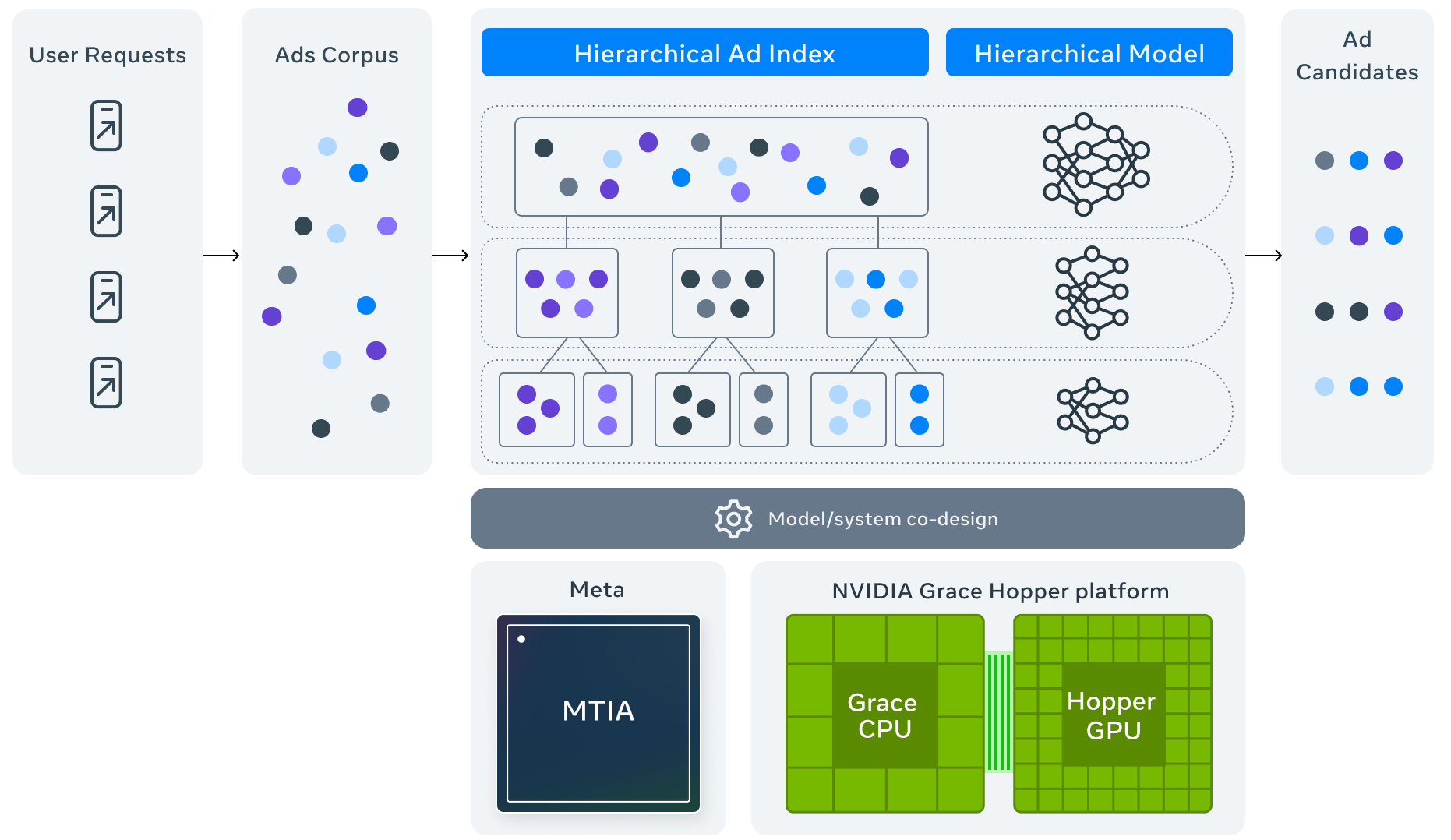
Previous versions of Meta's ad delivery used a combination of rule-based logic and earlier machine learning models. Andromeda replaces this with deep neural networks - more sophisticated AI models capable of analyzing millions of eligible ads in real time, matching them against user signals at a granularity that wasn't previously possible.
The technical foundation: Andromeda uses hierarchical indexing (a structured way of organizing and searching through large numbers of ads) combined with high-performance hardware (Meta has specifically mentioned NVIDIA Grace Hopper Superchips) to scan tens of millions of eligible ad candidates within the latency constraints required for real-time ad serving.
What "real-time" means here: Every time a Meta user loads their feed, Reels, or Stories, Andromeda runs - selecting which ads are most relevant to that specific user, in that specific moment, from the available pool of eligible ads. The decision happens in milliseconds. The sophistication of what that decision considers is what's new.
How Andromeda Changed Ad Retrieval
Before Andromeda: Ad selection relied heavily on predefined audience targeting - interest categories, demographic parameters, behavioral segments. Meta's algorithm would match ads to users based on whether the user fell into the targeting parameters the advertiser specified.
The advertiser defined the "who." Meta determined the "when" and managed the delivery.
With Andromeda: Deep neural networks analyze user signals holistically - past behavior, current session context, previous ad interactions, content consumption patterns, and even conversational intent from Meta's AI assistant - and match ads based on predicted relevance and conversion likelihood, not predefined targeting buckets.
The implications:
-
Audience targeting parameters matter less than they used to
-
The algorithm has more flexibility to find the right users outside narrow targeting specifications
-
Creative quality and conversion signal quality become the primary inputs the algorithm works with
The creative consequence: If the algorithm has more flexibility to find users, it needs signals to know what "finding the right user" looks like. Those signals come from:
-
Your creative: how users interact with your ads teaches the algorithm what resonates
-
Your conversion data: which users ultimately purchase teaches the algorithm who's worth targeting
What This Means for Your Campaigns
1. Broader targeting outperforms narrow targeting Andromeda performs best when given room to find the right users. Tight interest targeting or layered audience restrictions limit the algorithm's ability to explore. Broad targeting (or Advantage+ targeting with minimal restrictions) gives Andromeda the signal it needs without artificial constraints.
2. Single campaign structure often outperforms multiple ad sets Multiple ad sets create competition between your own campaigns for the same users (auction overlap). A single campaign with broad targeting and Advantage+ placements typically outperforms fragmented ad set structures - because it gives the algorithm one coherent learning problem rather than multiple competing ones.
3. Creative diversity is the new audience targeting If you previously used different ad sets to reach different segments, consider instead using multiple creative variations within a single campaign. Different creative pieces resonate with different users. Andromeda tests them and learns which creative reaches which user segments most effectively.
4. Campaign performance improves over time Because Andromeda's neural networks learn continuously, campaign performance should improve over time as the algorithm accumulates more data about which users convert for your specific brand. This makes account continuity - keeping campaigns running and accumulating data - more valuable than constant campaign restructuring.
Creative Strategy in the Andromeda Era
Andromeda amplifies the value of creative diversity and quality. The algorithm tests creative variations against user signals to identify which combinations drive the outcomes you're optimizing for.
Volume matters: More creative variations give Andromeda more combinations to test. A campaign with 10 creative variants gives the algorithm 10 hypotheses to test. A campaign with 2 gives it 2. More tests = faster learning.
Format diversity: Different formats (video, static, carousel, Reels) reach different user segments in different contexts. A user who engages with Reels may never see a static carousel on their primary feed. Cover the formats to cover the audiences.
Iterate frequently: Andromeda identifies creative fatigue faster than earlier systems because it's testing more combinations simultaneously. Plan for more frequent creative refreshes - at minimum monthly, ideally every 2–3 weeks for active prospecting campaigns.
Creative signals teach the algorithm: How users interact with your creative is training data for Andromeda. An ad that drives saves teaches the algorithm that saves-prone users are valuable for your brand. An ad that drives direct link clicks teaches a different user profile. Variety in engagement types creates more nuanced audience modeling.
Why Data Quality Is the Central Lever
Here's the most important implication of Andromeda for Shopify advertisers: the algorithm is more powerful than before, but its performance scales with the quality of the data it learns from.
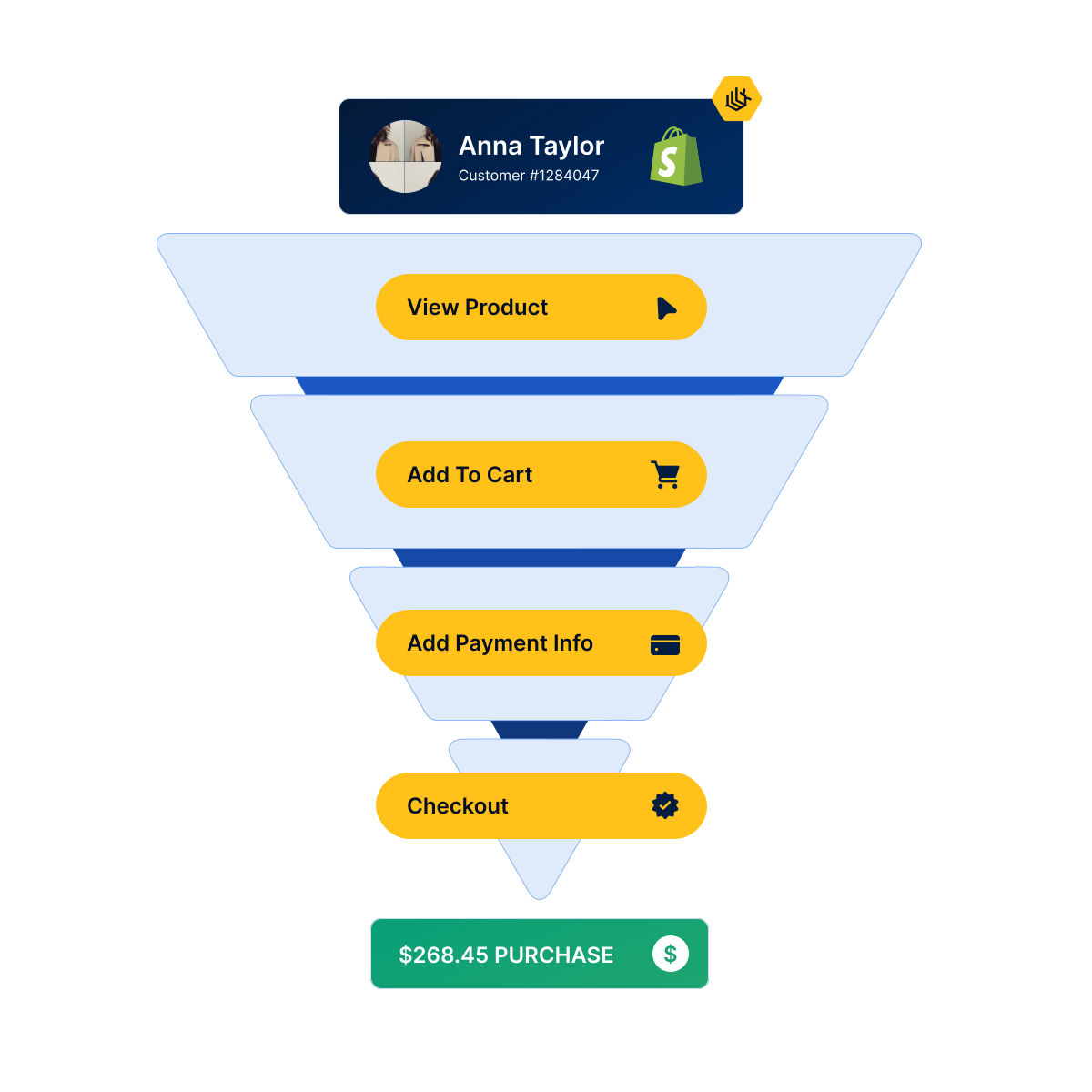
Andromeda's neural networks are trained on conversion outcomes. Which users, seeing which creatives, in which contexts, resulted in purchases? That's the model it builds. And it builds it from your conversion event data.
The completeness problem: If 30–40% of your purchase events don't reach Meta - blocked by ad blockers, not tracked due to iOS restrictions, lost to browser script failures, or suppressed by Consent Mode V2 enforcement - Andromeda learns from an incomplete and potentially biased sample of your actual buyers. With Google's Privacy Sandbox now effectively abandoned and iOS 26 tightening in-app browser restrictions further, these gaps are widening.
The algorithm builds a model that represents only the buyers whose events reached Meta - typically users on non-iOS devices who don't use ad blockers. This may be a systematically different profile from your full buyer population.
The result: Andromeda's optimization is as sophisticated as it's ever been, but it's optimizing for a fraction of your actual audience.
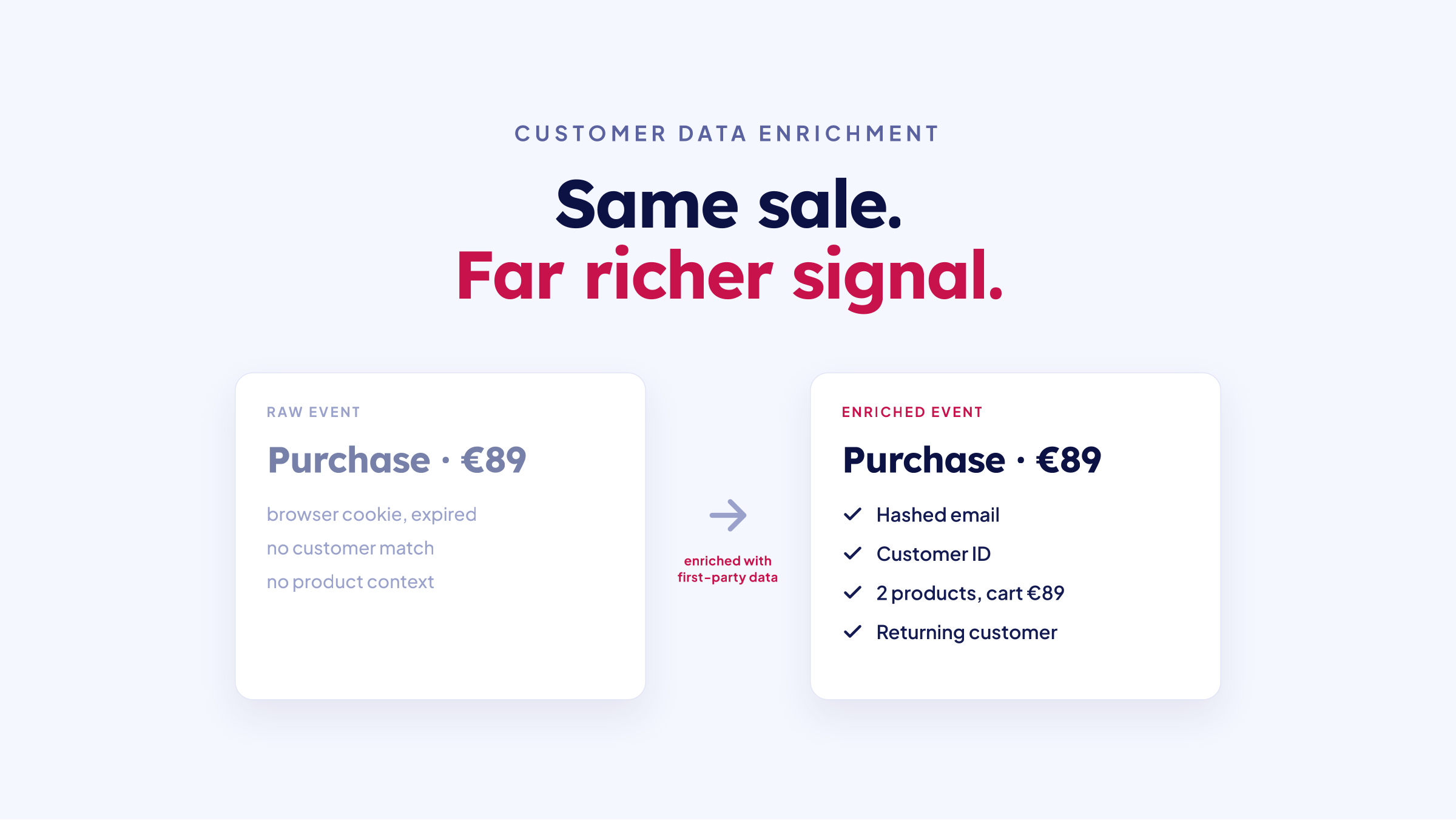
Server-side tracking as the Andromeda enabler: TrackBee's server-side event capture sends purchase events directly from Shopify's backend to Meta via the Conversions API - bypassing browser conditions. Every purchase, regardless of device, browser, or ad blocker status, reaches Meta.
Andromeda then trains on your complete buyer population - not just the trackable segment. The algorithm builds a more accurate model of who converts for your brand, which produces more precise targeting, lower CPMs, and better ROAS.
This is the mechanism behind the Petrol Industries case study: Meta ROAS doubled not because the creative or targeting changed, but because complete, enriched conversion data gave Meta's algorithm better training data to work with. See: How TrackBee enhances your marketing with better Event Match Quality for Meta.
How to Structure Campaigns for Andromeda
1. Simplify to one campaign per objective One prospecting campaign. One retargeting campaign. Give each a single, broad-targeting ad set. Let Andromeda find the audience - don't prescribe it with multiple narrow ad sets.
2. Load each campaign with multiple creative variations 5–10 creative variants per campaign (across formats) gives Andromeda sufficient variety to test and learn from.
3. Fix your tracking before restructuring campaigns Campaign restructuring doesn't matter if the conversion data is incomplete. Fix tracking first. With complete server-side event capture running, then restructure for Andromeda.
4. Let campaigns accumulate data before evaluating Andromeda's learning is continuous. Don't evaluate a restructured campaign after one week. Give it 2–3 weeks of data before comparing to your previous structure.
5. Monitor creative fatigue signals Frequency (how often the same user sees the same ad) is your primary fatigue indicator. When frequency on a creative variation rises above 2–3 within a week, introduce new creative.
Frequently Asked Questions
Do I need to rebuild all my existing campaigns for Andromeda? No. Andromeda is an infrastructure update - your existing campaigns are running on it whether you restructure or not. The optimization recommendations above (broader targeting, creative diversity, single campaign structure) are best practices that help Andromeda work better for you, not requirements.
Will Andromeda replace Advantage+ campaigns? No - Andromeda is the underlying delivery system. Advantage+ is the campaign type that gives Andromeda maximum targeting flexibility. They work together, not in place of each other. Andromeda benefits from Advantage+ because Advantage+ removes targeting restrictions that limit the algorithm.
How does Andromeda affect my ROAS targets? It shouldn't change your targets - but it may change how quickly you reach them. Andromeda's continuous learning means campaigns may start below target ROAS and improve as the algorithm accumulates data. Don't exit the learning phase early based on initial performance.
Is there anything specific about Andromeda in Meta's documentation? Meta's engineering blog has published technical details about Andromeda. The key practical implication they emphasize: data quality and creative diversity are the inputs that most improve Andromeda's performance for individual advertisers.
The Algorithm Is Ready. Is Your Data?
Meta Andromeda is the most sophisticated ad delivery system Meta has built. It can find high-converting users at scale, test creative variations systematically, and improve continuously as it learns.
But it's only as good as the data it learns from. Incomplete conversion tracking produces a sophisticated algorithm optimizing toward the wrong thing. Complete, server-side conversion data lets Andromeda do what it was designed to do.
TrackBee ensures every Shopify conversion reaches Meta via the Conversions API - enriched with Shopper Profile data, deduplicated, and delivered with the first-party identifiers that improve matching. Andromeda's algorithm gets complete training data. Your campaigns improve faster and more accurately.


.png)