Short answer: Meta's algorithm now tracks the sequence of user behaviour, not just isolated events, and uses that order to predict which ads to show next. This raises the stakes on complete, correctly ordered event tracking. Enriched server-side data that captures the full journey, in the right sequence, produces meaningfully better campaign performance.
Meta's advertising algorithm has quietly evolved. Where it once looked at individual events in isolation - a page view here, a purchase there - it now tracks the sequence of user behavior. The order in which things happen has become as important as the things themselves.
This shift has significant implications for Shopify advertisers. Combined with changes like Meta's new Maximize Interactions goal - where the algorithm weights multiple engagement types toward conversion prediction - it changes what data quality means, raises the stakes for complete event tracking, and explains why enriched server-side data produces meaningfully better campaign performance.
From Individual Events to Sequences
For most of its history, Meta's algorithm treated user events as independent data points. A product view was a product view. A purchase was a purchase. The system knew what happened, but not necessarily in what order or what the sequence of events meant about intent.
That's changed. Meta's current ad delivery system tracks not just what users do, but the sequence in which they do it - and uses that sequential pattern to predict which ads are most relevant to show next.
The difference matters. Consider two users:
-
User A: Viewed running shoes → read a fitness article → browsed marathon training gear → viewed running shoes again
-
User B: Viewed running shoes → browsed winter coats → checked home improvement content → viewed running shoes again
Both users viewed running shoes twice. But the behavioral sequences tell very different stories about intent. User A's path suggests deep engagement with fitness content - a strong signal of purchase intent for athletic gear. User B's sequence is scattered; the shoe views may be incidental.
Meta's algorithm can now read those sequences and make different predictions about each user. User A gets served a more targeted shoe ad. User B might get a more exploratory ad - or might not get a shoe ad at all.
Why Sequence Learning Works Like Language Models
The technology Meta uses for sequence learning is similar to what powers large language models like ChatGPT. These models are trained to predict what comes next in a sequence - the next word in a sentence, the next token in a pattern.
Applied to user behavior, the same principle holds: given what a user has done in sequence, what are they likely to do next? Which ad is most likely to be relevant? What product are they most likely to purchase? Meta's AI-driven ads personalization takes this even further, using conversational intent signals from Meta's AI assistant to shape ad relevance beyond behavioral data alone.
Just as ChatGPT learns that certain words predict what follows, Meta's system learns that certain behavioral sequences predict conversion intent. A user who has searched flights to Barcelona, then browsed Barcelona hotels, then looked at carry-on luggage isn't just "interested in travel." They're likely planning a specific trip - and that sequence is a strong purchase signal for relevant travel products.
For advertisers, the implication is clear: the value of your event data isn't just what events you send. It's the completeness and accuracy of those events as a sequence. A gap in the sequence - a missed add-to-cart event, a dropped product view - is a gap in Meta's ability to read intent accurately.
What This Means for Your Tracking Data
If Meta's algorithm is reading sequences, missing events don't just reduce your reported conversion count. They corrupt the sequence itself.
Example:
A customer visits your store, views a product (event captured), adds it to cart (event missed - ad blocker), initiates checkout (event captured), and purchases (event captured).
Meta sees: View → Checkout → Purchase. A sequence with a gap. The add-to-cart event that would have made the sequence coherent - and that would have told the algorithm something specific about purchase intent - is missing.
Multiply this across thousands of customer journeys, and Meta is building its intent model from sequences full of gaps. The patterns it learns are less accurate. Its predictions about which users will convert - and which ads to show them - are less reliable.
This is one of the reasons why fixing tracking data quality improves campaign performance even when you haven't changed your creative or targeting: you're giving Meta's algorithm cleaner sequences to learn from.
The Six Data Quality Factors That Matter Most
For your event data to enable effective sequence learning, six quality factors need to be in place:
1. Complete event coverage Every event in the funnel must be captured reliably. A sequence model is only as good as the sequences it receives. Missing events mean missing context. Server-side tracking ensures events reach Meta regardless of ad blockers or browser restrictions - see: Why profitable ad campaigns need event deduplication and two tracking methods.
2. Timing precision Sequences depend on timing - the algorithm needs to know not just what happened, but when. An add-to-cart that happened immediately after an ad click is a different signal than one that happened three days later. Your tracking needs to capture accurate timestamps for each event.
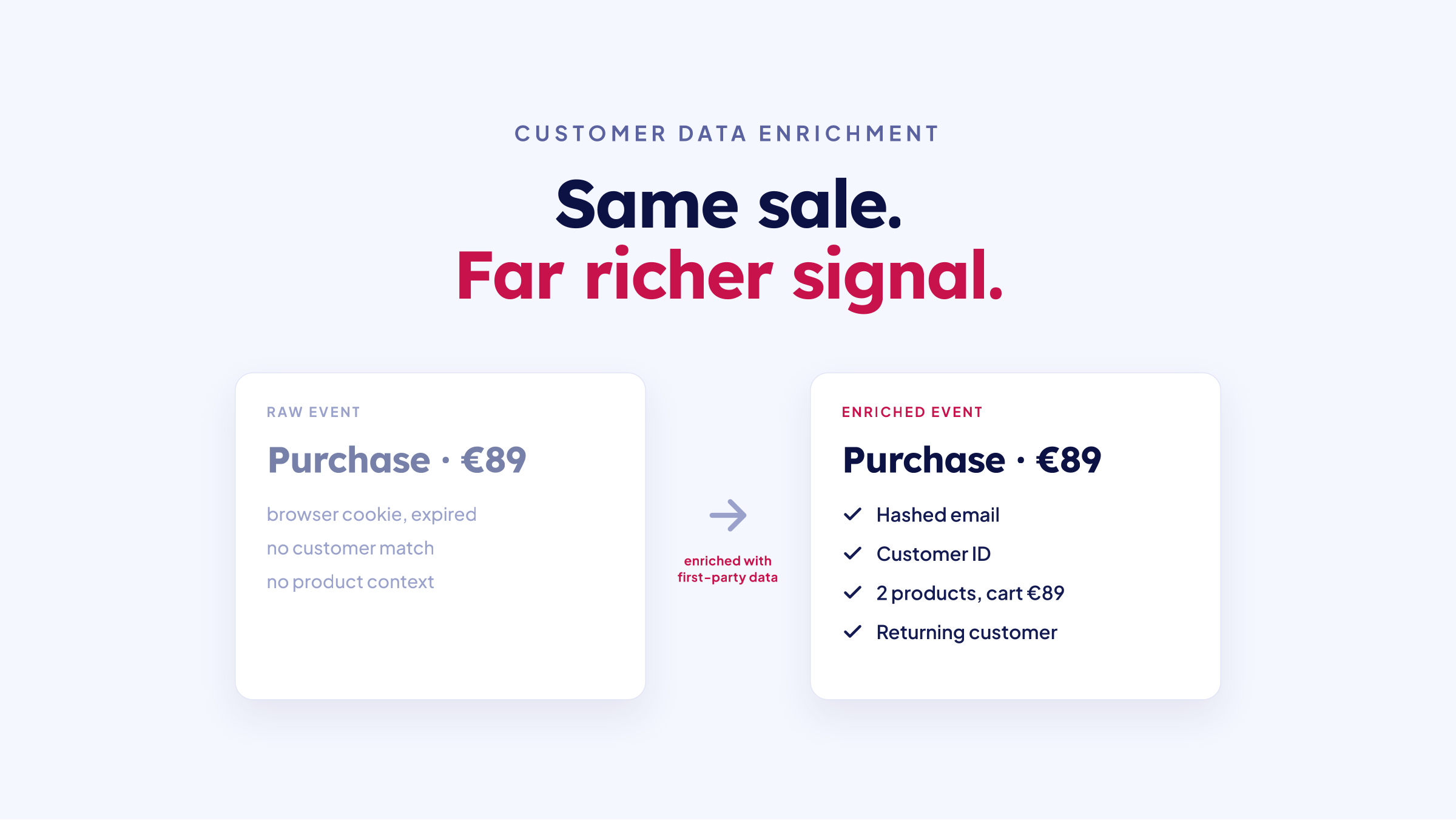
3. Enriched event data Raw events (page view, add to cart) become much more useful when enriched with context: device type, session data, referral source, UTM parameters. This enrichment helps Meta understand the full context of each event in the sequence.
4. Deduplication Duplicate events corrupt sequences. If the same purchase event appears twice - once from the Meta Pixel and once from the Conversions API without deduplication - Meta sees a sequence ending in two purchases. That's not accurate, and the algorithm's model suffers. Proper deduplication ensures each event appears in the sequence exactly once.
5. Cross-device connection Customer journeys often span multiple devices. A user who browses on their phone and purchases on their laptop is creating a sequence across two devices. Without cross-device identity resolution, Meta sees two disconnected sequences instead of one coherent journey. TrackBee's persistent shopper profiles connect these sessions.
6. Data accuracy over data volume More data is not always better. Inaccurate data - wrong email addresses, corrupted timestamps, mismatched event parameters - actively degrades the quality of the sequences Meta builds. Accurate, enriched data on fewer events outperforms high-volume, low-quality data.
Why Incomplete Tracking Hurts More Than You Think
The impact of incomplete event sequences goes beyond attribution gaps. It affects the algorithm's fundamental ability to predict intent.
When Meta's system is trained on sequences full of gaps, it learns inaccurate patterns. It might interpret "View → Purchase" (with add-to-cart missing) as a different user behavior pattern than "View → Add to Cart → Purchase." If it consistently sees the former when the latter is the truth, it builds a miscalibrated model.
At scale, this means:
-
Lookalike audiences built from corrupted behavioral sequences are less accurate
-
Bid optimization based on incomplete intent signals is less efficient
-
Ad delivery to high-intent users is less confident
The reverse is also true: when you provide complete, accurate behavioral sequences, the algorithm becomes significantly more capable. Its intent predictions are more accurate. It finds high-value users more efficiently. It bids more confidently on the right impressions.
This is the mechanism behind performance improvements like Petrol Industries doubling their Meta ROAS after implementing TrackBee - not a change in creative or targeting strategy, but better data that gave Meta's algorithm better sequences to learn from.
For more on how Meta's algorithm processes your data, see: Meta's incremental attribution: a step forward, but not the complete picture.
How TrackBee Provides the Data Meta Needs
TrackBee addresses all six data quality factors through its server-side tracking and session enrichment approach:
Complete event coverage: Server-side capture of all funnel events - ViewContent, AddToCart, InitiateCheckout, Purchase - regardless of browser conditions, ad blockers, or iOS restrictions.
Timing precision: Server-side events are timestamped accurately at the moment they occur on your Shopify store's backend.
Enriched event data: TrackBee's shopper profiles accumulate session context, UTM parameters, device information, and referral sources, which are appended to each event before it reaches Meta.
Automatic deduplication: Events captured both client-side and server-side are deduplicated to ensure Meta receives each event exactly once.
Cross-device identity resolution: TrackBee's persistent shopper profiles connect the same user across multiple sessions and devices, enabling Meta to see complete, connected sequences rather than fragmented multi-device journeys.
Data accuracy: TrackBee applies data validation and standardization before sending events to Meta, reducing the risk of corrupted or incorrectly formatted data reaching the algorithm.
The result: Meta receives complete, accurate, enriched behavioral sequences - the raw material its algorithm needs to predict intent accurately and optimize your campaigns effectively.
Frequently Asked Questions
Does this mean I need to track more events than just purchases? Yes. For Meta's sequence learning to work effectively, the algorithm needs the full funnel: ViewContent, AddToCart, InitiateCheckout, and Purchase. Tracking only purchases gives the algorithm the endpoint of the sequence without the context that builds its predictive model.
How does cross-device tracking connect to sequence learning? If a user's behavioral sequence spans two devices, a client-side tracking setup sees two disconnected sequences - one on the phone, one on the desktop. TrackBee's shopper profiles connect these sessions, giving Meta one coherent sequence for that user.
Does improving event sequence quality require changes to my Meta campaigns? No. You improve the data quality in your tracking setup, and the benefits flow automatically to your campaign performance. No campaign restructuring is required.
Is this sequence approach the same as Meta's Advantage+ targeting? Advantage+ uses Meta's algorithm to optimize across audiences and placements automatically. The sequence learning described here is the underlying mechanism that makes Advantage+ (and all Meta ad delivery) work better with higher quality data. Better input data → better Advantage+ performance.


.png)