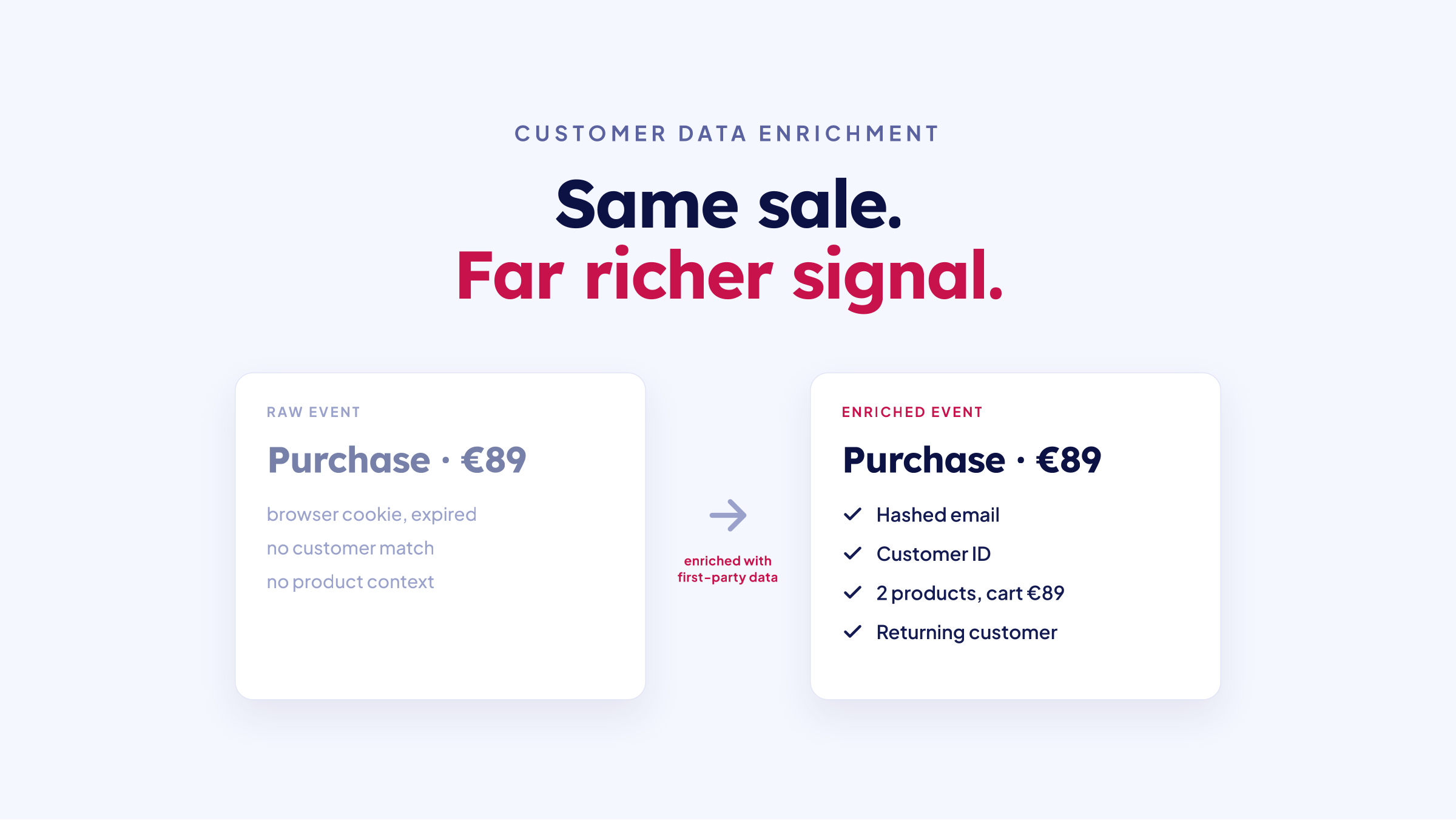
Short answer: Server-side tracking captures your Shopify conversion events on your server instead of in the visitor's browser, so you recover the 30-40% of data that ad blockers, iOS privacy and consent banners normally block. The best setup for Shopify captures events at the source, enriches them with first party data, and deduplicates against your existing pixels. That is exactly what TrackBee does, in a 5-minute install with no code.
Digital advertising has a data problem. The tools that performance marketers relied on for years - browser-based pixels, third-party cookies, client-side tags - are being systematically dismantled by browser manufacturers, operating systems, and regulators. The result: most Shopify stores are making budget decisions, audience targeting choices, and attribution calls based on data that's missing 30–40% of what actually happened.
Server-side tracking is the solution the industry has converged on. This guide covers everything you need to know: how it works, why it matters, how to implement it, and how to choose the right solution for your Shopify store.
What Is Server-Side Tracking?
Server-side tracking is a method of collecting user event data on your web server rather than in your visitor's browser. Instead of relying on JavaScript pixels that run client-side - and can be blocked by ad blockers, restricted by iOS, or limited by cookie policies - server-side tracking creates a direct, reliable connection between your server and your marketing platforms.
When a customer visits your Shopify store and takes an action - views a product, adds to cart, initiates checkout, purchases - your server records that event independently of what the visitor's browser allows. That event is then enriched with first-party data and sent directly to Meta, Google Ads, TikTok, Klaviyo, and other platforms via their server-side APIs (Meta Conversions API, Google Enhanced Conversions, TikTok Events API, etc.).
The result: complete, accurate, enriched event data reaching your ad platforms - regardless of whether the visitor uses an ad blocker, an iPhone, or a privacy-focused browser.
Why Client-Side Tracking Is Failing
Before understanding server-side tracking, you need to understand why the traditional approach - client-side tracking - is no longer sufficient.
%25201.png)
Client-side tracking works through JavaScript code that runs in your visitor's browser. When someone visits your store, tracking pixels (Meta Pixel, Google Analytics, TikTok Pixel) load in their browser, capture events, and send data directly to advertising platforms. For years, this was the standard.
What's breaking it today:
Ad blockers
are installed by 30–40% of internet users. When an ad blocker is active, tracking scripts simply don't load. The user can browse your store, add products to their cart, and purchase - and none of those events reach your platforms.
Apple's App Tracking Transparency (ATT)
requires explicit opt-in permission before apps can track users across other apps and websites. Most users decline. This has dramatically reduced tracking fidelity on iOS devices - a significant portion of Shopify traffic.
Safari's Intelligent Tracking Prevention (ITP)
limits cookie lifetimes to 7 days. A customer who browses today and returns to purchase in 10 days won't be correctly attributed to your campaign, even if your ad drove that initial visit.
Cookie consent requirements
mean that visitors who decline consent are invisible to your pixels - even if they eventually convert. With Google Consent Mode V2 enforced since July 2025, consent handling has become even more critical - platforms now require explicit consent signals to process user data in the EEA.
iOS 26 expanded Link Tracking Protection
takes Apple's privacy push further. Building on iOS 17's initial rollout, iOS 26 expands Link Tracking Protection across more apps and contexts, stripping click IDs (fbclid, gclid, ttclid) from URLs more aggressively. This makes it even harder for client-side pixels to attribute conversions to the right campaign.
Script performance degradation
- multiple tracking scripts competing in the browser contribute to slower page loads, higher Cumulative Layout Shift scores, and increased Total Blocking Time. These performance impacts directly hurt conversion rates and SEO.
The cumulative effect: you're receiving 60–70% of your actual conversion data. The rest is silently lost before it ever reaches your platforms.
For a detailed comparison of client-side and server-side approaches, see: Client-side vs server-side tracking: essential differences for Shopify stores.
Client-Side vs Server-Side: Side-by-Side
If you only remember one thing from this guide, make it this comparison. It shows, dimension by dimension, why the industry is moving to server-side.
| What we're comparing | Client-side | Server-side |
|---|---|---|
| Where data collection happens | Visitor's browser | Your web server |
| Blocked by ad blockers | Yes, losing lots of data | No, almost no impact |
| Affected by privacy settings | Yes, major limits | Very little effect |
| Impact on website speed | Can slow down your site | Almost no effect on speed |
| Data quality | Often incomplete | Complete, with richer information |
| Implementation difficulty | Easier but less effective | More complex on your own, simple with a purpose-built tool |
| Long-term sustainability | Declining effectiveness | Growing importance |
How Server-Side Tracking Works, Step by Step
-
A visitor interacts with your Shopify store - views a product, adds to cart, initiates checkout, or completes a purchase
%25202.png)
-
Your server captures the event - at the server level, independent of the visitor's browser. Ad blockers cannot interfere. iOS cannot restrict it. Cookie policies don't apply.
-
TrackBee enriches the event - first-party data is appended: customer email, name, IP address, click IDs (fbclid, gclid), UTM parameters, and session context. This enrichment dramatically improves platform matching rates.
-
Deduplication runs - if the same event was also captured client-side (by your existing pixel), TrackBee ensures platforms receive it exactly once. No double-counting.
-
The enriched event is distributed - simultaneously sent to all connected platforms: Meta (via Conversions API), Google Ads (Enhanced Conversions), TikTok (Events API), Klaviyo, Pinterest, and GA4.
-
Shopper profiles are updated - TrackBee's persistent shopper profiles accumulate data across sessions and devices, enabling cross-device attribution and more precise targeting.
This entire process happens in milliseconds, in the background, without any impact on your visitor's experience or your store's performance.
Server-Side Tracking vs Server-Side Tagging
These terms are often used interchangeably, but they refer to different things.
%25203.png)
Server-side tracking
focuses on data collection - capturing user events on your server rather than in the browser. This is about where data originates.
Server-side tagging
focuses on tag management - deploying and managing marketing tags through a server-based container (like Google Tag Manager's server-side container). This is about how tags are organized and deployed. Server-side tagging typically requires:
-
Setting up and maintaining a cloud server (e.g., Google Cloud Run)
-
Configuring container templates for each marketing platform
-
Writing and maintaining complex tag firing rules
-
Ongoing technical management as platform APIs change
Server-side tagging is powerful but technically demanding. For most Shopify stores - which don't have dedicated engineering teams - it's an over-engineered solution to a problem that can be solved more directly. If you're currently using a GTM-based setup, our guides to Elevar alternatives and Stape alternatives compare the operational overhead of GTM-dependent solutions with purpose-built Shopify tracking tools.
TrackBee focuses on server-side tracking: you get the full data quality benefits without the complexity of managing a server-side tagging infrastructure. The result is better data, implemented in minutes, with zero ongoing maintenance.
The 9 Key Benefits
1. Complete data collection
Recover the 30–40% of conversion events lost to ad blockers, iOS restrictions, and cookie policies.
%25204.png)
2. Session enrichment and shopper profiles
Build persistent customer profiles that connect sessions across devices and time, enriched with first-party identifiers that improve platform matching.
3. Better ad targeting
Give algorithms complete training data. Higher quality input → smarter audience models → better campaign performance → higher ROAS.
4. Improved email marketing revenue
Capture browse and cart abandonment events reliably, triggering more Klaviyo flows and recovering more abandonment revenue. Because TrackBee tracks up to 171% more events than standard client-side tracking and identifies shoppers across devices, more re-engagement emails reach customers who would otherwise be missed. HoneyBalm saw 213% more abandonment revenue after implementing TrackBee.
5. Faster website performance
Reduce browser-side script load. TrackBee customers have seen Cumulative Layout Shift drop from 0.635 to 0.154 and Total Blocking Time decrease from 3,472ms to 2,101ms.
6. Easy installation and zero maintenance
Five-minute setup. No server configuration. No ongoing maintenance. TrackBee updates automatically as platforms change their APIs.
7. Shopify-native integration
Built specifically for Shopify - not a generic solution adapted for Shopify. No conflicts with your existing app stack.
8. Immediate impact
Data improvements are visible within 24–48 hours. No weeks-long setup or waiting period.
9. Future-proof tracking
Server-side, first-party data architecture is the tracking model that works within increasingly restrictive privacy environments. No third-party cookie dependency. While Google reversed its plan to remove third-party cookies from Chrome - keeping them with a user-choice model instead - the direction of travel remains clear: first-party, server-side data is the foundation that survives every privacy shift.
For the full breakdown of each benefit: 9 key benefits of server-side tracking for Shopify stores.
Server-Side Tracking for Shopify: What Makes It Different
Shopify stores face tracking challenges that aren't present on generic web platforms:
Checkout environment restrictions
- Shopify's checkout pages (particularly post-purchase thank-you pages) have historically limited custom JavaScript. This creates gaps at the most critical moment - purchase confirmation. Server-side tracking captures purchase events directly from Shopify's order data, bypassing these restrictions entirely.
High iOS traffic
- Shopify's customer base skews heavily toward mobile. iPhones represent a disproportionate share of traffic - and iOS is where client-side tracking loss is most severe. Server-side tracking is especially valuable for stores with high mobile traffic.
Complex app ecosystems
- Shopify stores typically run multiple apps, each potentially adding its own tracking scripts. These scripts can conflict, slow down stores, and create tracking failures. Server-side tracking consolidates event collection, reducing the script footprint.
Cross-device customer journeys
- e-commerce customers routinely browse on mobile and purchase on desktop (or vice versa). Client-side cookie-based tracking cannot connect these sessions. TrackBee's persistent shopper profiles can - enabling accurate cross-device attribution.
How to Implement Server-Side Tracking
The traditional path (complex)
Without a purpose-built tool, implementing server-side tracking for Shopify requires:
-
Setting up a server-side container in Google Tag Manager
-
Provisioning and configuring a cloud server (Google Cloud Run, etc.)
-
Configuring client templates for each marketing platform
-
Writing tag firing logic and deduplication rules
-
Testing and validating each platform's data receipt
-
Ongoing maintenance as APIs and privacy regulations change
This typically represents weeks of work and requires ongoing developer involvement. Most Shopify stores don't have this capacity - which is why most Shopify stores are still using client-side tracking only. For agencies managing multiple Shopify clients, the operational overhead of maintaining GTM-based setups across 10, 20, or 50 accounts makes this path even less practical.
With TrackBee (5 minutes)
Step 1: Create your TrackBee account at trackbee.io
Step 2: Connect your Shopify store - follow the guided on-screen steps
Step 3: Install the TrackBee app from the Shopify App Store
Step 4: Connect your ad platforms - select Meta, Google Ads, TikTok, Pinterest, Klaviyo, and GA4 and follow the connection guides for each
TrackBee handles all server infrastructure, API integrations, deduplication logic, and ongoing maintenance automatically. You set it up once and never touch it again.
Technical requirements: a Shopify store (any plan), admin access, and access to your ad platform accounts. No coding knowledge required.
Common Mistakes to Avoid
Duplicate events without deduplication
- if you implement server-side tracking without deduplication, platforms receive the same event twice: once from your pixel and once from your server. This inflates conversion numbers and confuses algorithms. TrackBee handles deduplication automatically.
Missing critical events
- server-side tracking is only as good as the events it captures. Make sure all funnel events - view content, add to cart, initiate checkout, purchase - are tracked server-side, not just purchases.
Ignoring enrichment
- capturing events server-side without enriching them with first-party data (email, name, IP) misses a major benefit. Event Match Quality improvements on Meta, for example, require enriched events.
Not testing after implementation
- verify that events are reaching your platforms correctly using each platform's event testing tools (Meta Events Manager, Google Tag Assistant, TikTok Events).
Replacing rather than augmenting
- the optimal approach is running client-side and server-side tracking in parallel. Don't remove your existing pixels; let TrackBee complement them.
How to Choose the Right Solution
When evaluating server-side tracking solutions for Shopify, consider:
Ease of implementation
- does it require developer resources, or can a non-technical team member set it up in minutes?
Shopify compatibility
- is it built for Shopify specifically, or is it a generic solution that requires custom configuration?
Deduplication
- does it automatically prevent double-counting when both client-side and server-side tracking capture the same event?
Data enrichment
- does it enrich events with first-party data before sending to platforms? This is critical for Meta Event Match Quality improvements.
Maintenance requirements
- does it update automatically as platforms change their APIs, or does it require ongoing technical management?
Platform coverage
- does it support all the platforms you use: Meta, Google, TikTok, Pinterest, GA4 and Klaviyo?
Data ownership
- who owns the data? Make sure your first-party data stays in your control.
TrackBee is purpose-built to score well on all of these dimensions for Shopify merchants. For detailed comparisons with specific alternatives, see our guides to Littledata alternatives (for stores prioritizing GA4 accuracy) and TripleWhale alternatives (for stores evaluating attribution tools).
Frequently Asked Questions
Will server-side tracking work with my existing Meta Pixel and Google Analytics setup? Yes. TrackBee works alongside your existing client-side tracking - it doesn't replace it. Both run in parallel, with TrackBee handling deduplication.
Does server-side tracking help with GDPR compliance? Server-side tracking based on first-party data is generally more privacy-compliant than third-party cookie-based tracking. However, it doesn't eliminate the need for consent management. Consult a legal professional for specific compliance advice.
How does TrackBee's deduplication work? TrackBee uses event IDs to identify events that have already been sent to a platform. If the same event is captured both client-side and server-side, the platform receives it exactly once.
Can server-side tracking help with Shopify's checkout tracking limitations? Yes. This is one of the most significant benefits for Shopify specifically. TrackBee captures purchase events directly from Shopify's order data, bypassing the JavaScript restrictions in the checkout environment.
How much does server-side tracking cost compared to what I'm losing without it? The cost calculation is simple: if you're losing 30–40% of conversion data, your ad platforms are making targeting and optimization decisions on incomplete information. The ROAS improvement from better data typically far exceeds the cost of the tracking solution. Petrol Industries doubled their Meta ROAS after implementing TrackBee.


.png)