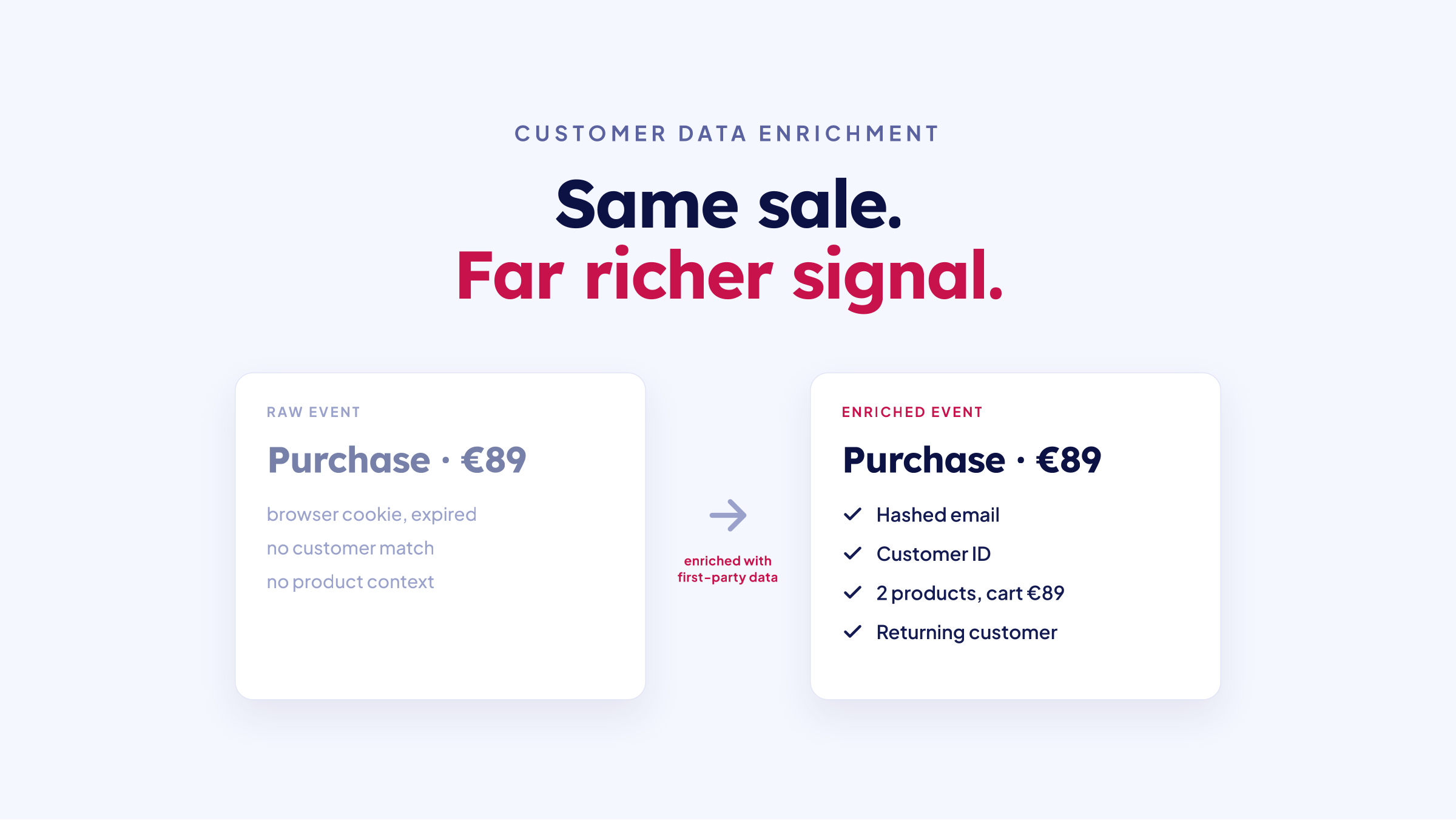
Short answer: Klaviyo misses cart abandoners because its browser tracking loses events to ad blockers, iOS privacy and logged-out or anonymous shoppers, so the abandonment flow never triggers. The fix is to capture cart and checkout events server-side and enrich them with first party data, which is what TrackBee does, triggering 2-3x more abandonment flows including for anonymous and returning shoppers.
Your Klaviyo abandoned cart flow isn't broken. The problem is worse than that: the majority of cart abandonment events never reach Klaviyo in the first place, which means the flow trigger never fires. You can't optimize a flow that doesn't know about the event. This article explains why Klaviyo misses 60-70% of cart abandoners, why the problem is invisible in your Klaviyo dashboard, and how server-side event capture with persistent shopper profiles fixes it.
The Root Cause: Client-Side Tracking with a 24-Hour Window
Klaviyo tracks visitors using a JavaScript snippet that runs in the shopper's browser. When a visitor adds a product to their cart or starts a checkout, the snippet sends that event to Klaviyo. For the event to trigger a flow, two things must happen simultaneously:
-
The tracking script must execute successfully in the browser.
-
Klaviyo must be able to identify the visitor - meaning it needs an active cookie linking that browser session to a known Klaviyo profile.
Here is the critical constraint: Klaviyo's identification cookie has a functional window of approximately 24 hours. After a visitor's last active session, the cookie either expires or is cleared by the browser. Safari's Intelligent Tracking Prevention (ITP) enforces this aggressively, but the effect extends across all browsers through various privacy mechanisms.
This 24-hour window creates a structural limitation. A shopper who browses your store on Monday, returns on Wednesday to add something to their cart, and abandons - that shopper is invisible to Klaviyo if the cookie from Monday has expired. The cart event fires into a void. No profile match. No trigger. No email.
For a deeper look at how server-side tracking works and how to set it up for Shopify, we've covered the technical foundations in a separate guide.
The Three Reasons Abandonment Events Go Missing
The 60-70% gap isn't caused by a single issue. Three distinct mechanisms each remove a portion of your abandonment events before Klaviyo can act on them.

1. Ad Blockers and Browser Privacy Features
Ad blockers don't just block ads. They block tracking scripts - including Klaviyo's JavaScript snippet. When an ad blocker prevents the snippet from loading, no client-side events are generated. The visitor browses, adds to cart, abandons, and leaves. Klaviyo receives nothing.
Browser privacy features compound this. Firefox Enhanced Tracking Protection, Brave's built-in shields, and Safari's ITP all restrict or block third-party tracking scripts to varying degrees. The combined effect across your traffic is significant: a meaningful percentage of your visitors are browsing your store in conditions where Klaviyo's tracking script either cannot run or cannot identify them.
2. Cookie Expiry and the 24-Hour Identification Gap
Even when Klaviyo's script loads successfully, identification depends on cookies. Cookies expire. Browsers clear them. Privacy settings restrict them.
Consider a typical shopping journey: a customer sees your Instagram ad on her phone during lunch, taps through, browses two products, and closes the browser. Two days later, she opens Safari on the same phone, types your store URL directly, adds a product to her cart, and gets distracted. She never completes checkout.
By the time she returns, Klaviyo's cookie from the first visit is gone. The second session - the one with the actual cart abandonment - is anonymous. The Added to Cart event either isn't sent or can't be matched to her profile. The abandonment flow doesn't trigger.
This is the most common cause of missing cart triggers. It is also the hardest to detect, because the flow itself appears to be working normally for the events that do make it through.
Understanding the key benefits of server-side tracking helps explain why this cookie-dependency creates such a large gap in abandonment data.
3. Cross-Device and Cross-Browser Journeys
Modern shoppers don't stay in one browser on one device. They start on their phone (often in an in-app browser from Instagram or TikTok), continue on a laptop, and maybe finish on a tablet. Each browser context has its own cookies. Klaviyo sees these as separate, unconnected visitors.
This matters for abandonment flows because the cart context from one session doesn't carry over. A visitor who added to cart on mobile and later visits your store on desktop is, from Klaviyo's perspective, a completely new visitor. The desktop session generates no abandonment trigger because Klaviyo has no record of the cart activity from the mobile session.
For Shopify stores where 60-70% of traffic comes from mobile (often via social media ads), this cross-device gap is the norm rather than the exception.
Why This Problem Is Invisible in Klaviyo
This is perhaps the most important thing to understand: Klaviyo cannot show you what it doesn't know about.

When you open your abandoned cart flow in Klaviyo and review its performance, you see metrics for the events that successfully fired and matched to a profile. Open rate, click rate, conversion rate, revenue attributed - all of this is calculated against the flow entries that occurred. The flow might look healthy. A 45% open rate, 8% click rate, strong revenue per recipient.
But those metrics tell you nothing about the events that never arrived.
There is no "missed events" counter in Klaviyo. There is no alert that says, "You had 1,200 cart abandoners this week, but we only received events for 400 of them." Klaviyo reports on what it received. The other 800 abandoners are simply absent from every report, dashboard, and flow metric.
This is why brands often invest time optimizing the wrong thing. They A/B test subject lines, adjust send timing, add discount incentives - all of which optimizes the flow for the 30-40% of abandoners Klaviyo already sees. Meanwhile, the larger opportunity - the 60-70% of abandoners whose events never fire - remains completely unaddressed.
The only way to identify the gap is to compare Klaviyo's event volume against a source that tracks independently of browser-side limitations. Shopify's server-side analytics, your Google Analytics session data, or a server-side tracking platform can provide that comparison baseline.
The Difference Between a Broken Flow and a Missing Trigger
This distinction matters for how you diagnose and solve the problem.

A broken flow
is a flow that receives triggers but doesn't convert well. Maybe the email copy is weak, the timing is off, or the discount isn't compelling. You fix a broken flow by optimizing the flow itself: subject lines, send windows, content, incentive structure.
A missing trigger
is a trigger that never fires because the event never reached Klaviyo. The flow is structurally fine - it would convert those visitors if it received the events. You fix a missing trigger by fixing the tracking infrastructure upstream of Klaviyo.
Most Shopify brands have spent significant effort on the first problem. Far fewer have addressed the second. Yet the second problem typically represents 2-3x more revenue opportunity than the first, simply because the volume of missing triggers is so much larger than the volume of flow optimization improvements. For strategies on what to include in your recovery emails once triggers are working, see our guide to Shopify abandoned cart discount strategies.
To learn more about optimizing your cart flow once the triggers are in place, read our guide on how to improve your Klaviyo abandoned cart flow.
The Fix: Server-Side Events + Persistent Shopper Profiles
Fixing the 60-70% gap requires two things working together: a way to capture events independently of the browser, and a way to identify visitors across the 24-hour cookie boundary.

Server-Side Event Capture
Server-side tracking records events from your Shopify store's backend infrastructure rather than from the visitor's browser. When a visitor adds a product to their cart, the event is captured at the server level and sent directly to Klaviyo via API - no browser script required.
This means:
-
Ad blockers are irrelevant. Server-to-server communication isn't affected by browser extensions.
-
Cookie consent doesn't gate event capture. The event is recorded regardless of the visitor's consent preferences for client-side scripts.
-
Browser privacy features don't interfere. Safari ITP, Firefox ETP, and similar mechanisms restrict browser-side tracking. They have no effect on server-side event transmission.
Persistent Shopper Profiles
Capturing events server-side solves half the problem. The other half is identification: connecting those events to a known person so Klaviyo can send them an email.
TrackBee builds persistent shopper profiles that link the same visitor across multiple sessions, browsers, and devices. Instead of relying on a 24-hour cookie, TrackBee maintains a profile with a memory window of 7, 14, or 100+ days. When a returning visitor adds to cart - even if Klaviyo's cookie is long expired - TrackBee's profile can match them to their known email address and send the enriched event to Klaviyo with identity attached.
This directly addresses the three failure modes:
| Failure Mode | Client-Side (Klaviyo Default) | Server-Side + Persistent Profiles |
|---|---|---|
| Ad blocker active | Event blocked. No trigger. | Event captured server-side. Trigger fires. |
| Cookie expired (>24 hours) | Visitor anonymous. No trigger. | Persistent profile matches visitor. Trigger fires. |
| Cross-device journey | Sessions disconnected. No trigger. | Profile links sessions. Trigger fires. |
The result isn't a marginal improvement. When the majority of your abandonment events were previously invisible, recovering them produces a step-change in flow volume and revenue.
For more detail on improving browse abandonment specifically, see our guide on how to improve your Klaviyo browse abandonment flow and recover more revenue.
How the Parallel Flow Setup Works
When you connect TrackBee to Klaviyo, the recommended setup is to run a parallel TrackBee abandonment flow alongside your existing native Klaviyo flow. Here is why - and how it works.
Why Parallel, Not Replacement
Your native Klaviyo flow still captures events for visitors who are identified within Klaviyo's cookie window. There is no reason to discard those triggers. Instead, TrackBee sends additional events for the visitors Klaviyo missed - the ones whose cookies expired, who were blocked by ad blockers, or who switched devices.
Preventing Duplicate Sends
The obvious risk with two flows is sending duplicate emails to the same person. TrackBee handles this with profile filters. The parallel TrackBee flow includes a filter that checks whether the visitor already received an email from the native Klaviyo flow for the same event. If they did, the TrackBee flow skips them. If they didn't - because Klaviyo never received the original event - the TrackBee flow triggers.
The Setup in Practice
-
Keep your existing Klaviyo abandoned cart flow active. Don't change it.
-
TrackBee creates a parallel flow that triggers on TrackBee-sourced abandonment events.
-
Profile filters ensure no visitor receives emails from both flows for the same abandonment.
-
Monitor both flows in Klaviyo. You'll see the TrackBee flow generating triggers for visitors your native flow never knew about.
The setup takes minutes. There is no need to rebuild your existing flow or change your Klaviyo configuration. The two flows operate independently with deduplication handled at the profile level.
Real Results from Recovering Missing Triggers
When brands connect TrackBee's server-side Klaviyo integration, the typical result is 2-3x more abandonment flow triggers. Here is what that looks like in practice:
saw a 194% increase in abandonment revenue within 30 days of activating TrackBee's Klaviyo integration. The flow itself didn't change. The increase came entirely from triggers that were previously missing.
experienced a 53% increase in Klaviyo abandonment revenue. Again - same flow, same emails, same timing. More triggers.
generated $89,000 in Klaviyo abandonment revenue over 6 weeks. For a brand of their size, this represented a significant portion of previously invisible revenue.
recovered $15,000 in additional browse abandonment revenue in 30 days - revenue from visitors their existing Klaviyo setup couldn't see.
added an extra $26,000 (≈$24,000) in Klaviyo revenue within 30 days of activating server-side abandonment events.
The pattern across these results is consistent: the flow quality was already adequate. The bottleneck was trigger volume. When you double or triple the number of triggers entering a well-built flow, revenue scales accordingly.
Frequently Asked Questions
Q: Does TrackBee replace Klaviyo? A: No. TrackBee works alongside Klaviyo by sending it additional events that Klaviyo's client-side tracking misses. Your Klaviyo account, flows, and email templates stay exactly the same. TrackBee adds to Klaviyo's data - it doesn't replace it.
Q: Will I get duplicate emails if I run both a native and a TrackBee flow? A: No. The parallel flow setup includes profile-level filters that prevent duplicate sends. If a visitor already triggered the native Klaviyo flow, the TrackBee flow skips them.
Q: How quickly will I see more flow triggers after connecting TrackBee? A: Most brands see increased trigger volume within the first 24-48 hours. The full effect builds over the first two weeks as TrackBee's persistent shopper profiles accumulate more visitor data.
Q: Does this only work for cart abandonment, or browse abandonment too? A: Both, and abandoned checkout too. TrackBee sends server-side events for Browse Abandonment, Cart Abandonment, and Abandoned Checkout. Each flow type benefits from the expanded trigger volume. See our guide on improving your browse abandonment flow for more detail.
Q: Do I need a developer to set this up? A: No. TrackBee installs in under 5 minutes from the Shopify App Store. The Klaviyo connection is configured in the TrackBee dashboard - no code, no developer required.
Q: Is this compliant with GDPR and privacy regulations? A: Yes. TrackBee is built with privacy by design and respects consent signals. Server-side tracking captures events without relying on the browser mechanisms that privacy regulations restrict, while still honoring visitor consent preferences.
Q: Why does Klaviyo's 24-hour cookie window cause such a large gap? A: Because most shopping journeys span multiple sessions over multiple days. A shopper who first visits your store on Monday and returns to complete their cart on Wednesday has already exceeded the 24-hour window. Safari and iOS enforce this window aggressively through Intelligent Tracking Prevention (ITP), which affects all mobile traffic from iPhones and iPads.
Not sure whether your Klaviyo revenue is tracking low in the first place? Our Klaviyo revenue benchmark guide shows what percentage of revenue Klaviyo should drive for a healthy Shopify store.
Ready to fix your tracking?
TrackBee installs in minutes, no developer needed. Try TrackBee for free, or book a free demo.


.png)