Short answer:
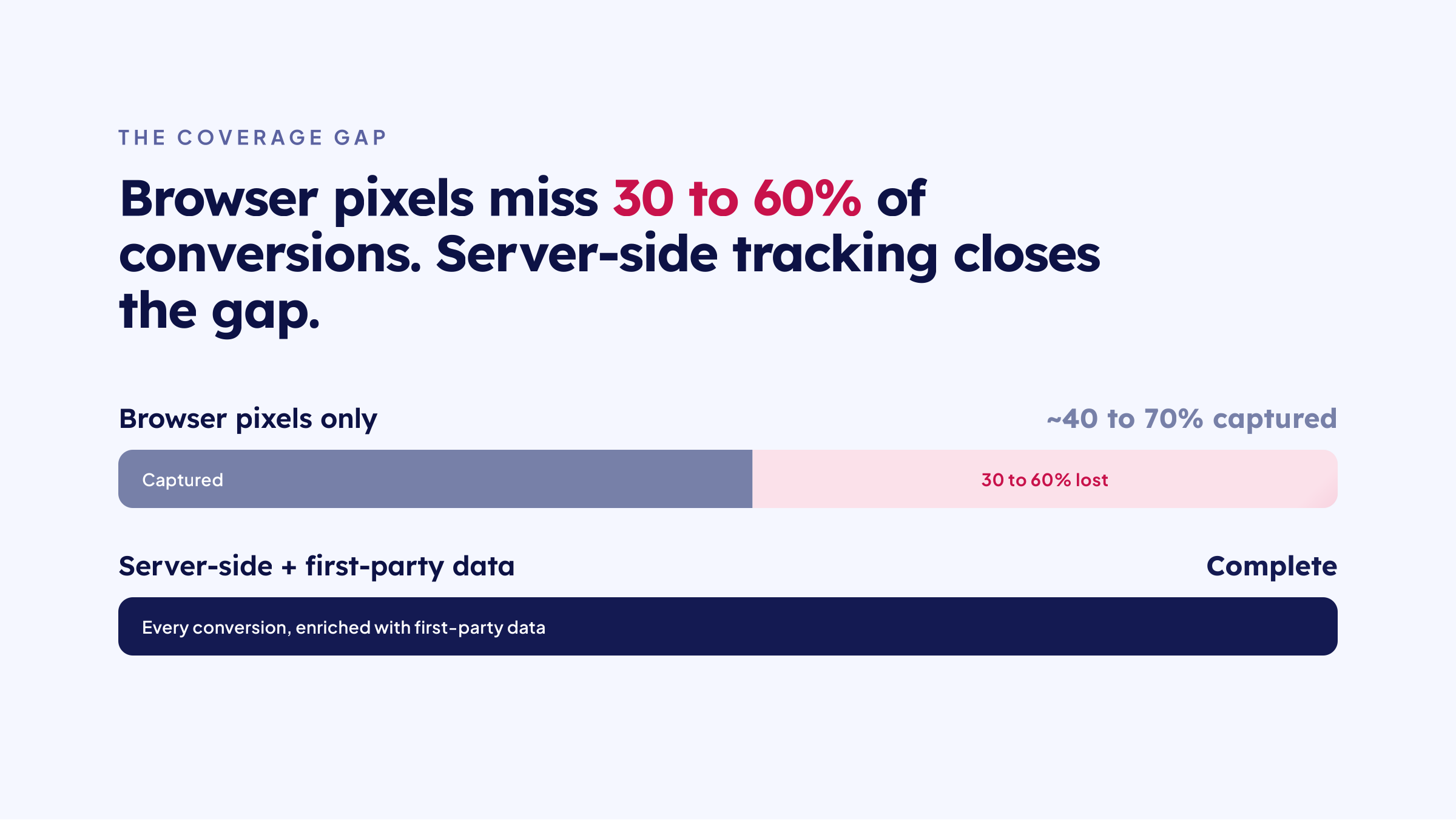
Cookieless tracking measures visitors and conversions without depending on third-party cookies, which browsers now block by default. For Shopify stores this matters because browser pixels already miss 30% to 60% of conversions once ad blockers, iOS restrictions and consent choices are in play. The fix is not another cookie workaround. It is server-side tracking that captures events on your server and enriches it with first-party data, so your data and your ad performance survive the shift.
For most of the last decade, Shopify tracking ran on cookies. A pixel dropped a cookie, followed the visitor around, and reported back when they bought something. That model is breaking down. Browsers now block third-party cookies, cap first-party ones, and hand shoppers a switch to opt out entirely.
The word for what comes next is "cookieless tracking." It sounds like a downgrade, as if you can no longer measure anything. It isn't. Set up the right way, cookieless tracking gives you a more complete and more durable picture of your store than the cookie setup it replaces. This guide covers what it is, why cookies are going away, what breaks if you sit still, and how to get your Shopify store ready.
That shift is exactly what TrackBee is built for. It captures your conversions server-side and enriches it with first-party data, so Meta, Google, TikTok, Pinterest, GA4 and Klaviyo still see the sales the browser pixel misses.
What is cookieless tracking?
Cookieless tracking is any method of measuring visitor behaviour and conversions that does not rely on third-party cookies to identify and follow users.
A quick distinction that trips a lot of people up:
-
Third-party cookies are set by a domain other than the one you are visiting. Ad platforms used them to recognise the same person across different websites. These are the cookies being killed off.
-
First-party cookies are set by the website you are actually on, like your Shopify store. They still work, but browsers increasingly limit how long they last.
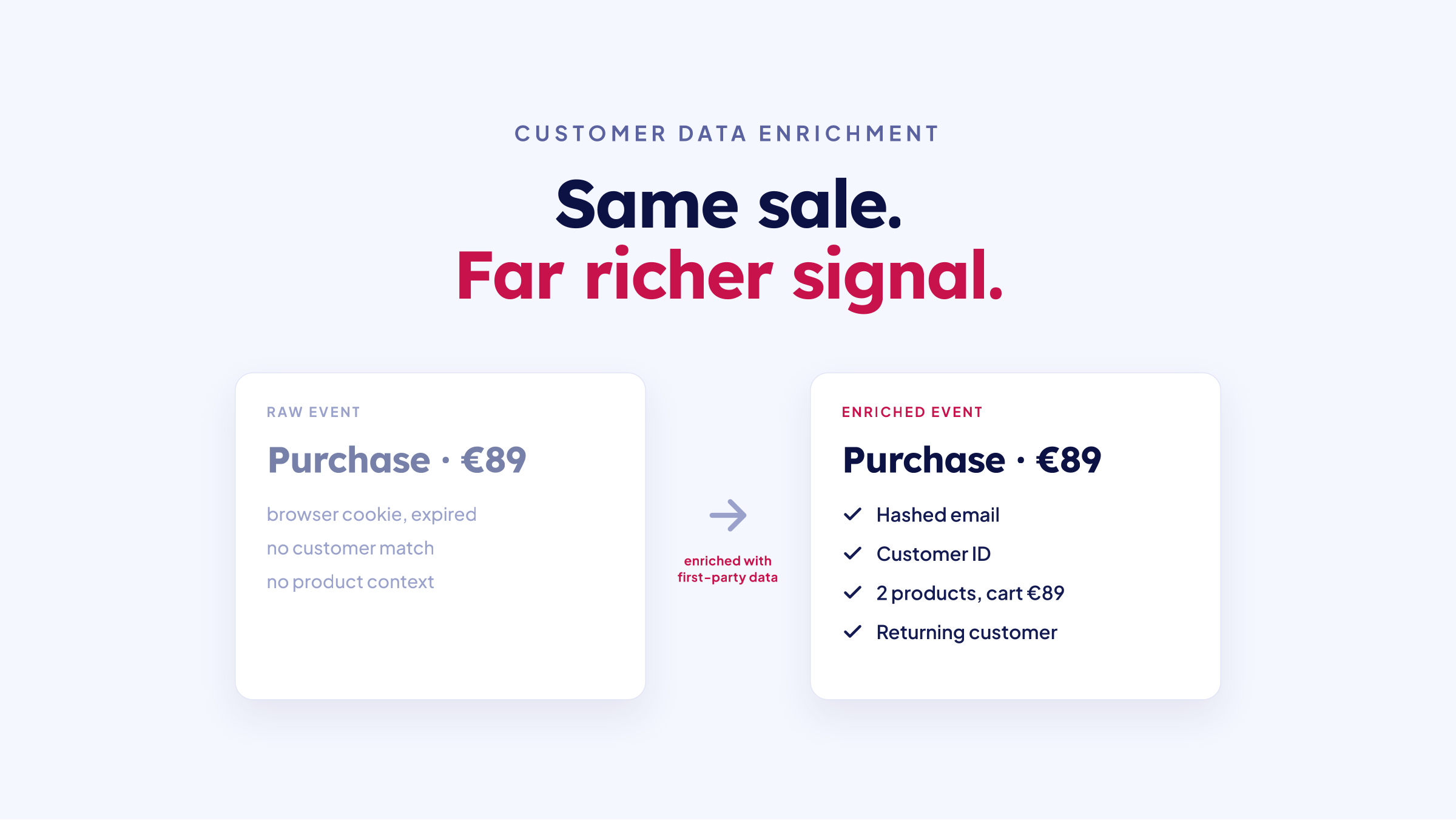
Cookieless tracking leans on signals that do not depend on that cross-site cookie at all: data you collect directly from your own store, server-side events, and durable first-party data like a hashed email or a customer ID. Instead of asking the browser "have I seen this cookie before," you use information the shopper gave you on your own site.
Why cookies are disappearing
This is not one event on one date. It is a slow squeeze from several directions at once, and it is already well underway.
Third-party cookie deprecation
The long, on-again off-again removal of third-party cookies in Chrome has landed where Safari and Firefox already were: shoppers can browse with third-party cookies switched off, and a large and growing share of your traffic already does. Anything that depended on those cookies to attribute a sale is losing signal.
Safari's Intelligent Tracking Prevention
Apple's Intelligent Tracking Prevention caps first-party cookie lifetimes at seven days, and often just 24 hours for ad clicks. A shopper who clicks your ad today and buys ten days later can look like organic traffic, because the cookie that tied them to your campaign already expired.
iOS App Tracking Transparency
Apple's App Tracking Transparency framework lets users block app-level tracking with a single tap, and most of them do. Since iPhones make up a large share of Shopify traffic, iOS shoppers are systematically underrepresented in cookie-based data.
Consent banners and Consent Mode v2
Cookie consent laws mean visitors who decline tracking are invisible to your pixels, even when they buy. Google's Consent Mode v2 now requires explicit consent signals before tags fire, adding one more gate between your store and your data.
Stack these together and the result is signal loss: a cookie-only setup shows you a partial, shrinking slice of what is actually happening in your store. For a fuller breakdown of what that costs, see how much revenue you're losing to bad tracking.
What breaks when you rely on cookies
The gap between what happened and what your tools report is not a reporting nuisance. It changes decisions and it costs money.
Your ad platforms learn from incomplete data
Meta and Google run on machine learning. They decide who to show your ads to by studying the conversions you send back. Feed them 60% of your purchases and they optimise toward a distorted version of your best customer, bid less confidently, and waste budget. Complete data is a direct performance lever, not a nice-to-have.
Attribution gets blurry
When conversions go untracked, you cannot see which campaigns actually drove them. A channel that looks like it is underperforming might actually be profitable. You end up defunding what works and feeding what does not.
Klaviyo flows go quiet
Cookie-based tracking failures reach email too. If browse and cart abandonment events do not fire reliably, your Klaviyo flows do not trigger, and that abandoned-cart revenue is never recovered.
Returning shoppers get lost
With short cookie lifetimes, the same person on their phone this week and their laptop next week looks like two strangers. You lose the ability to tell new customers from returning ones, and you pay to re-acquire people you already have.
Cookieless does not mean data-less
The important part is this: losing third-party cookies does not mean losing your data. It means changing where you collect it and what you identify shoppers with.
Two shifts do the heavy lifting.
From the browser to your server.
Instead of trusting a script in the shopper's browser to fire and report back, server-side tracking records the event on your own server and sends it straight to the ad platforms. No cookie needs to survive, no script needs to dodge an ad blocker. The event is captured regardless of what the browser does.
From cookies to first-party identifiers.
A cookie is a guess about identity. A hashed email, a customer ID or an order reference is a fact you already hold. Cookieless setups match conversions on this durable first-party data, which is both more accurate and more privacy-respecting than a cross-site cookie ever was.
So cookieless tracking isn't damage control. It's a better base to build on.
How server-side tracking makes your store cookieless-ready
Server-side tracking is the practical answer to the cookieless shift, and it is exactly what TrackBee is built for on Shopify. Rather than replacing your pixels, it works alongside them:
-
Client-side tracking keeps running. Your existing pixels and tags stay in place for the shoppers where they still work.
-
Server-side tracking runs in parallel. TrackBee captures events on the server, independent of browser conditions, ad blockers or expired cookies, and sends them to Meta, Google, TikTok, Pinterest, GA4 and Klaviyo.
-
Automatic deduplication. When an event is caught by both methods, TrackBee makes sure each platform counts it exactly once.
-
Session enrichment. TrackBee builds persistent shopper profiles that connect a shopper across sessions and devices, and enriches it with first-party data before each event is sent.
The events reach Meta through the Conversions API and Google through Enhanced Conversions, both of which are designed to match on first-party data instead of cookies. For a side-by-side of the two approaches, see client-side vs server-side tracking.
Cookieless tracking on Shopify, specifically
Shopify stores feel the cookie squeeze in a few particular ways.
The checkout gap.
Shopify limits what custom scripts can run on the thank-you page, precisely where the purchase happens. Server-side tracking reads the purchase straight from Shopify's order data, so the most important event of all does not depend on a browser at all.
Cross-device journeys.
Browse on mobile, buy on desktop is the norm in ecommerce. Cookie-based identity cannot connect those sessions; cross-device tracking with shopper profiles can.
Script overload.
Most stores run five to fifteen tracking scripts, each one more weight and another point of failure. Consolidating collection server-side trims both.
What to do now
You do not need to rebuild your stack overnight. A sensible path:
-
Assume the loss is already happening. If you are cookie-only, you are working from partial data today, not at some future deadline.
-
Get server-side tracking live. This is the single biggest step toward cookieless-ready measurement. With TrackBee it installs in about five minutes and needs no ongoing maintenance.
-
Sort out consent properly. Make sure your setup respects Consent Mode v2 so you keep the signal you are allowed to keep.
-
Lean into first-party data. Capture emails and identifiers you can match on, and let enrichment do the rest.
Frequently asked questions
Is cookieless tracking legal and privacy-friendly? Yes. Cookieless tracking built on first-party data and server-side collection is more privacy-respecting than third-party cookies, because it uses information shoppers share with you directly and honours their consent choices. It is designed for a world of GDPR, consent banners and Consent Mode v2, not against it.
Do I lose retargeting without third-party cookies? Not with a first-party, server-side setup. Because events are matched on durable identifiers and sent through the Conversions API and Enhanced Conversions, platforms can still build and match audiences, often more accurately than with cookies.
Is cookieless tracking the same as server-side tracking? They overlap but are not identical. Cookieless tracking is the goal: measuring without third-party cookies. Server-side tracking is the main method that gets you there, alongside first-party data collection.
How long until I see the difference? Most TrackBee stores see more complete data within 24 to 48 hours of install. Campaign performance tends to improve over the following two to four weeks as the platforms retrain on the better data.
Will this break my current tracking? No. Server-side tracking runs alongside your existing pixels rather than replacing them, with deduplication making sure nothing gets counted twice.


.png)