

Short answer:
Customer data enrichment adds first-party details, like a hashed email, a customer ID, and cart and product context, to the conversion events you send to ad platforms. It matters because browser pixels miss 30% to 60% of conversions and send thin, hard-to-match data. Enriching it with first-party data helps Meta, Google, TikTok, Pinterest, GA4 and Klaviyo match conversions to real people, which sharpens targeting and lifts ROAS. TrackBee does this automatically on Shopify.
Most Shopify stores already sit on the data they need to advertise well. The problem is that the data reaching Meta and Google is a thin copy of it. A browser pixel fires, drops whatever it can grab, and a lot goes missing along the way. What is left is often too sparse for the platforms to match to a real person.
Customer data enrichment fixes that. It takes the raw, incomplete event and adds the first-party context you already hold, so the platforms can recognise the shopper and learn from the sale. This guide explains what it is, what it adds, and why it moves ROAS on a Shopify store.
That work is exactly what TrackBee handles. It captures your conversions server-side and enriches it with first-party data before sending each event on, so the platforms see complete, matchable conversions.
What is customer data enrichment?
Customer data enrichment is the process of adding extra, first-party information to a customer event before it is used for advertising or analytics, so the event is more complete and easier to match to a real person.
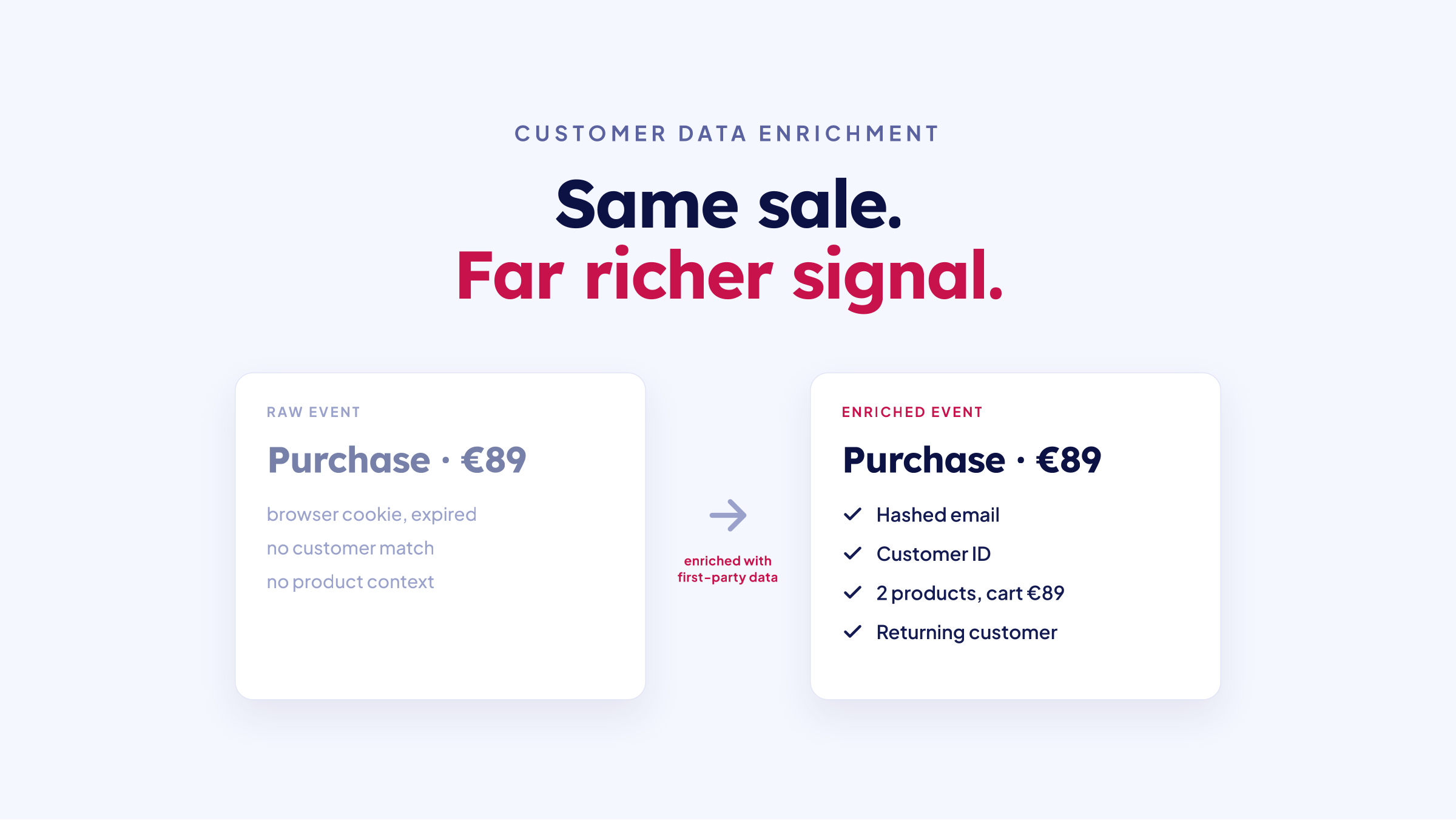
A raw purchase event from a browser pixel might carry little more than "a purchase happened, for this amount." An enriched version of that same event also carries a hashed email, a customer ID, the products and cart value, and whether this is a new or returning shopper. Same sale, far richer signal.
The key word is first-party. Enrichment does not mean buying third-party data about strangers. It means using the first-party data your shoppers already gave you on your own store, and attaching it to the events that would otherwise go out half-empty. For the general version of this idea, see our explainer on what data enrichment is and why it matters.
Why your raw data is incomplete
Before enrichment can help, it is worth being honest about how much is missing. A browser-pixel setup loses signal at several points:
-
Ad blockers stop the pixel from firing at all for a large share of visitors.
-
iOS restrictions and Safari's cookie limits strip or shorten the identifiers that tie a sale back to a shopper.
-
Consent choices mean visitors who decline are invisible to your tags, even when they buy.
The result is signal loss: the platforms receive a partial, thin slice of your real conversions. And even the events that do arrive are often too sparse to match confidently. Enrichment tackles both problems, the missing events and the thin ones.
What enrichment actually adds
Not all enrichment is the same. The details that matter for a Shopify store fall into a few groups.
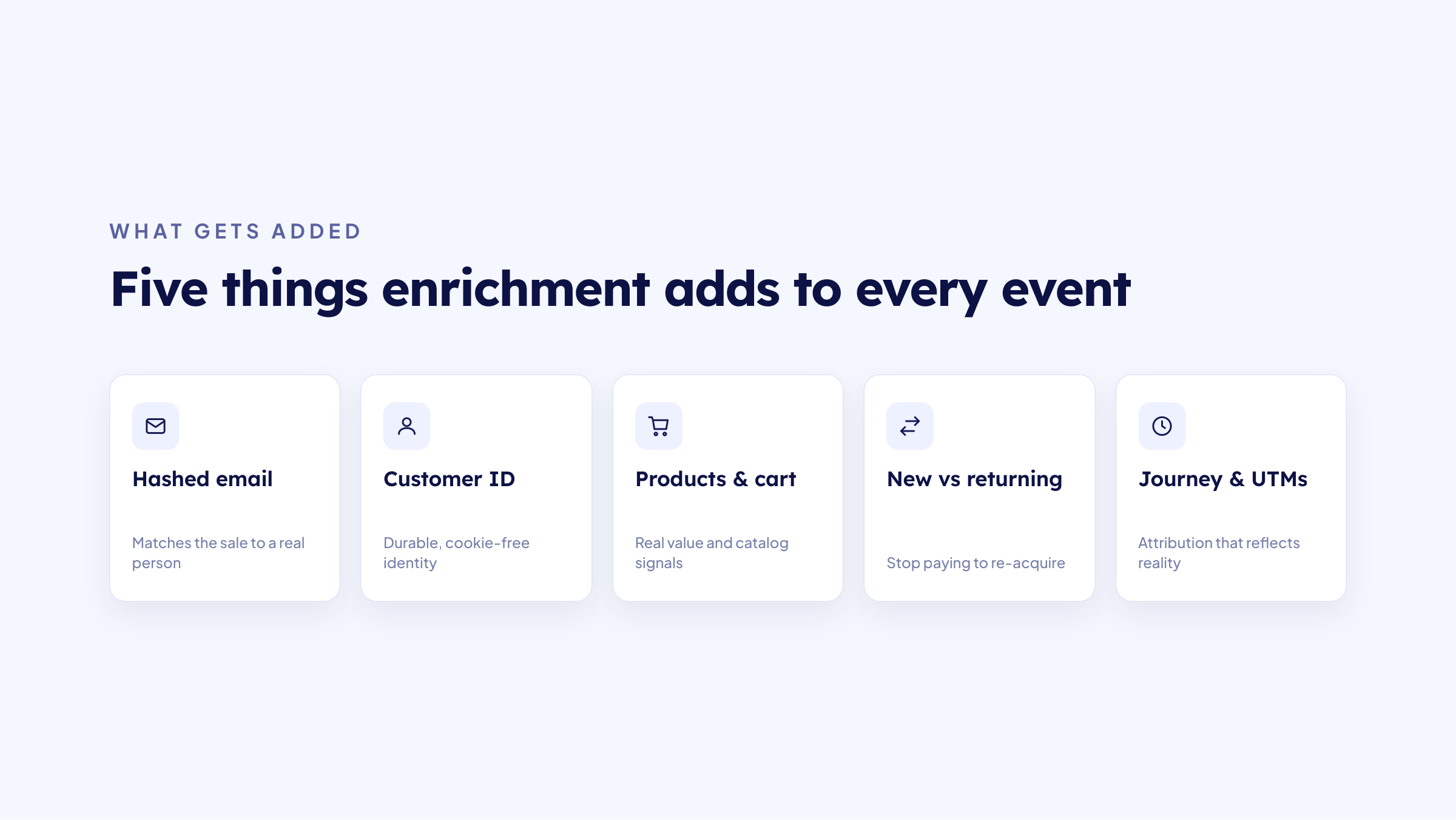
Identity.
A hashed email, phone number or customer ID. This is the single biggest lever for matching, because it lets a platform link the sale to a real account in its system instead of guessing from a cookie.
Product and cart context.
Which products, which categories, the cart value. This powers better catalog and audience signals, not just a flat "purchase."
Telling the platforms whether a buyer is new or an existing customer stops you from paying to re-acquire people you already have.
Session and journey context.
UTM parameters and the path a shopper took, so attribution reflects what actually drove the sale.
Cross-session identity.
Linking a shopper across devices and visits through persistent shopper profiles, so the browse-on-mobile, buy-on-desktop journey is one person, not two.
Why enrichment lifts ad performance
Enriched data is not a reporting nicety. It changes what the ad platforms can do.
Better matching.
Meta and Google score how confidently they can tie an event to a real person. Thin, cookie-only events score low. Events enriched with first-party identifiers score high, which is what Meta measures as Event Match Quality. Higher match quality means more of your conversions are actually attributed and usable.
Smarter targeting.
The platforms learn who to chase from the conversions you feed them. Complete, enriched data trains their models on your real best customers, so they bid more confidently and waste less budget.
Cleaner attribution.
When events carry their journey context, you can see which campaigns truly drove sales instead of defunding channels that only looked weak because their conversions went untracked.
The payoff shows up where it counts: more matched conversions, more efficient spend, and a ROAS figure you can trust. For the Meta-specific version of this, see how to improve your match quality score.
How TrackBee enriches your data
TrackBee is built to do this automatically on Shopify, without you managing data pipelines:
-
It captures events server-side. Because collection happens on the server, the events survive ad blockers, iOS limits and script failures that would drop a browser pixel.
-
It builds persistent shopper profiles. Session enrichment connects a shopper across sessions and devices, so each event carries the fullest possible identity.
-
It enriches it with first-party data. Hashed email, customer ID, product and cart context, and new-versus-returning are attached to each event before it leaves.
-
It sends clean, deduplicated events to Meta, Google, TikTok, Pinterest, GA4 and Klaviyo, so every platform gets the enriched version exactly once.
The events reach Meta through the Conversions API and Google through Enhanced Conversions, both of which are designed to match on first-party data.
Customer data enrichment on Shopify, specifically
Shopify is a good place for enrichment to pay off, for a few reasons.
The order data is right there.
Shopify holds the customer, the order and the cart. Reading enrichment straight from that order data is more reliable than reconstructing it from a browser.
Checkout is where the pixel is weakest.
Shopify limits scripts on the thank-you page, exactly where the purchase and its details live. Server-side enrichment captures the full purchase regardless.
Repeat customers are common.
Recognising returning shoppers with first-party identity is where a lot of wasted spend hides, and where enrichment saves the most money.
Getting started
You do not need a data team. A sensible path:
-
Get server-side tracking live, so events are captured completely before you enrich them.
-
Capture the identifiers you are allowed to. Emails at checkout and customer accounts are the raw material enrichment runs on.
-
Let enrichment run automatically. With TrackBee it installs in about five minutes and needs no ongoing maintenance.
Frequently asked questions
Is customer data enrichment the same as buying third-party data? No. Enrichment here means using the first-party data your own shoppers gave you, like an email at checkout or a customer ID, and attaching it to your own events. It does not involve buying data about strangers.
Is it privacy-compliant? Yes, when built on first-party data and consent. Identifiers are hashed before they are sent, and consent choices are respected. This approach is more privacy-friendly than tracking people with third-party cookies.
Does enrichment help email as well as ads? Yes. Complete, enriched events keep your Klaviyo flows firing on the right triggers, so cart and browse abandonment recovery does not quietly break.
How much does enrichment improve results? It varies by store, but the mechanism is consistent: more matched conversions and better targeting lead to more efficient spend. The lift is largest for stores currently running browser pixels only, where the most data is being lost.
Do I need to change my ads to benefit? No. Enrichment improves the data feeding your existing campaigns. The platforms simply get a more complete and matchable picture to optimise against.


.png)