
Short answer:
Google AI Max for Search reached general availability in April 2026, and from September 2026 it auto-upgrades campaigns using automatically created assets and campaign-level broad match (Dynamic Search Ads follow in February 2027). AI Max optimizes on your conversion data, and browser tracking misses 30-60% of conversions, so the one thing worth doing before September is feeding it complete, server-side data.
You are about to hand Google's AI the keys to your Search campaigns. AI Max for Search hit general availability in April 2026, and starting September 2026 Google begins auto-upgrading campaigns that use automatically created assets and campaign-level broad match. It drives exactly as well as the data you give it.
Most guides stop at the control settings. The prerequisite they skip is simpler and more important: AI Max learns from your conversion signals, so if those signals are incomplete, it optimizes toward the wrong thing with total confidence. Here is what is changing, and how to get your data ready first.
What Google AI Max for Search is
Google AI Max for Search is a bundle of machine-led features that sits on top of your Search campaigns. It expands how your ads match to queries (search term matching, which succeeds broad match), rewrites and customizes your ad text with AI (text customization), and can send clicks to more relevant landing pages than the one in your ad (final URL expansion). In short, it hands more of the targeting and creative decisions to Google's models.
Google reports that advertisers using the full feature suite see an average of about 7% more conversions or conversion value at a similar CPA or ROAS, compared to search term matching alone. That is Google's own figure, measured for non-Retail advertisers, so treat it as a directional promise rather than a guarantee for your store. The lift, whatever it turns out to be for you, comes from the AI making more decisions. Which is exactly why the data behind those decisions matters.
What auto-upgrades in September 2026 (and what moved to February 2027)
Here is the timeline that actually affects your account. As of Google's June 2026 update, the auto-upgrade runs on two clocks:
-
September 2026: campaigns using automatically created assets and the campaign-level broad match setting are auto-upgraded to AI Max. This is most accounts.
-
February 2027: Dynamic Search Ads (DSA) migrate to AI Max. Google pushed this back five months from the original September date, citing advertiser feedback and Q4. You can create new DSA campaigns again until January 2027.
Upgrading does not mean losing control. These are the main levers that stay in your hands:
-
Search term controls and negative keywords, including account-level negatives and brand exclusions.
-
Brand controls that decide which brands your ads can and cannot show against.
-
Location of interest controls for where demand comes from, not just where the user is.
-
Text guidelines that tell the AI what it can and cannot say in your ads.
-
Final URL expansion controls, so you can opt out or restrict it with page feeds and URL exclusions.
-
Creative guidance and reporting, an AI brief to steer generated assets plus visibility into what the AI produced.
Set these deliberately before the upgrade, not after you notice something odd.
The catch nobody mentions: AI Max optimizes on your data
AI Max and Smart Bidding share one engine underneath: they learn from the conversions you report back to Google. Every bid, every match, every rewritten headline is chosen to get more of the outcomes your account is feeding the system. That is the whole point of the automation.
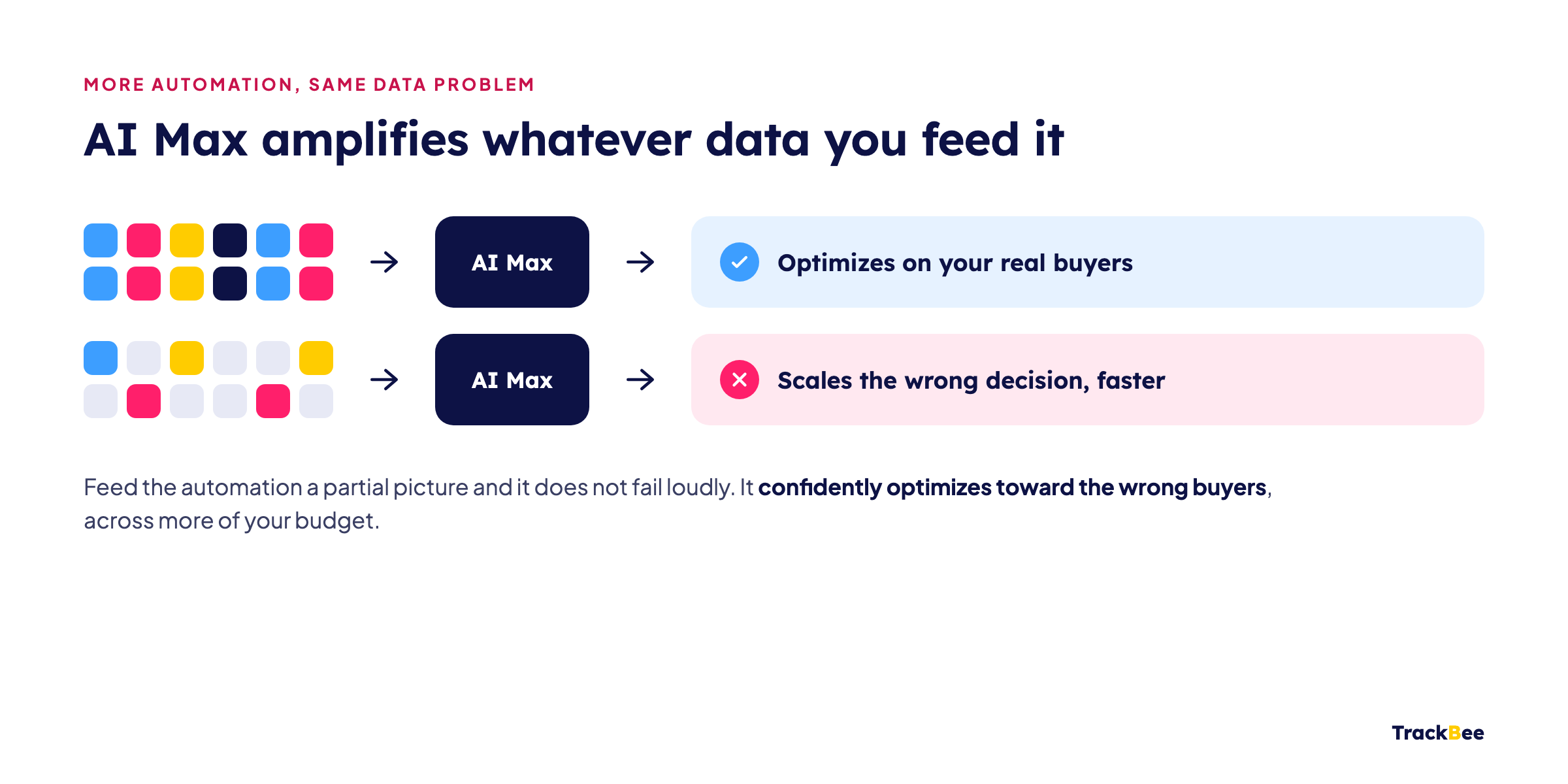
Now the problem. Browser tracking misses 30-60% of conversions. Ad blockers stop the tag from firing, iOS restrictions strip identifiers, consent banners block events, and ordinary script failures drop the rest. This is signal loss, and it means the typical store hands Google a partial, skewed picture of who actually converts.
Feed a learning system a biased sample and it does not fail loudly. It optimizes, confidently, toward the slice of buyers whose conversions happened to reach Google. More automation on incomplete data does not fix the gap. It scales the mistake faster, across more of your budget, with less for you to inspect. The better AI Max gets at optimizing, the more it matters that it is optimizing on the truth.
Why Enhanced Conversions matters more now
Google's own answer to signal loss is Enhanced Conversions. Instead of relying on cookies, it matches conversions back to Google accounts using hashed first-party data like email and phone. Enhanced Conversion Coverage is the share of your conversions that get matched this way, and it is effectively a scorecard for how much accurate feedback Google receives.
Under manual bidding, low coverage cost you some reporting accuracy. Under AI Max, that same gap now shapes every automated decision the system makes on your behalf. Higher coverage means a cleaner training signal, which means the automation aims at your real buyers. Raising it is the highest-leverage thing you can do before September.
How to feed AI Max clean data before September
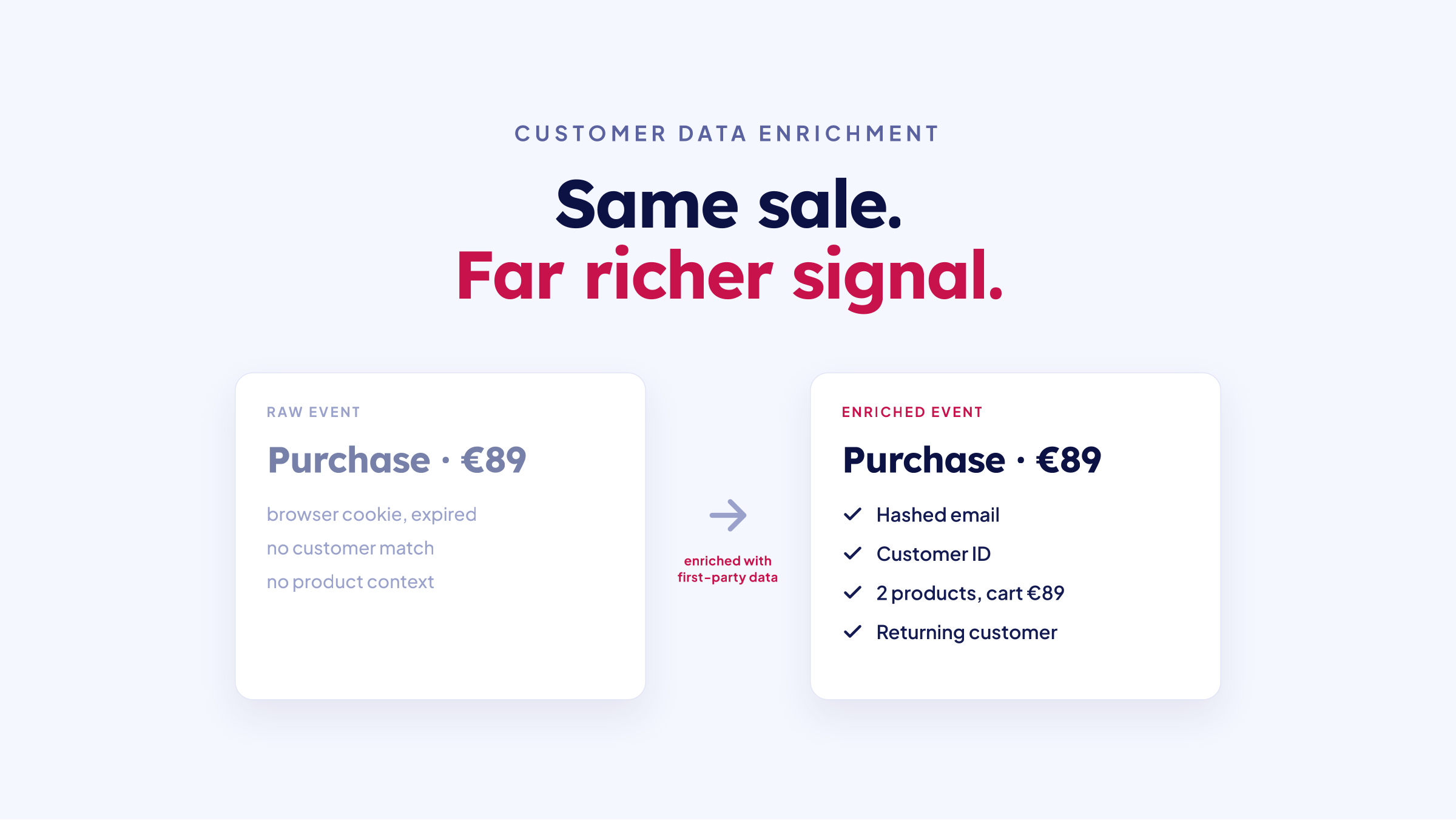
The fix is to stop depending on the browser to report conversions. Server-side tracking captures the conversions browser pixels miss and enriches them with first-party data (hashed email, phone, order value and product context), then sends complete, deduplicated events straight to Google.
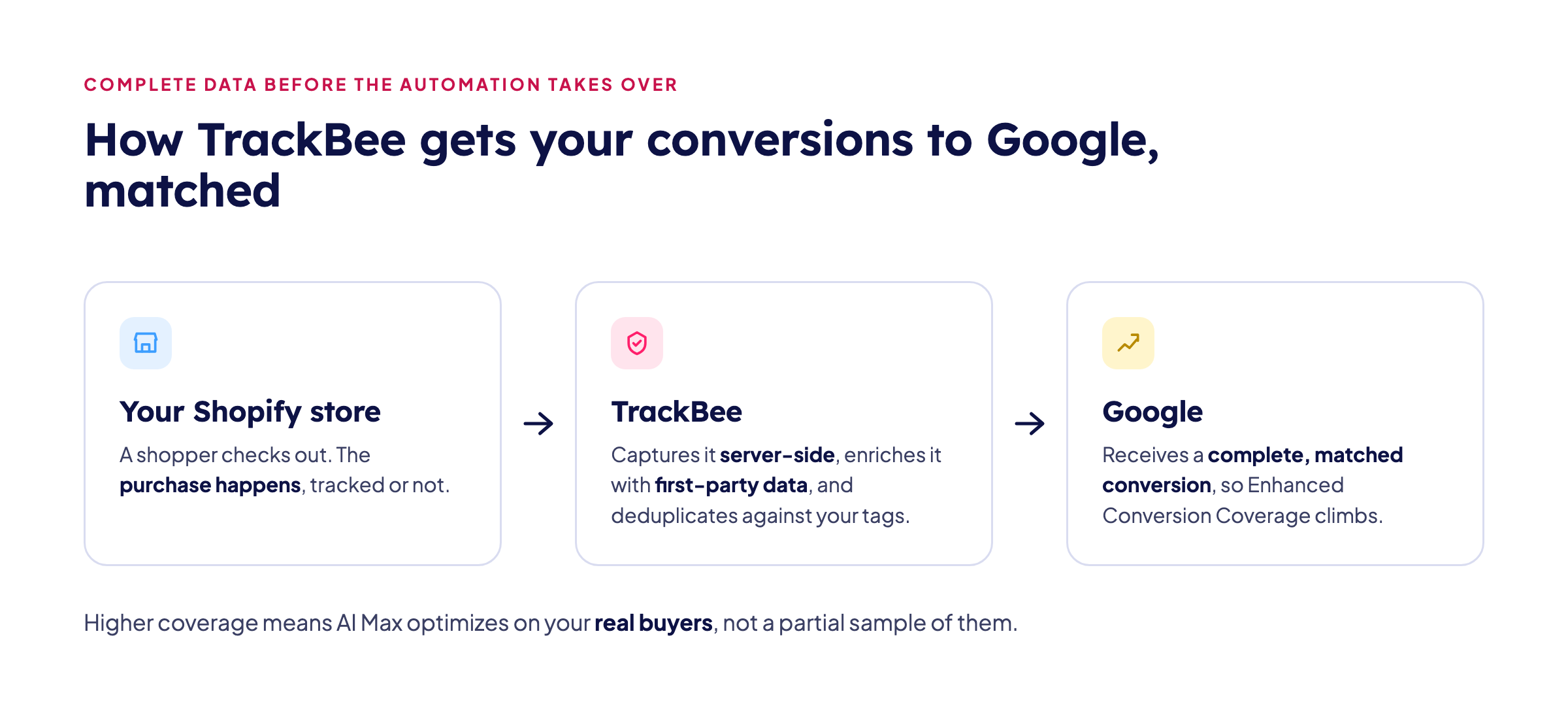
This is where TrackBee comes in. It captures every purchase at the source, enriches it with first-party data through session enrichment, and deduplicates browser and server events so nothing double-counts. The direct result is higher Enhanced Conversion Coverage: more of your real conversions reach Google, matched and accurate. That is exactly the clean feedback AI Max needs to optimize on your actual buyers instead of a lucky sample of them. For the full walkthrough, see the ultimate guide to Google Enhanced Conversions.
Setup on Shopify takes about five minutes, with no developer and no code. The point is to have complete data flowing before the automation takes over, not to scramble after it does.
Your pre-September checklist
Work through this before the auto-upgrade reaches your account:
-
Confirm server-side tracking is live for Google. Check that purchase events are sent server-side, not from the browser alone.
-
Turn on Enhanced Conversions and check your coverage. In Google Ads, confirm Enhanced Conversions is enabled and look at your coverage figure. Higher is better. See how to set up Google Enhanced Conversions on Shopify.
-
Verify your events are deduplicated. Make sure browser and server events for the same conversion are matched so you are not counting twice or reporting noise.
-
Review your six AI Max control levers. Set negative keywords, brand controls, location controls, text guidelines and final URL expansion the way you want them before the switch.
-
Write your AI brief and text guidelines now. Give the automation your brand voice and guardrails up front, so its first decisions are on your terms.
Each step is a one-afternoon job. Together they decide whether AI Max learns from your whole store or a fraction of it.
The bottom line
AI Max is coming to your account whether you opt in or not. You cannot stop the automation, but you can decide what it learns from. The stores that win the transition are not the ones with the cleverest settings. They are the ones feeding Google complete, accurate conversion data, so the AI optimizes on real buyers from day one. Automation only amplifies what you give it, so give it the truth.
Frequently Asked Questions
When does Google AI Max take over my Search campaigns? AI Max for Search reached general availability in April 2026. From September 2026, Google auto-upgrades campaigns using automatically created assets and the campaign-level broad match setting. Dynamic Search Ads were delayed and migrate in February 2027. Most accounts are affected by the September date.
Do I lose control of my campaigns when AI Max turns on? No. You keep several levers: search term controls and negative keywords, brand controls, location of interest controls, text guidelines, final URL expansion controls, and an AI brief plus reporting for generated creative. Setting these before the upgrade is better than reacting after it.
Why does AI Max need better conversion data than manual campaigns? AI Max and Smart Bidding learn from the conversions you report to Google. If browser tracking misses 30-60% of your conversions, the automation optimizes toward a biased sample and scales that mistake across your budget. Complete, accurate data lets it optimize toward your real buyers.
What is Enhanced Conversion Coverage and why does it matter for AI Max? Enhanced Conversion Coverage is the share of your conversions Google matches using hashed first-party data instead of cookies. It is a measure of how much accurate feedback Google receives. Higher coverage means a cleaner training signal, so AI Max makes better automated decisions.
How do I prepare my Shopify store before September 2026? Get server-side tracking live for Google, turn on Enhanced Conversions and check your coverage, confirm your events are deduplicated, and set your AI Max control levers and AI brief before the auto-upgrade. TrackBee handles the server-side tracking, enrichment and deduplication in a five-minute Shopify setup.
Ready to get your Google data AI-Max-ready?
See how complete your Google conversion data really is, and close the gaps before the automation takes over. Try TrackBee for free, or book a free demo.
Read next: AI bidding needs better data | The ultimate guide to Google Enhanced Conversions


.png)