
Short answer:
As of July 2026 Meta is removing the off-platform activity opt-out, and the data businesses already share with Meta can now personalize your Feed and Meta AI answers, not just ad targeting. For advertisers this is less a privacy debate and more a signal: Meta wants more data than ever. What you can control is whether the data your store sends is complete and accurate, because browser pixels miss 30-60% of conversions before this policy even enters the picture.
Meta wants more of your data, and it just made that official. The Meta off-platform data opt-out, the control that let people limit how their activity on other websites was used, is going away in July 2026. The same signals your store already sends Meta will now personalize what shoppers see in their Feed and what Meta AI tells them, on top of the ad targeting that always used them.
Most coverage treats this as a privacy story. For a Shopify store running Meta ads, it is something more useful: a prompt to check that the data you feed Meta is actually worth learning from.
What actually changed in July 2026
Meta announced on 9 June 2026 that it is retiring the old "Your activity off Meta technologies" opt-out. In its place is a broader "Activity from other businesses" control, and the data it governs now feeds three things instead of one: ad targeting, Feed recommendations, and Meta AI responses.
The rollout starts in July 2026 across the US, UK, Brazil, and a number of other markets, with the EU treated separately under GDPR. Meta is clear that it is not collecting any new data through this update. It is using the signals you already send, purchases, add-to-carts, and other events from your website, for more than ads.
There is one detail that matters for advertisers more than the privacy framing. The new control only stops Meta from using a person's data to personalize their own experience. It does not stop your store from sending that data to Meta in the first place. The pipeline stays intact regardless of what any individual shopper toggles. So the data quality question lands entirely on your side of the fence.
Why this is a data quality story, not just a privacy story
Meta's algorithm gets better as the signals it receives get more complete and more accurate. That has always been true for ad targeting, and it is now true for Feed and AI personalization too. More surfaces are learning from your data, which raises the value of every event you send correctly, and the cost of every event you send incomplete or not at all.
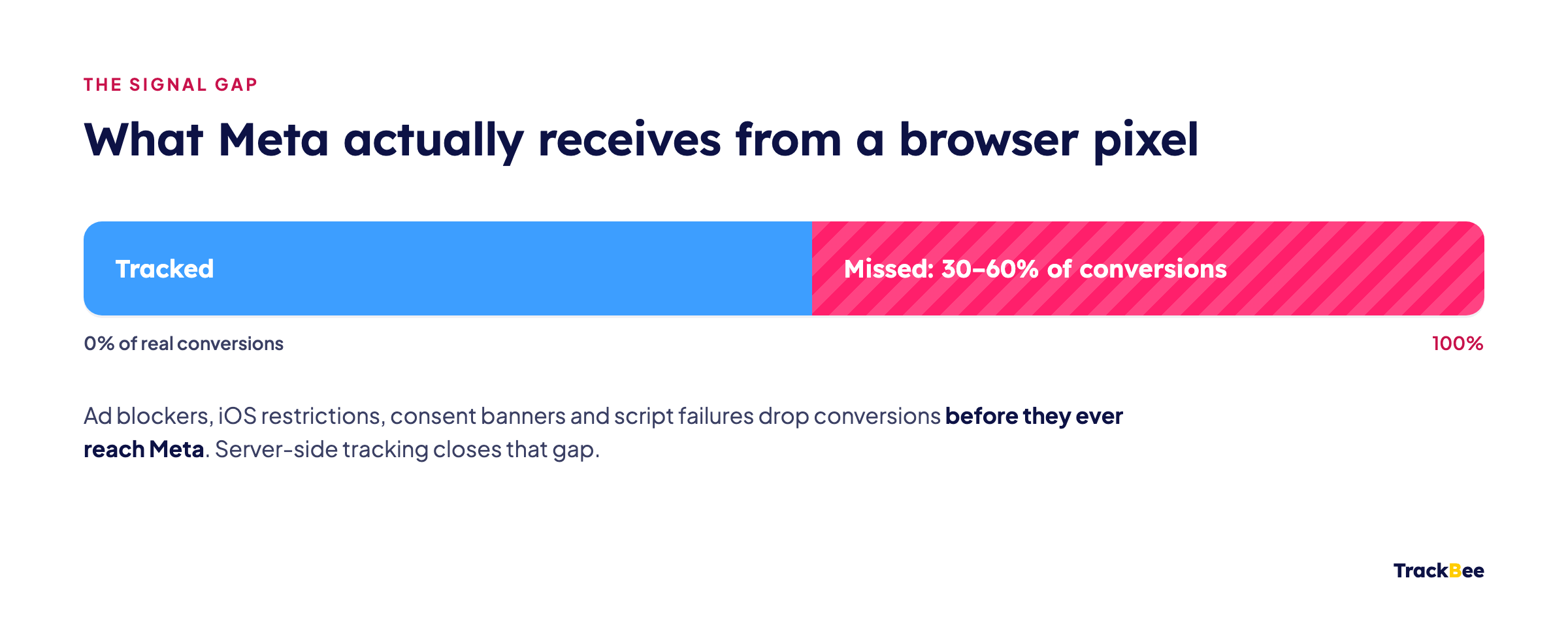
Here is the gap most stores never see. Browser pixels miss 30-60% of conversions. Ad blockers stop the pixel from loading, iOS restrictions strip identifiers, consent banners block events before they fire, and ordinary script failures drop the rest. This is signal loss, and it means the typical store is sending Meta far less than it thinks.
So the two trends collide. Meta is hungrier for data than ever, while the average Shopify store quietly feeds it an incomplete, biased sample of what really happened. The algorithm then optimizes toward the slice of buyers whose events happened to reach Meta, not your full customer base. You do not control Meta's policy. You do control the completeness of what you send, and that has never mattered more.
What "the right data" means for Meta
For Meta specifically, quality means four things:
-
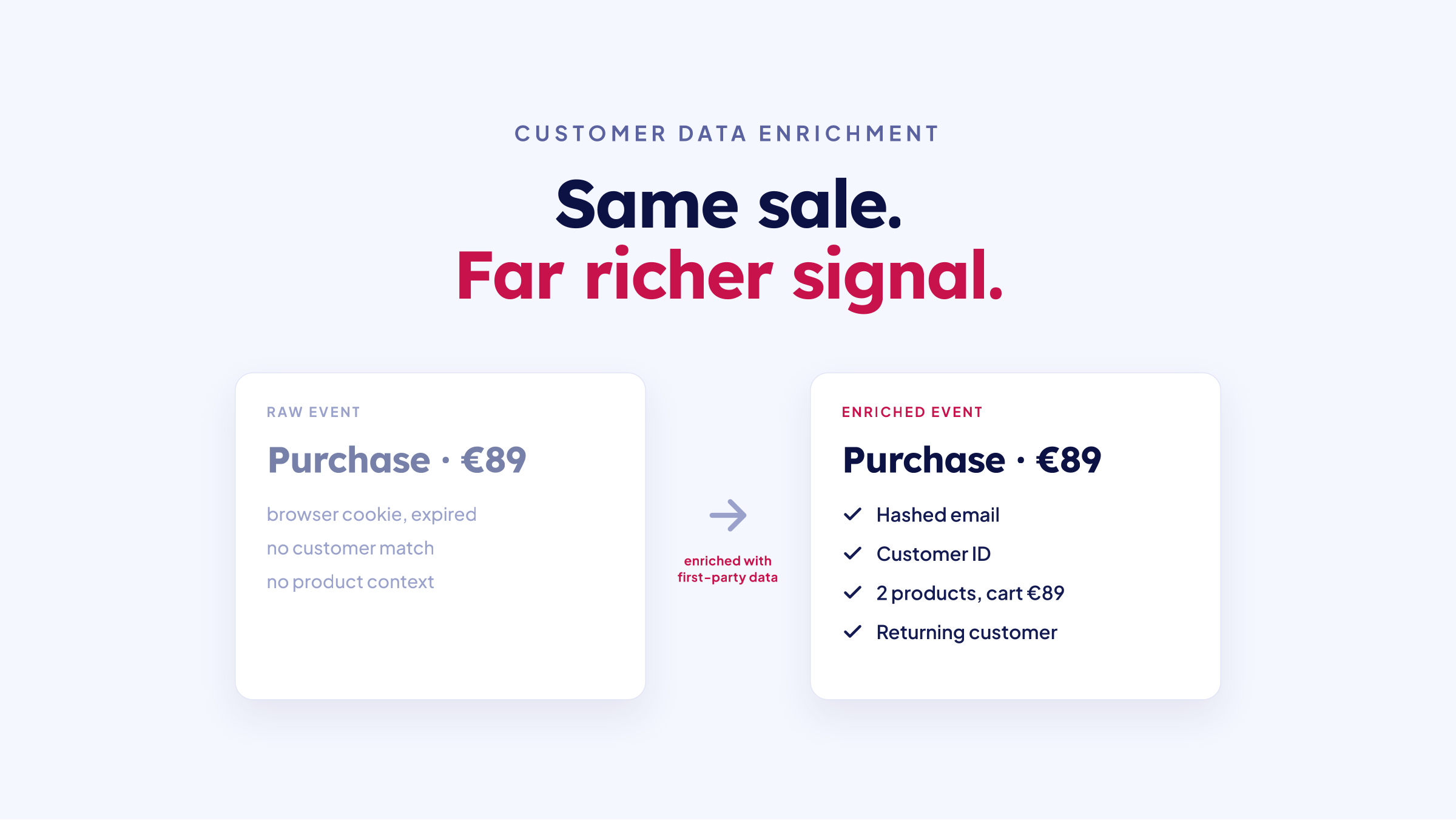
Matched events carry the identifiers Meta needs to tie a conversion to a real account, sent as hashed first-party data.
-
Order value so Meta can optimize for revenue, not just conversion counts.
-
Product and cart context so the signal reflects what was actually bought.
-
Deduplicated browser and server events, so one purchase counts once instead of inflating or corrupting your numbers.
Meta scores exactly this with Event Match Quality (EMQ), its own scorecard for how well your events match to users. A higher EMQ means more conversions attributed and better modeling. Getting there depends on clean event deduplication and rich matching data, which browser-only setups cannot reliably deliver.
How server-side tracking sends Meta complete, accurate data
The fix for signal loss is to stop depending on the browser. Server-side tracking sends conversion events from your server straight to Meta through the Meta Conversions API, so they arrive even when the pixel is blocked, the shopper is on iOS, or a cookie banner blocks the client-side event.
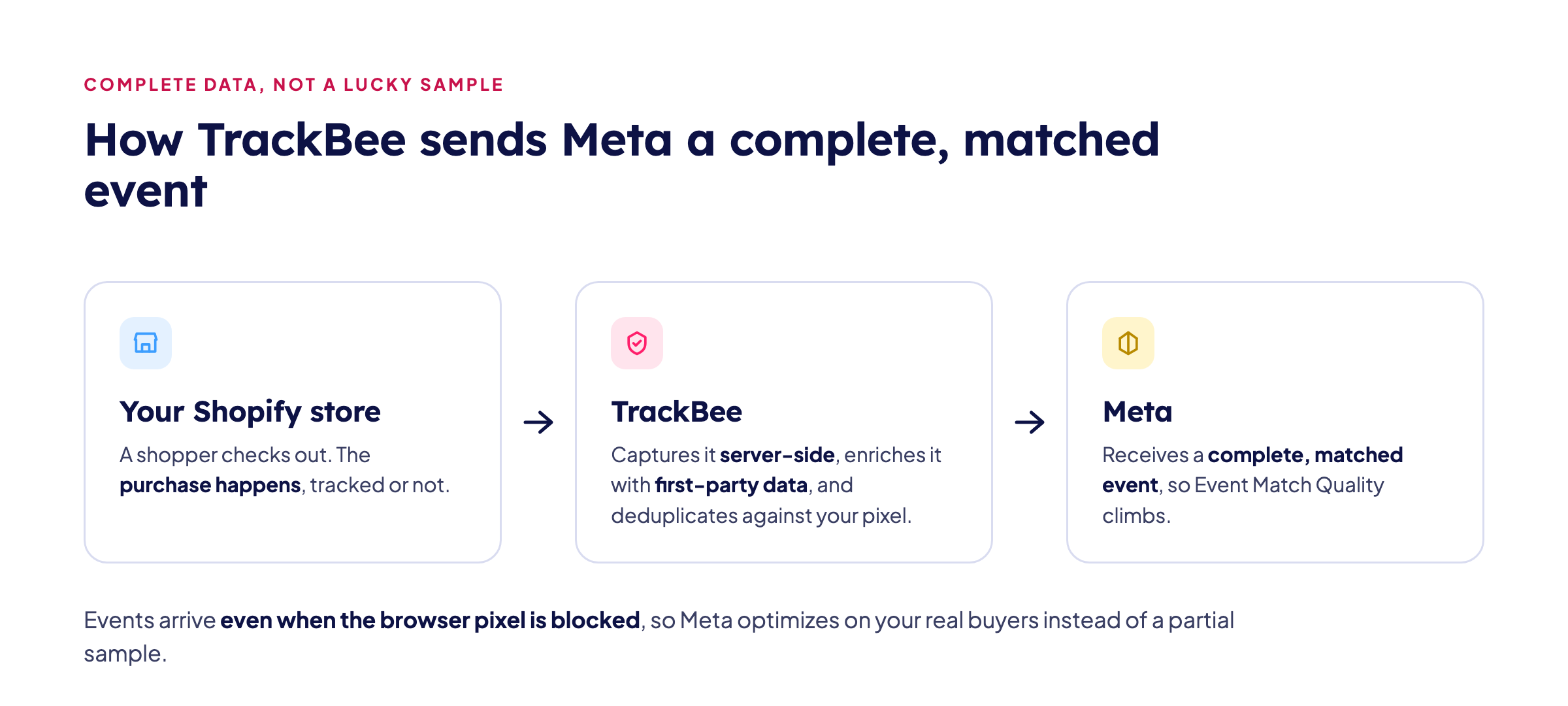
Captured events on their own are only half the job. The other half is enrichment. This is where TrackBee comes in. As a Meta Business Partner, TrackBee captures each event server-side and enriches it with first-party data: the hashed shopper identifiers, order value, and product context Meta uses to match an event to a real account and understand its worth. That session enrichment is what lifts your EMQ, while TrackBee deduplicates browser and server events automatically through CAPI, so nothing double-counts.
The result is the thing Meta's newly hungry algorithm actually rewards: a complete, accurate, deduplicated view of every purchase, whether the shopper was tracked by the browser or not. Setup on Shopify takes about five minutes, no developer required.
A practical checklist for Shopify stores this week
You cannot change Meta's policy, so spend the effort where it pays off. Run through this before your next campaign review:
-
Confirm CAPI is live and deduplicated. Check Meta Events Manager for events with a "Server" source, and make sure browser and server events share an event ID so they are deduplicated, not double-counted.
-
Check your EMQ score. Open Events Manager and look at Event Match Quality for your Purchase event. Below roughly 6 out of 10 means Meta is struggling to match your conversions. See how to improve your Event Match Quality.
-
Verify order value and product data flow through. Confirm that value, currency, and product identifiers arrive with every purchase event, not just the fact that a purchase happened.
-
Confirm Advantage+ is getting the data it needs. Automated campaigns lean hardest on complete signals. Make sure you feed Advantage+ the data it needs so it optimizes on your real buyers.
Each of these is a one-afternoon check. Together they decide whether Meta learns from your store accurately or from a lucky sample of it.
The bottom line
Meta will keep taking more data, and now it will use that data in more places than ever. That part is out of your hands. What stays in your hands is the quality of what you send. Stores with complete, enriched, deduplicated server-side data feed the algorithm properly and get better optimization across ads, Feed, and AI. Stores relying on the browser alone hand Meta an incomplete picture and let it guess.
If Meta is going to learn from your data everywhere, make sure it is learning from the truth.
Frequently Asked Questions
What is the Meta off-platform data change in July 2026? Meta is removing the off-platform activity opt-out and replacing it with a broader "Activity from other businesses" control. The behavioral data businesses already send Meta, such as purchases and add-to-carts from your website, can now personalize a user's Feed and Meta AI responses, not only their ad targeting. It rolls out from July 2026 in the US, UK, Brazil, and other markets, with the EU handled separately under GDPR.
Does turning off the new control stop my store from sending data to Meta? No. The control only stops Meta from using a person's data to personalize their own Feed, ads, and AI. It does not stop businesses from sending that data to Meta. The underlying data pipeline stays intact, which is why the quality of the data you send is the thing worth focusing on.
Do I need to change anything in Meta Ads Manager because of this? There is no setup change required for the policy itself. The practical action is making sure your conversion tracking is complete and accurate so Meta learns from the truth. That means confirming CAPI is live and deduplicated, checking your EMQ score, and verifying order value and product data flow through with every event.
Why do browser pixels miss so many conversions? Ad blockers prevent the pixel from loading, iOS App Tracking Transparency strips identifiers, cookie consent banners block events before they fire, and ordinary script or page-load failures drop more. Combined, browser pixels miss 30-60% of conversions for a typical Shopify store, which is why server-side tracking matters.
How does server-side tracking improve the data Meta receives? Server-side tracking sends events from your server to Meta through the Conversions API, so they arrive even when the browser pixel is blocked. TrackBee also enriches each event with hashed first-party data, order value, and product context, then deduplicates it against your pixel. That raises your Event Match Quality and gives Meta a complete, accurate view of every purchase.
Ready to send Meta complete data?
See what data your store is actually sending Meta, and fix the gaps in about five minutes. Try TrackBee for free, or book a free demo.
Read next: Meta AI ads personalization: what to know | Meta Conversions API for Shopify: the complete guide


.png)