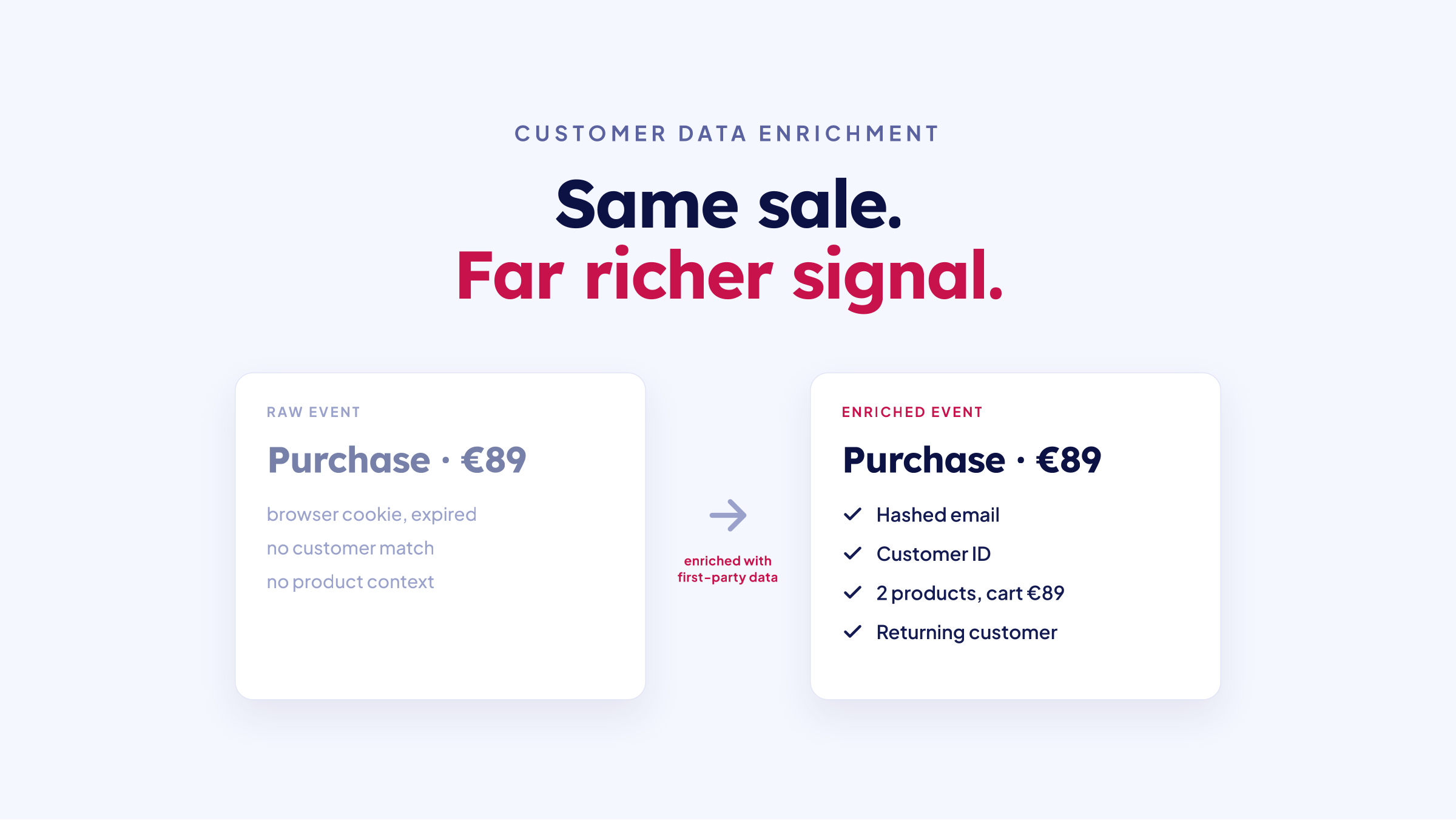
Short answer: Pinterest Tag misses up to 40 percent of Shopify conversions because ad blockers, iOS privacy restrictions and cross-device journeys break browser tracking. Pinterest's Conversions API sends events server-to-server directly from your server, bypassing those limits entirely. Setting it up restores complete conversion data so Pinterest can attribute and optimise your campaigns accurately.
Pinterest is an intent-driven platform. Users actively search for products, save ideas, and build collections of things they want to buy. For Shopify brands in the right categories - home, fashion, beauty, food, lifestyle - Pinterest advertising can be exceptionally efficient.
But like every browser-based ad platform, Pinterest's standard conversion tracking (the Pinterest Tag) faces the same limitations: ad blockers, iOS privacy restrictions, and cross-device attribution failures cause a significant percentage of conversions to go unmeasured.
Pinterest's Conversions API (CAPI) solves this. It's a server-side event delivery mechanism that sends conversion data directly from your server to Pinterest - bypassing browser limitations entirely.
This guide covers how Pinterest conversion tracking works, why the Conversions API is necessary, and how to implement it correctly for your Shopify store.
How Pinterest Conversion Tracking Works
Pinterest conversion tracking connects your advertising activity (Promoted Pins, Shopping Ads, video ads) to actions that happen on your Shopify store. When a Pinterest user clicks your ad and later purchases from your store, Pinterest needs to know about that purchase to:
-
Show you accurate ROAS and cost-per-acquisition data
-
Build Custom Audiences for retargeting (previous site visitors, purchasers)
-
Create Lookalike Audiences (users similar to your buyers)
-
Optimize campaign delivery toward users most likely to convert
Pinterest provides two complementary mechanisms for conversion tracking:
Pinterest Tag
- A JavaScript snippet installed on your Shopify store. The Tag fires events in the customer's browser when they visit pages, add products to cart, or complete a purchase. Fast, but subject to browser limitations.
Pinterest Conversions API (CAPI)
- A server-to-server integration that sends the same events directly from your server (or TrackBee's) to Pinterest. Slower to appear in reports but not blockable by browser conditions and capable of including richer first-party data.
The recommended approach is to run both together, with event deduplication to prevent double-counting - the same best-practice architecture as Meta's Pixel + CAPI and TikTok's Pixel + Events API.
The Pinterest Tag: What It Does and What It Misses
The Pinterest Tag is a standard client-side tracking script. It installs on your Shopify store, fires events based on page activity, and sends them to Pinterest. For most standard desktop browsing sessions with no ad blockers, it works correctly.

What the Pinterest Tag does well:
-
Fires events immediately (real-time data in Pinterest Analytics)
-
Captures in-session click attribution from Pinterest ads
-
Enables basic retargeting audiences (page visitors, cart abandoners)
-
Standard installation - well-supported in Shopify
What the Pinterest Tag misses:
Ad blockers Pinterest's Tag is a trackable script that ad blockers target. Any visitor running an ad blocker generates no Tag events, regardless of their behavior on your store.
iOS privacy restrictions Apple's App Tracking Transparency framework restricts cross-app tracking on iOS. Safari's Intelligent Tracking Prevention limits cookie duration to 7 days. Purchases that occur more than 7 days after an initial Pinterest click are unattributed via Tag alone.
Cross-device attribution Pinterest is heavily used on mobile for discovery and inspiration. But purchases often happen on desktop. A user who saves a product on their phone and purchases on their laptop a week later represents a conversion the Tag cannot track - different device, no shared cookie.
Consent banner restrictions In markets with GDPR or CCPA requirements, users who decline non-essential cookies prevent the Tag from firing entirely. Since July 2025, Google Consent Mode V2 enforcement has raised the bar for consent compliance across all ad platforms - and Pinterest is no exception. Your European or privacy-conscious traffic generates zero Tag events.
The cumulative effect: 25–40% of conversions that your Pinterest ads influence never reach Pinterest's reporting system. Your ROAS appears lower than reality, and your optimization algorithms learn from a filtered sample of your buyers.
Pinterest Conversions API: Server-Side Tracking for Pinterest
Pinterest's Conversions API solves the browser-dependency problem. Instead of firing events in the customer's browser, CAPI sends events from your server directly to Pinterest's API endpoint.

How server-side event delivery works:
-
A customer clicks a Pinterest ad and lands on your Shopify store
-
They browse, add to cart, and complete a purchase
-
Shopify's server records the order with complete order data
-
TrackBee (or your server-side implementation) sends a Purchase event to Pinterest's API with the order data and enriched customer attributes
-
Pinterest receives the event regardless of whether the browser Tag fired
What server-side events include that Tag events can't:
-
Hashed email address and phone number for cross-device user matching
-
Complete order value from Shopify's backend (not estimated from browser-side data)
-
UTM attribution data preserved from the original Pinterest click
-
Cross-session attribution via persistent Shopper Profiles
Pinterest uses the email and phone data to match conversion events to Pinterest user accounts via their internal user graph - the same mechanism as Meta's Conversions API. This enables attribution for conversions where the browser-side click data was lost.
Why Pinterest CAPI Matters for Shopify Campaign Performance
The conversion data Pinterest uses for optimization comes from the events it receives. Incomplete events mean suboptimal optimization.

Audience building Pinterest Custom Audiences (Page Visitors, Cart Abandoners, Purchasers) are built from the conversion events Pinterest receives. When 30–40% of events are missing, your Custom Audiences are smaller and less representative of your actual buyers. Retargeting campaigns reach fewer of your actual previous customers. Lookalike audiences are modeled from an unrepresentative sample.
Bidding and campaign optimization Pinterest's campaign objectives (Conversion campaigns, Catalog Sales) optimize delivery based on conversion signals. More complete conversion data gives the algorithm a more accurate picture of what your buyers look like - enabling more efficient targeting and delivery.
ROAS accuracy Your reported Pinterest ROAS is calculated from conversions Pinterest has visibility into. If 35% of your Pinterest-driven purchases are invisible to Pinterest's tracking, your reported ROAS is 35% lower than your actual ROAS. You may be pausing profitable campaigns or underinvesting in a channel that's actually performing well.
Shopping campaign performance Pinterest Shopping Ads (Catalogs) require accurate conversion data to optimize which products are served to which audiences. Incomplete purchase event data degrades catalog campaign performance.
Step-by-Step: Setting Up Pinterest Tracking on Shopify
Option A: Via TrackBee (Recommended)
TrackBee handles both the Pinterest Tag installation and the Conversions API integration automatically.

Step 1: Install TrackBee on your Shopify store Connect TrackBee to your Shopify store. This takes approximately 5 minutes and requires no developer resources.
Step 2: Connect your Pinterest business account In TrackBee's settings, navigate to Pinterest and authenticate with your Pinterest Business account. Select the ad account and Tag you want to connect.
Step 3: TrackBee configures CAPI automatically TrackBee begins sending server-side events to Pinterest via CAPI. All standard ecommerce events (ViewContent, AddToCart, Checkout, Purchase) are sent with enriched customer data including hashed email and phone numbers.
Step 4: Verify in Pinterest Events Manager In Pinterest Ads Manager → Analyze → Conversion Events, confirm that events are being received from both browser (Tag) and server (CAPI) sources.
Option B: Pinterest Tag via Shopify's Integration
Pinterest offers a native Shopify integration for the Pinterest Tag.
Step 1: Install the Pinterest app from the Shopify App Store Search "Pinterest" in the Shopify App Store and install the official Pinterest app.
Step 2: Connect your Pinterest business account Follow the authentication flow to connect your Pinterest Business account, ad account, and Tag.
Step 3: Enable Conversions API In the Pinterest app settings within Shopify Admin, look for "Enhanced Match" or "Conversions API" settings. Enable this to activate server-side event delivery alongside the browser Tag.
Step 4: Verify setup in Pinterest Events Manager Check that events appear under both browser and API sources.
Pinterest Tag Installation (Manual)
If you prefer manual installation:
Step 1: Get your Pinterest Tag base code In Pinterest Ads Manager → Analyze → Conversions → Create Conversion Tag. Copy your Tag's base code.
Step 2: Install via Shopify Theme or Google Tag Manager
Add the base code to your Shopify theme's <head> section, or install via GTM if you're using Tag Manager.
Step 3: Configure event codes Add event codes for PageVisit, ViewCategory, AddToCart, Checkout, and Purchase on the relevant Shopify pages.
Step 4: Add CAPI integration Manual CAPI setup requires connecting to Pinterest's Events API endpoint. See Pinterest's developer documentation for API specifications and authentication requirements.
Event Deduplication for Pinterest
When running both Pinterest Tag and CAPI simultaneously, configure deduplication to prevent double-counting.
Pinterest's deduplication mechanism Pinterest matches Tag events and CAPI events for the same action using a combination of:
-
dedup_key- a unique identifier you include in both the Tag event and the corresponding CAPI event (typically the order ID for Purchase events) -
User matching attributes (email, MAID, external ID)
When both events carry the same dedup_key and user attributes, Pinterest deduplicates and counts one conversion.
Implementation
Include event_id (the dedup_key) in your Tag event JavaScript and match this to the dedup_key field in your CAPI request for the same event. For Purchase events, use the Shopify Order ID as the dedup_key - unique per order and available to both the browser Tag and your server-side event.
TrackBee handles deduplication automatically - the same event IDs are used across both browser and server-side event delivery.
Optimizing Pinterest Campaigns with Complete Conversion Data
With complete conversion tracking in place, you can use the data for more effective Pinterest campaign management.
Accurate catalog optimization Pinterest Shopping Ads (Catalog campaigns) optimize which products to show based on product-level conversion data. Complete CAPI events - including the specific products purchased - enable Pinterest to identify your highest-performing products and serve them to the most relevant audiences.
Retargeting precision Build Custom Audiences from complete Purchase and Cart Abandonment events. Your retargeting pools now include customers whose conversions were previously invisible to the Tag. Particularly impactful for mobile-to-desktop journeys where the majority of mobile browsing conversions happen on desktop.
First-party audience matching Upload your Shopify customer list (hashed email addresses) to Pinterest for Customer List targeting. CAPI's improved user matching means more of your actual customers are matched to Pinterest accounts - enabling more effective suppression (excluding existing customers from prospecting) and more accurate lookalike modeling.
Keyword and interest targeting refinement Pinterest's behavioral targeting (keywords, interests) benefits from a larger, more representative sample of your actual converters. CAPI-enriched conversion data feeds more accurate interest and behavioral modeling.
See: Why consistent data across all your ad channels is essential for performance.
Frequently Asked Questions
Is Pinterest's Conversions API the same as the Pinterest Tag? No - they're complementary. The Pinterest Tag fires events in the customer's browser (fast but blockable). The Conversions API sends events from your server (not blockable, includes richer data). Both together provide the most complete conversion tracking.
What events should I send via Pinterest CAPI? For Shopify e-commerce stores: PageVisit, ViewCategory, AddToCart, Checkout, and Purchase events. Purchase is the most important - it's what Pinterest uses for Conversion campaign optimization. AddToCart and Checkout events support funnel analysis and retargeting audience building.
Does Pinterest CAPI work with all Pinterest campaign types? Yes. Conversion campaigns, Catalog Sales campaigns, and Shopping Ads all benefit from more complete conversion data. The CAPI doesn't restrict which campaign types you can run - it just ensures Pinterest has complete visibility into the conversions your ads drive.
How does Pinterest CAPI handle customer privacy? Customer data (email, phone) is hashed using SHA-256 before being sent to Pinterest. Pinterest cannot reverse the hash to recover the original data. This is consistent with GDPR requirements for pseudonymization and aligns with how Meta, Google, and TikTok handle first-party data in their CAPI implementations.
How do I know if my Pinterest CAPI is working? In Pinterest Ads Manager → Analyze → Conversion Events, check for events appearing under the "API" source alongside your "Tag" source. Compare the total Purchase event volume against your Shopify order count for the same period. If you see meaningful API events in addition to Tag events, your CAPI is working correctly.
Can I use Pinterest CAPI without the Tag? Technically yes, but it's not recommended. The Tag provides real-time event data and in-session click attribution that CAPI alone can't replicate for same-session conversions. Run both together for maximum coverage.
Complete Tracking Is the Foundation of Pinterest Performance
Pinterest advertising performs best when the platform has complete, accurate data about who converts. The Pinterest Tag provides real-time data for users whose browsers don't block it. The Conversions API captures the conversions the Tag misses.
For Shopify brands investing in Pinterest advertising, implementing CAPI isn't optional - it's the difference between reporting that shows a fraction of your Pinterest-driven conversions and reporting that shows all of them.
TrackBee's Pinterest integration handles both the Tag management and CAPI event delivery automatically. Connect your Pinterest account and complete server-side tracking begins immediately.


.png)