Server-Side Tracking for Shopify Agencies: How to Deliver Better Results Across Every Client

Agencies managing multiple Shopify clients need a tracking infrastructure that scales. Here's how server-side tracking transforms agency-side data quality - and client retention.
March 16, 2026
Latest
Server-side tracking

Server-Side Tracking for Shopify Agencies: How to Deliver Better Results Across Every Client

Agency performance marketing lives and dies by data. Every recommendation you make to a client - where to allocate budget, which campaigns to scale, which creative to run - depends on the quality of the conversion data you're working with.

But most Shopify clients have the same underlying data problem: their browser-based tracking is losing 25–40% of conversion events. Meta Pixel misses conversions. Google Ads tag fires inconsistently on Shopify checkout pages. Klaviyo doesn't receive the "Started Checkout" events it needs to trigger abandoned cart flows. And across all platforms, cross-device journeys go unattributed.

For agencies, this creates a systematic problem: you're making optimization decisions based on incomplete data, across multiple client accounts, simultaneously.

Server-side tracking solves this. This guide covers why it matters for agency operations, how to scale it across client accounts, and what the business impact looks like when you get data quality right.

The Agency Data Quality Problem

Here's the situation at most Shopify agencies:

A client's Meta ROAS shows 3.2x. But you're not confident in that number because you know the Pixel fires inconsistently on mobile. Google Ads shows Target ROAS is "on track" but the Smart Bidding is showing unusual volatility. Klaviyo reports 22% of its flows are triggering on time - but you suspect the "Started Checkout" event is leaking.

You can feel the data gaps without being able to quantify them precisely. And when you make budget recommendations based on incomplete data, you're managing to the wrong numbers.

The root cause is consistent across every client: standard browser-based tracking (Meta Pixel, Google Ads tag, Klaviyo's JavaScript SDK) loses a meaningful percentage of events to ad blockers, iOS restrictions, Safari ITP, and consent banners. The clients don't know this. Many agencies don't surface it proactively. And the result is that the entire performance marketing operation is built on a foundation with structural holes.

For agencies with 10, 20, or 50+ Shopify clients, this problem multiplies. The inefficiency isn't in one account - it's systemic across your entire client base.


Why Client-Side Tracking Fails at Scale

The mechanics of client-side tracking failure are well-documented:

Ad blockers (affects all browsers) uBlock Origin, AdBlock Plus, and similar extensions block Meta Pixel, Google Analytics, and other tracking scripts. Shopify merchants serving privacy-aware audiences - particularly in tech, B2B-adjacent DTC, and European markets - see ad blocker rates of 20–35% among their users.

iOS App Tracking Transparency (iOS 14.5+) Users who decline ATT on iOS restrict Meta's ability to match browser events to their Meta profiles. This affects every Meta Pixel-based client, directly correlated with iPhone usage share in their audience (typically 50–70% for US/UK DTC brands).

Safari Intelligent Tracking Prevention 7-day cookie cap. Any customer who clicks an ad and purchases more than 7 days later is unattributed in browser-based tracking. For considered purchases - anything over ~€50 where customers research before buying - this is a significant gap.

iOS 17 Link Tracking Protection Strips fbclid, gclid, ttclid, and other click-tracking parameters from URLs on iOS 17 devices. Click-level attribution in Meta and Google is degraded for any URL accessed on iOS 17.

Shopify checkout restrictions Shopify's hosted checkout environment limits third-party script access. Events that should fire at checkout (InitiateCheckout, AddPaymentInfo) are frequently missing from client-side implementations.

GDPR/CCPA consent rejection and Consent Mode V2 enforcement EU visitors who reject non-essential cookies generate zero client-side tracking events. With Consent Mode V2 now enforced across the EU, this is no longer a gray area - compliant consent handling is mandatory. For agencies with European client bases, consent rejection rates of 30–50% in some markets mean substantial portions of European traffic are invisible to client-side tracking. Meanwhile, Google's Privacy Sandbox has been effectively abandoned, leaving no browser-level replacement for these lost signals.

iOS 26 in-app browser restrictions Building on iOS 14's ATT framework, iOS 26 introduces additional restrictions on tracking within in-app browsers (Safari, Instagram, Facebook). Click IDs are stripped more aggressively, and cross-app attribution is further degraded. For agencies managing clients with significant mobile traffic, this is the next wave of signal loss.

Each of these mechanisms compounds. A client might lose 15% to ad blockers, 20% to iOS restrictions, 10% to consent rejection, and 5% to Shopify checkout limitations. The aggregate tracking loss: 40%+ of conversion events never reach the platforms.


What Server-Side Tracking Provides for Agencies

Server-side tracking moves event capture from the browser to the server. Events fire at the Shopify backend level - independent of browser conditions.

For agencies, the key benefits:

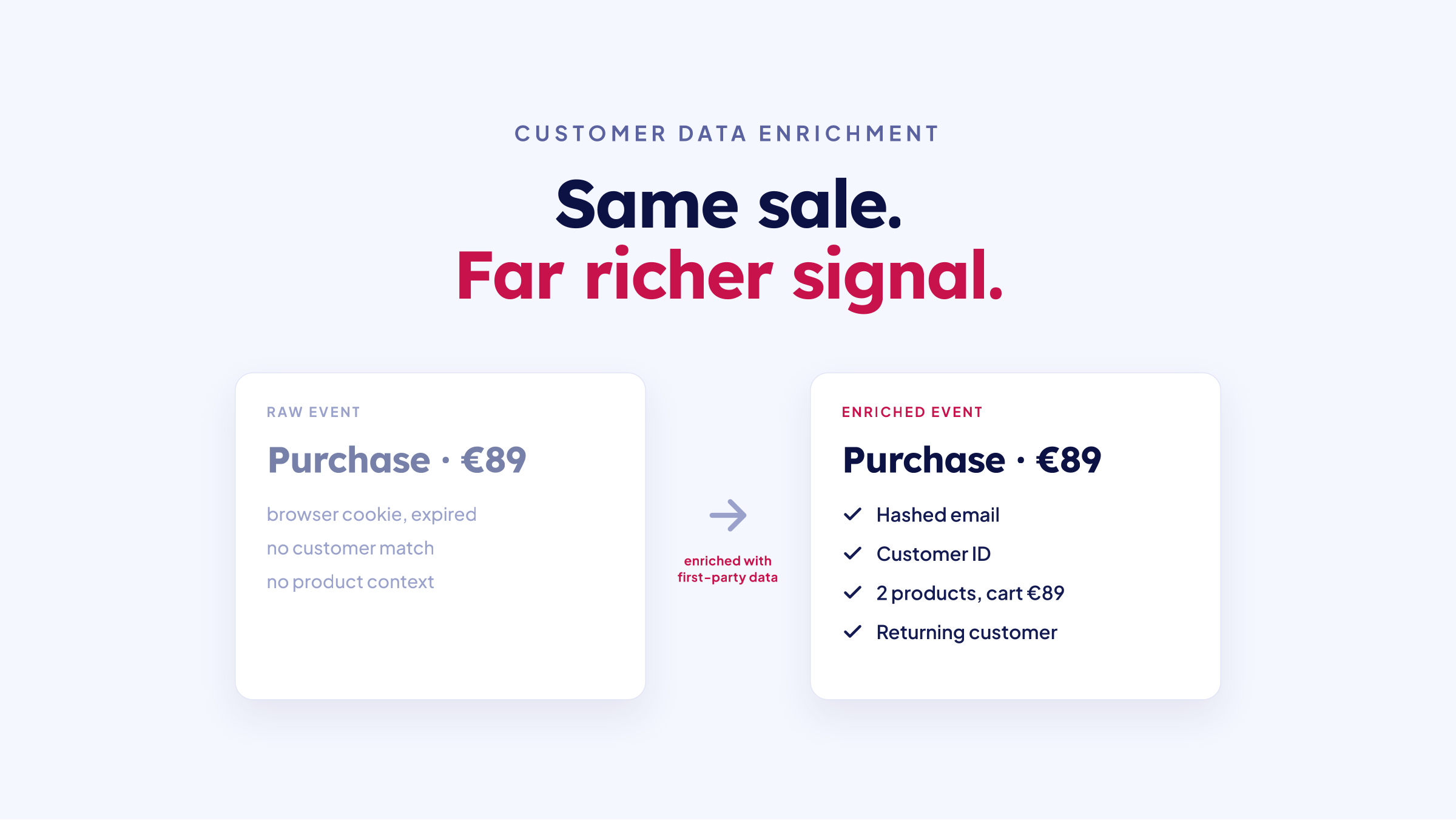
Complete conversion data across all clients Server-side Purchase events capture every Shopify order - regardless of browser, device, consent status, or ad blocker. Your platform reporting reflects actual Shopify revenue rather than the portion that was trackable by the browser.

Accurate attribution for algorithm optimization Meta's Advantage+, Google's Smart Bidding, and TikTok's Smart Performance Campaigns all train on the conversion signals they receive. More complete conversion data means better algorithm training - which means better delivery optimization. This improvement is systematic across every client account where you implement server-side tracking.

Cross-device attribution via Shopper Profiles TrackBee builds persistent Shopper Profiles that connect a customer's sessions across devices. A customer who clicks a Meta ad on their phone and purchases on their laptop days later - a common journey - is attributed correctly via their email identifier. This cross-device attribution improvement benefits every client running mobile-heavy campaigns.

Klaviyo flow reliability Klaviyo's browse abandonment and cart abandonment flows depend on "Viewed Product" and "Started Checkout" events arriving correctly. When these events are captured server-side, they reach Klaviyo reliably - even when the browser event was blocked or the customer switched devices. For clients where Klaviyo is a significant revenue channel, this directly impacts email revenue.

Consistent reporting foundation Server-side tracking provides a consistent, auditable event data model. The same events, captured the same way, across every Shopify client. This standardizes your reporting infrastructure and reduces the time spent investigating tracking anomalies per account.


Implementing Server-Side Tracking Across Multiple Shopify Clients

For agencies, the implementation model matters as much as the technology.

Requirements for agency-scale server-side tracking:

  • Multi-account management (connect multiple Shopify stores from a single dashboard)

  • Per-client configuration (each client connects their own Meta, Google, TikTok, Pinterest, Klaviyo accounts)

  • Standardized event model across clients (same event names, same enrichment, consistent deduplication)

  • Agency-level reporting visibility (performance metrics across client accounts from one view)

  • No developer resources required per client installation

TrackBee's agency model: TrackBee supports agency-level account management. You can connect multiple client Shopify stores, with each store independently connected to the client's own ad platform accounts. Tracking is standardized across all clients using TrackBee's server-side event infrastructure.

Installation per client: approximately 5 minutes. No developer resources, no custom GTM containers, no per-client data layer setup. This is the operational efficiency argument for purpose-built platforms over manual GTM-based server-side setups.

What not to do at agency scale: Building server-side tracking via custom GTM containers and manual API integrations per client works - but it creates a substantial maintenance burden. Each client has its own container to update when Meta or Google updates their APIs. Each client requires bespoke troubleshooting. The marginal cost of each new client is high, and the time-to-value for new clients is measured in weeks, not hours.


The Operational Case: Reduced Maintenance, Better Reporting

Beyond campaign performance, server-side tracking changes the economics of agency operations.

Reduced tracking maintenance time Manual GTM-based tracking requires ongoing maintenance: when Meta updates its CAPI implementation, you update GTM configurations across every client. When Google deprecates a tag type, you reconfigure. TrackBee handles API updates automatically - when platform APIs change, TrackBee's implementation updates. Your agency isn't caught managing tracking fires across 20 client accounts simultaneously.

Fewer "why don't our numbers match" conversations The most common client tracking conversation in agencies: "Why does Meta show 400 conversions but Shopify shows 300 orders?" This discrepancy is partially platform attribution window overlap, but a significant part is Pixel over-reporting (view-through conversions) and missing server-side events. With server-side tracking and accurate deduplication, the gap between platform-reported and Shopify-actual revenue narrows. Fewer reconciliation discussions. More time on strategy.

Proactive data quality as a differentiator Agencies that identify and fix client tracking gaps before clients notice them demonstrate a level of strategic ownership that distinguishes them from execution-only agencies. Presenting a client with "Your Meta Pixel is missing 38% of your actual purchases - we've fixed this with server-side tracking" is a high-value conversation. It connects directly to ROAS and campaign performance.

Audit as a prospecting tool A tracking audit - using TrackBee's diagnostic data to identify how many conversions a prospective client is missing - is an effective new business conversation starter. Most DTC brands don't know the magnitude of their tracking gaps. Showing them the data converts a general "we do performance marketing" pitch into a specific, quantified problem with a clear solution.


Business Impact: What Better Data Does for Campaign Performance

The downstream effects of complete conversion data on campaign performance are documented across TrackBee's client base.

Meta Advantage+ optimization Complete purchase event data (via server-side CAPI) gives Meta's Advantage+ algorithm a representative sample of your client's buyers. The algorithm identifies better audience segments, delivers to users more likely to convert, and reduces waste on low-intent audiences. For clients with high iOS traffic, the improvement can be substantial - recovering the optimization quality that iOS 14 degraded.

Google Smart Bidding training Google's Target ROAS and Target CPA rely on historical conversion data for their predictions. When 35% of conversions are missing, the algorithm's predictions are calibrated to the wrong baseline. More complete conversion data typically results in tighter Smart Bidding performance and fewer algorithm learning periods triggered by unexplained conversion gaps.

Klaviyo revenue recovery For clients where Klaviyo is a meaningful revenue channel, the impact of server-side event capture on Klaviyo flows is significant. When browse and cart abandonment events are captured reliably, flow trigger rates increase - directly increasing email-attributed revenue from flows that were already configured but not firing for a large portion of abandoners.

HoneyBalm, a TrackBee client, saw after fixing their tracking: +171% more Add to Cart events in Klaviyo, +220% more abandoned cart flow triggers, and +213% more abandonment revenue. None of this came from changing their email content. It came from fixing the event capture. See: How to improve your Klaviyo abandoned cart flow.


How to Position Tracking as a Service

For agencies, server-side tracking isn't just a technical implementation - it's a commercial conversation.

Framing the value:

  • "We ensure 100% of your Shopify conversions reach your ad platforms" - not a feature, a business outcome

  • "Your algorithm is currently training on 65% of your actual buyers. We fix that." - specific, quantified, impactful

  • "Your Klaviyo abandoned cart flow is only triggering for 40% of actual abandoners. Server-side tracking recovers the rest." - directly connects to lost revenue

Data quality audit as a service: Offer a tracking audit as the first step of every new client engagement - or as a standalone service for prospective clients. The audit quantifies the gap between trackable conversions and actual Shopify orders. This creates a specific, measurable problem that your agency can solve. It also positions you as analytically rigorous in a way that differentiates from agencies that start with creative.

Recurring value: Unlike a one-time campaign optimization, tracking infrastructure is a recurring value. Once implemented, server-side tracking continuously improves data quality - every month, every campaign. This supports retainer-based engagements and gives clients a reason to stay.


Frequently Asked Questions

Do I need to implement server-side tracking separately for each client? With TrackBee, each client's Shopify store is connected individually - but the setup process is standardized and takes approximately 5 minutes per client. There's no custom code, no per-client GTM configuration, and no developer resources required. The agency manages a single TrackBee workspace with multiple client stores.

How does server-side tracking handle clients with GDPR consent requirements? Server-side tracking can be configured to respect consent signals. TrackBee processes server-side events in compliance with data processing requirements. For EU clients, events are processed according to the consent mode configuration - ensuring that tracking operates within the legal framework without sacrificing data completeness for consenting users.

What's the maintenance overhead for agencies after implementation? Minimal. TrackBee handles API updates automatically when Meta, Google, TikTok, or Pinterest update their server-side event specifications. You don't need to maintain code, update GTM containers, or monitor API changelogs per client. The main ongoing activity is monitoring event health dashboards to confirm events are flowing correctly.

How do I demonstrate the value of server-side tracking to clients who don't understand tracking? Quantify it. Show the gap between Meta-reported conversions and Shopify orders. Show the Klaviyo "Started Checkout" event volume versus Shopify's checkout data. Frame it as: "You're currently seeing only X% of your actual conversions in your ad platforms - your campaigns are optimizing on an incomplete picture. Here's what full visibility looks like and what it means for your ROAS."

Does server-side tracking work for clients on all Shopify plans? Yes. TrackBee works with all Shopify plans (Basic, Shopify, Advanced, Shopify Plus). The server-side tracking architecture is independent of Shopify plan - it connects directly to Shopify's backend API, which is available on all plans.

Can agencies white-label TrackBee for client reporting? Contact TrackBee for information about agency partnership and white-label options.


The Agency Advantage: Better Data, Better Results, Stronger Retention

Agencies that build their service delivery on complete, accurate data have a structural advantage over those that don't. Not because they're doing anything fundamentally different in campaign management - but because their optimization decisions are based on a complete picture rather than a partial one.

The campaigns perform better. The Klaviyo flows trigger more reliably. The reporting conversations focus on strategy rather than explaining discrepancies. And the agency is seen as the reason performance is improving - because it is.

Server-side tracking via TrackBee installs in 5 minutes per client, requires no ongoing maintenance, and systematically improves data quality across your entire client base.

In this article
Boost Your Revenue
Track Missing Conversion Data
Lorem Ipsum

Boost Your Revenue

Track & Enrich
Missing Conversion Data

Try for free
Share this:

Agency performance marketing lives and dies by data. Every recommendation you make to a client - where to allocate budget, which campaigns to scale, which creative to run - depends on the quality of the conversion data you're working with.

But most Shopify clients have the same underlying data problem: their browser-based tracking is losing 25–40% of conversion events. Meta Pixel misses conversions. Google Ads tag fires inconsistently on Shopify checkout pages. Klaviyo doesn't receive the "Started Checkout" events it needs to trigger abandoned cart flows. And across all platforms, cross-device journeys go unattributed.

For agencies, this creates a systematic problem: you're making optimization decisions based on incomplete data, across multiple client accounts, simultaneously.

Server-side tracking solves this. This guide covers why it matters for agency operations, how to scale it across client accounts, and what the business impact looks like when you get data quality right.

The Agency Data Quality Problem

Here's the situation at most Shopify agencies:

A client's Meta ROAS shows 3.2x. But you're not confident in that number because you know the Pixel fires inconsistently on mobile. Google Ads shows Target ROAS is "on track" but the Smart Bidding is showing unusual volatility. Klaviyo reports 22% of its flows are triggering on time - but you suspect the "Started Checkout" event is leaking.

You can feel the data gaps without being able to quantify them precisely. And when you make budget recommendations based on incomplete data, you're managing to the wrong numbers.

The root cause is consistent across every client: standard browser-based tracking (Meta Pixel, Google Ads tag, Klaviyo's JavaScript SDK) loses a meaningful percentage of events to ad blockers, iOS restrictions, Safari ITP, and consent banners. The clients don't know this. Many agencies don't surface it proactively. And the result is that the entire performance marketing operation is built on a foundation with structural holes.

For agencies with 10, 20, or 50+ Shopify clients, this problem multiplies. The inefficiency isn't in one account - it's systemic across your entire client base.


Why Client-Side Tracking Fails at Scale

The mechanics of client-side tracking failure are well-documented:

Ad blockers (affects all browsers) uBlock Origin, AdBlock Plus, and similar extensions block Meta Pixel, Google Analytics, and other tracking scripts. Shopify merchants serving privacy-aware audiences - particularly in tech, B2B-adjacent DTC, and European markets - see ad blocker rates of 20–35% among their users.

iOS App Tracking Transparency (iOS 14.5+) Users who decline ATT on iOS restrict Meta's ability to match browser events to their Meta profiles. This affects every Meta Pixel-based client, directly correlated with iPhone usage share in their audience (typically 50–70% for US/UK DTC brands).

Safari Intelligent Tracking Prevention 7-day cookie cap. Any customer who clicks an ad and purchases more than 7 days later is unattributed in browser-based tracking. For considered purchases - anything over ~€50 where customers research before buying - this is a significant gap.

iOS 17 Link Tracking Protection Strips fbclid, gclid, ttclid, and other click-tracking parameters from URLs on iOS 17 devices. Click-level attribution in Meta and Google is degraded for any URL accessed on iOS 17.

Shopify checkout restrictions Shopify's hosted checkout environment limits third-party script access. Events that should fire at checkout (InitiateCheckout, AddPaymentInfo) are frequently missing from client-side implementations.

GDPR/CCPA consent rejection and Consent Mode V2 enforcement EU visitors who reject non-essential cookies generate zero client-side tracking events. With Consent Mode V2 now enforced across the EU, this is no longer a gray area - compliant consent handling is mandatory. For agencies with European client bases, consent rejection rates of 30–50% in some markets mean substantial portions of European traffic are invisible to client-side tracking. Meanwhile, Google's Privacy Sandbox has been effectively abandoned, leaving no browser-level replacement for these lost signals.

iOS 26 in-app browser restrictions Building on iOS 14's ATT framework, iOS 26 introduces additional restrictions on tracking within in-app browsers (Safari, Instagram, Facebook). Click IDs are stripped more aggressively, and cross-app attribution is further degraded. For agencies managing clients with significant mobile traffic, this is the next wave of signal loss.

Each of these mechanisms compounds. A client might lose 15% to ad blockers, 20% to iOS restrictions, 10% to consent rejection, and 5% to Shopify checkout limitations. The aggregate tracking loss: 40%+ of conversion events never reach the platforms.


What Server-Side Tracking Provides for Agencies

Server-side tracking moves event capture from the browser to the server. Events fire at the Shopify backend level - independent of browser conditions.

For agencies, the key benefits:

Complete conversion data across all clients Server-side Purchase events capture every Shopify order - regardless of browser, device, consent status, or ad blocker. Your platform reporting reflects actual Shopify revenue rather than the portion that was trackable by the browser.

Accurate attribution for algorithm optimization Meta's Advantage+, Google's Smart Bidding, and TikTok's Smart Performance Campaigns all train on the conversion signals they receive. More complete conversion data means better algorithm training - which means better delivery optimization. This improvement is systematic across every client account where you implement server-side tracking.

Cross-device attribution via Shopper Profiles TrackBee builds persistent Shopper Profiles that connect a customer's sessions across devices. A customer who clicks a Meta ad on their phone and purchases on their laptop days later - a common journey - is attributed correctly via their email identifier. This cross-device attribution improvement benefits every client running mobile-heavy campaigns.

Klaviyo flow reliability Klaviyo's browse abandonment and cart abandonment flows depend on "Viewed Product" and "Started Checkout" events arriving correctly. When these events are captured server-side, they reach Klaviyo reliably - even when the browser event was blocked or the customer switched devices. For clients where Klaviyo is a significant revenue channel, this directly impacts email revenue.

Consistent reporting foundation Server-side tracking provides a consistent, auditable event data model. The same events, captured the same way, across every Shopify client. This standardizes your reporting infrastructure and reduces the time spent investigating tracking anomalies per account.


Implementing Server-Side Tracking Across Multiple Shopify Clients

For agencies, the implementation model matters as much as the technology.

Requirements for agency-scale server-side tracking:

  • Multi-account management (connect multiple Shopify stores from a single dashboard)

  • Per-client configuration (each client connects their own Meta, Google, TikTok, Pinterest, Klaviyo accounts)

  • Standardized event model across clients (same event names, same enrichment, consistent deduplication)

  • Agency-level reporting visibility (performance metrics across client accounts from one view)

  • No developer resources required per client installation

TrackBee's agency model: TrackBee supports agency-level account management. You can connect multiple client Shopify stores, with each store independently connected to the client's own ad platform accounts. Tracking is standardized across all clients using TrackBee's server-side event infrastructure.

Installation per client: approximately 5 minutes. No developer resources, no custom GTM containers, no per-client data layer setup. This is the operational efficiency argument for purpose-built platforms over manual GTM-based server-side setups.

What not to do at agency scale: Building server-side tracking via custom GTM containers and manual API integrations per client works - but it creates a substantial maintenance burden. Each client has its own container to update when Meta or Google updates their APIs. Each client requires bespoke troubleshooting. The marginal cost of each new client is high, and the time-to-value for new clients is measured in weeks, not hours.


The Operational Case: Reduced Maintenance, Better Reporting

Beyond campaign performance, server-side tracking changes the economics of agency operations.

Reduced tracking maintenance time Manual GTM-based tracking requires ongoing maintenance: when Meta updates its CAPI implementation, you update GTM configurations across every client. When Google deprecates a tag type, you reconfigure. TrackBee handles API updates automatically - when platform APIs change, TrackBee's implementation updates. Your agency isn't caught managing tracking fires across 20 client accounts simultaneously.

Fewer "why don't our numbers match" conversations The most common client tracking conversation in agencies: "Why does Meta show 400 conversions but Shopify shows 300 orders?" This discrepancy is partially platform attribution window overlap, but a significant part is Pixel over-reporting (view-through conversions) and missing server-side events. With server-side tracking and accurate deduplication, the gap between platform-reported and Shopify-actual revenue narrows. Fewer reconciliation discussions. More time on strategy.

Proactive data quality as a differentiator Agencies that identify and fix client tracking gaps before clients notice them demonstrate a level of strategic ownership that distinguishes them from execution-only agencies. Presenting a client with "Your Meta Pixel is missing 38% of your actual purchases - we've fixed this with server-side tracking" is a high-value conversation. It connects directly to ROAS and campaign performance.

Audit as a prospecting tool A tracking audit - using TrackBee's diagnostic data to identify how many conversions a prospective client is missing - is an effective new business conversation starter. Most DTC brands don't know the magnitude of their tracking gaps. Showing them the data converts a general "we do performance marketing" pitch into a specific, quantified problem with a clear solution.


Business Impact: What Better Data Does for Campaign Performance

The downstream effects of complete conversion data on campaign performance are documented across TrackBee's client base.

Meta Advantage+ optimization Complete purchase event data (via server-side CAPI) gives Meta's Advantage+ algorithm a representative sample of your client's buyers. The algorithm identifies better audience segments, delivers to users more likely to convert, and reduces waste on low-intent audiences. For clients with high iOS traffic, the improvement can be substantial - recovering the optimization quality that iOS 14 degraded.

Google Smart Bidding training Google's Target ROAS and Target CPA rely on historical conversion data for their predictions. When 35% of conversions are missing, the algorithm's predictions are calibrated to the wrong baseline. More complete conversion data typically results in tighter Smart Bidding performance and fewer algorithm learning periods triggered by unexplained conversion gaps.

Klaviyo revenue recovery For clients where Klaviyo is a meaningful revenue channel, the impact of server-side event capture on Klaviyo flows is significant. When browse and cart abandonment events are captured reliably, flow trigger rates increase - directly increasing email-attributed revenue from flows that were already configured but not firing for a large portion of abandoners.

HoneyBalm, a TrackBee client, saw after fixing their tracking: +171% more Add to Cart events in Klaviyo, +220% more abandoned cart flow triggers, and +213% more abandonment revenue. None of this came from changing their email content. It came from fixing the event capture. See: How to improve your Klaviyo abandoned cart flow.


How to Position Tracking as a Service

For agencies, server-side tracking isn't just a technical implementation - it's a commercial conversation.

Framing the value:

  • "We ensure 100% of your Shopify conversions reach your ad platforms" - not a feature, a business outcome

  • "Your algorithm is currently training on 65% of your actual buyers. We fix that." - specific, quantified, impactful

  • "Your Klaviyo abandoned cart flow is only triggering for 40% of actual abandoners. Server-side tracking recovers the rest." - directly connects to lost revenue

Data quality audit as a service: Offer a tracking audit as the first step of every new client engagement - or as a standalone service for prospective clients. The audit quantifies the gap between trackable conversions and actual Shopify orders. This creates a specific, measurable problem that your agency can solve. It also positions you as analytically rigorous in a way that differentiates from agencies that start with creative.

Recurring value: Unlike a one-time campaign optimization, tracking infrastructure is a recurring value. Once implemented, server-side tracking continuously improves data quality - every month, every campaign. This supports retainer-based engagements and gives clients a reason to stay.


Frequently Asked Questions

Do I need to implement server-side tracking separately for each client? With TrackBee, each client's Shopify store is connected individually - but the setup process is standardized and takes approximately 5 minutes per client. There's no custom code, no per-client GTM configuration, and no developer resources required. The agency manages a single TrackBee workspace with multiple client stores.

How does server-side tracking handle clients with GDPR consent requirements? Server-side tracking can be configured to respect consent signals. TrackBee processes server-side events in compliance with data processing requirements. For EU clients, events are processed according to the consent mode configuration - ensuring that tracking operates within the legal framework without sacrificing data completeness for consenting users.

What's the maintenance overhead for agencies after implementation? Minimal. TrackBee handles API updates automatically when Meta, Google, TikTok, or Pinterest update their server-side event specifications. You don't need to maintain code, update GTM containers, or monitor API changelogs per client. The main ongoing activity is monitoring event health dashboards to confirm events are flowing correctly.

How do I demonstrate the value of server-side tracking to clients who don't understand tracking? Quantify it. Show the gap between Meta-reported conversions and Shopify orders. Show the Klaviyo "Started Checkout" event volume versus Shopify's checkout data. Frame it as: "You're currently seeing only X% of your actual conversions in your ad platforms - your campaigns are optimizing on an incomplete picture. Here's what full visibility looks like and what it means for your ROAS."

Does server-side tracking work for clients on all Shopify plans? Yes. TrackBee works with all Shopify plans (Basic, Shopify, Advanced, Shopify Plus). The server-side tracking architecture is independent of Shopify plan - it connects directly to Shopify's backend API, which is available on all plans.

Can agencies white-label TrackBee for client reporting? Contact TrackBee for information about agency partnership and white-label options.


The Agency Advantage: Better Data, Better Results, Stronger Retention

Agencies that build their service delivery on complete, accurate data have a structural advantage over those that don't. Not because they're doing anything fundamentally different in campaign management - but because their optimization decisions are based on a complete picture rather than a partial one.

The campaigns perform better. The Klaviyo flows trigger more reliably. The reporting conversations focus on strategy rather than explaining discrepancies. And the agency is seen as the reason performance is improving - because it is.

Server-side tracking via TrackBee installs in 5 minutes per client, requires no ongoing maintenance, and systematically improves data quality across your entire client base.

Latest

Discover other Blogs

Explore our collection of informative and engaging blog posts.

6
min read
6
min read
6
min read
Start using TrackBee today
Better campaign performance and accurate insights
Track 100% accurate data in less than 5 minutes
Get started