TikTok has become a legitimate performance marketing channel for DTC Shopify brands. With 1.5 billion monthly active users and 55% of users reporting direct purchases influenced by TikTok content, the audience and purchase intent are there. The question for advertisers is whether the cost structure makes sense for their business.
This guide covers what TikTok advertising actually costs in 2026, how to structure campaigns efficiently, and why conversion tracking accuracy - not just creative quality - determines your real ROI.
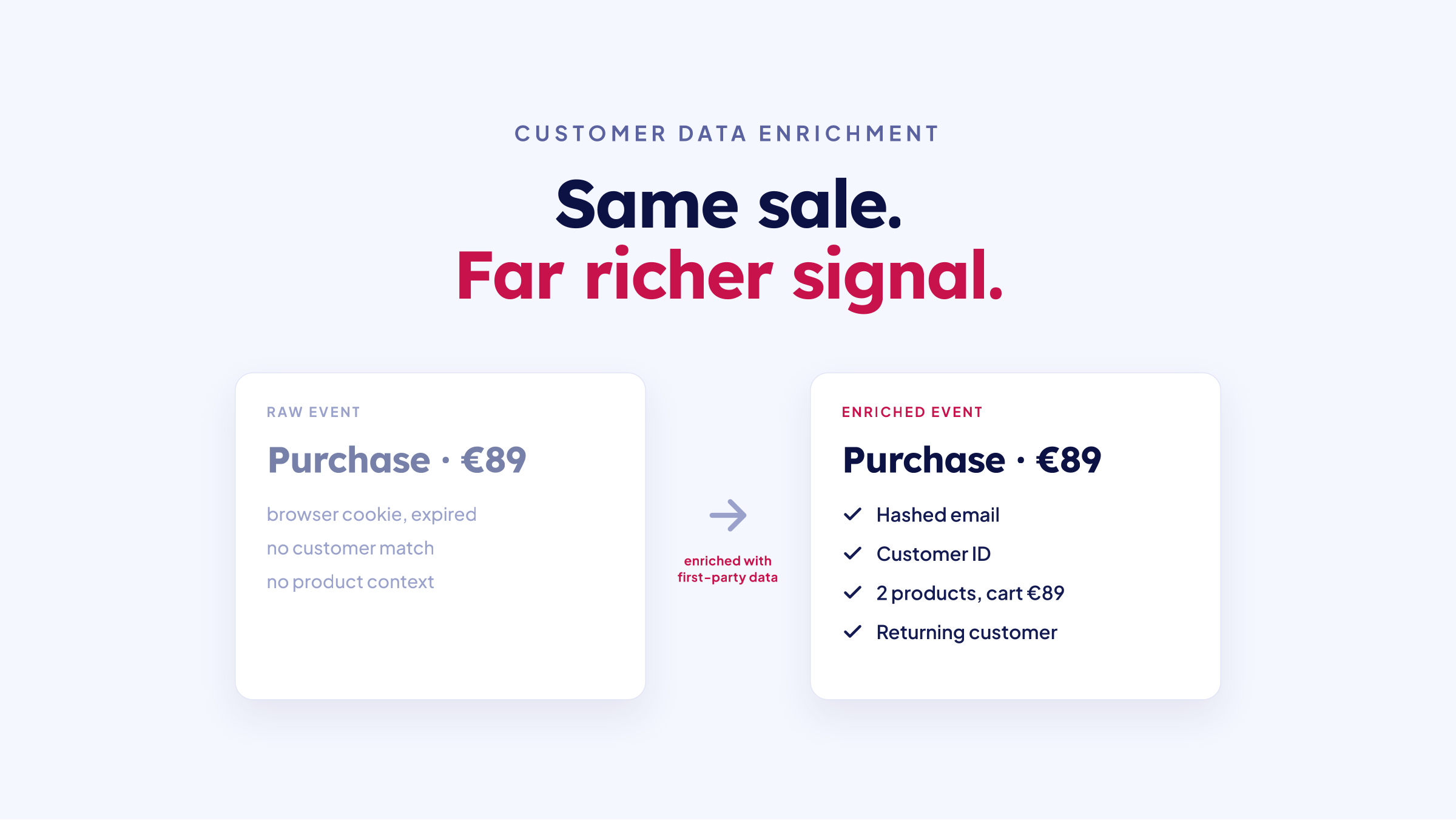
That accuracy is what TrackBee delivers. It captures your conversions server-side and enriches them with first-party data, so TikTok sees the sales the browser pixel misses and you get an honest cost per acquisition.
TikTok Ads Cost Overview
Average cost benchmarks for 2026:
| Metric | Average Cost |
|---|---|
| CPM (Cost per 1,000 impressions) | ~€10 |
| CPC (Cost per click) | ~€1.00 |
| Daily ad-group minimum (official) | ~€20 |
| Recommended test budget | €500 |
CPM and CPC figures come from aggregated TikTok ad cost benchmarks. TikTok's official budget minimums are much lower than the €500 above: roughly €45 ($50) at the campaign level and €18 ($20) at the ad-group level. The €500 is a recommended test budget, not a hard requirement.
These are industry averages. Actual costs vary by:
-
Industry / product category: Fashion and beauty typically see lower CPMs than B2B or finance categories
-
Creative quality: TikTok's algorithm rewards native-feeling, high-engagement creative with lower CPMs
-
Audience competition: Interest categories with more advertiser competition have higher CPMs
-
Seasonality: Q4 (Black Friday through Christmas) drives significantly higher CPMs across all categories
TikTok CPMs are generally comparable to Meta's, though with meaningful variation based on creative performance. TikTok's algorithm is known for rewarding content that feels native to the platform - highly produced brand creative typically underperforms genuine, relatable content.
Already running TikTok ads on a Shopify store? This table can't show you the most expensive line. Browser pixels miss 30-60% of conversions (ad blockers, iOS limits, consent banners), so TikTok's algorithm learns from a fraction of your real buyers. That gap quietly raises what every result costs you. If you're spending real budget here, it's worth checking how much of your conversion data actually reaches TikTok. Here's how server-side tracking closes that gap.
TikTok Ad Formats and Their Cost Structures
In-Feed Ads The standard format. Appears in users' For You feed as they scroll. Up to 60 seconds. These are the primary performance marketing format - they can be optimized for conversions, clicks, or video views. Most Shopify advertisers start here. Best for: Product discovery, conversion campaigns

Spark Ads Promotes existing organic TikTok content (either your own or creator content you have authorization to promote). Allows you to boost a well-performing organic post as a paid ad. Engagement stays on the original post, building social proof. Best for: UGC amplification, brands with strong organic TikTok presence
Top View Ads Full-screen takeover when users open TikTok. High visibility, high cost. More appropriate for brand awareness at scale than performance marketing. Best for: Brand launches, major product announcements
Brand Takeover Ads Full-screen video or image for 3–5 seconds immediately after app open. Very high cost (estimated at around €50,000/day). Relevant for large brands, not DTC growth-stage brands.
Branded Hashtag Challenges Invites users to participate in a branded challenge using a specific hashtag. Featured on the Discover page. Significant creative and budget commitment. Best for: Viral brand awareness campaigns, not direct response
For most Shopify DTC brands:
In-Feed Ads (standard and spark) are the primary formats. Optimize for conversions (purchases or add-to-cart) to align the algorithm with your business objective. For a systematic approach to creating high-performing UGC creative for TikTok and Meta, see our UGC framework for profitable campaigns.
Budget Requirements: Minimum and Recommended
Minimum budgets:

-
Campaign daily budget: about €45 ($50) minimum (official)
-
Ad-group daily budget: about €18 ($20) minimum (official)
-
Benchmark sources suggest a test budget of around €300 to €500 to give the algorithm sufficient data to exit the learning phase
The €45 and €18 figures are TikTok's actual platform minimums. The €300 to €500 test budget is a practical recommendation from benchmark sources, not an enforced requirement.
Practical budget for testing: A meaningful test of TikTok as a channel requires 2–4 weeks at sufficient spend to generate enough conversion events for the algorithm to optimize. For most Shopify stores, this means €1,000–€3,000 for an initial test before drawing conclusions.
Scaling budget: TikTok's algorithm responds well to gradual budget increases (20–30% per day rather than large sudden jumps). Large budget jumps can destabilize campaign learning.
Note on practical budgets: TikTok's official minimums are low (about €45/day at campaign level, €18/day at ad-group level), but giving the algorithm enough signal to exit the learning phase pushes toward more concentrated spend than the floor implies. In practice, TikTok is most appropriate for brands that can commit at least €500–1,000/month to the channel.
Bidding Strategies Explained
Automatic Bidding (Lowest Cost) TikTok's algorithm bids to maximize your chosen optimization event (conversions, clicks, video views) within your budget. Recommended starting point for most advertisers - let the algorithm learn what works before adding bid constraints.
Manual Bidding (Cost Cap / Bid Cap) You set a maximum bid per optimization event. This prevents overspending per conversion but can limit delivery if the bid cap is set too low. Use manual bidding once you have sufficient conversion data to know your target CPA.
Audience Expansion TikTok's feature that automatically expands beyond your specified target audience when it identifies additional high-converting users. Similar to Meta's Advantage+. Generally beneficial - enables Andromeda-style exploration beyond your manually specified parameters.
Recommendation for Shopify stores: Start with automatic bidding (Lowest Cost) and Audience Expansion enabled. Once you have 50–100 conversion events in the campaign, review CPA and optionally add a cost cap that reflects your target CPA.
What Drives TikTok Ad Performance
TikTok's algorithm differs from Meta and Google in one important way: creative quality has a disproportionate impact on cost and delivery. An ad that earns strong engagement (saves, shares, comments, completions) receives preferential delivery at lower CPMs. An ad that earns poor engagement gets limited reach even with high bids.

What TikTok's algorithm rewards:
-
Content that feels native to the platform - vertical video, natural pacing, unpolished aesthetic
-
Video that captures attention in the first 1–2 seconds (early scroll-stop rate is a key signal)
-
Content that invites engagement (questions in caption, "comment which you'd choose" hooks)
-
Sound-on content - TikTok users engage with audio; silent ads underperform
What underperforms:
-
Repurposed horizontal video from Meta or Google
-
Highly produced brand creative that looks like a traditional TV or Instagram ad
-
Static images (TikTok is inherently a video platform)
The UGC opportunity: Creator-style content - authentic, first-person, relatable - consistently outperforms polished brand creative on TikTok. If you can source genuine UGC from customers or work with micro-creators, it's worth testing against in-house produced content.
TikTok Tracking: Why the Events API Matters
TikTok, like Meta and Google, offers both client-side tracking (the TikTok Pixel, which runs in the browser) and server-side tracking (the TikTok Events API, which sends events server-to-server).
The TikTok Pixel faces the same limitations as other browser-based tracking:
-
Ad blockers prevent it from loading on 30–40% of sessions
-
iOS restrictions limit cross-app tracking
-
Cookie limitations fragment cross-session attribution
Why this matters for your TikTok ROAS: TikTok's bidding algorithm learns from the conversion events it receives. If your Pixel is missing 35% of purchases, TikTok's algorithm is training on 65% of your actual buyers. It builds an audience model based on the trackable segment - which may not represent your full buyer population.
The Events API sends conversion data directly from your server to TikTok, bypassing browser restrictions. Combined with the Pixel (deduplicated), you get complete conversion coverage - and TikTok's algorithm trains on data that reflects your actual buyers.
TrackBee supports the TikTok Events API integration, sending server-side conversion events to TikTok alongside your existing Pixel. The same server-side infrastructure that improves Meta and Google performance extends to TikTok. See: Full-funnel tracking for Shopify: how does it work?.
If you run a Shopify store, here's the complete TikTok Events API setup guide that walks through connecting server-side tracking step by step.
TikTok vs. Meta vs. Google: Cost Comparison
| TikTok | Meta | Google Shopping | |
|---|---|---|---|
| Average CPM | ~€10 | €8–15 | N/A (CPC-based) |
| Average CPC | ~€1.00 | €0.80–1.50 | €0.50–2.00 |
| Minimum budget | ~€45/day campaign (official); €500 recommended test | Low (€5/day possible) | No formal minimum |
| Creative requirement | High - native video | Moderate | Lower (product feed) |
| Audience intent | Discovery/browsing | Discovery/intent mix | Active search intent |
| Learning phase | 7–14 days, 50+ events | 7–14 days, 50 events | 30 days, 30+ conversions |
Practical implications for Shopify advertisers:
-
Google Shopping reaches users actively searching for products - higher purchase intent but narrower reach
-
Meta reaches users in browse mode - good for discovery and retargeting
-
TikTok reaches users in entertainment mode - highest creative barrier to entry, but unique discovery potential
TikTok is most effective as a top-of-funnel channel for DTC brands whose products translate well to short video format. Use TikTok for awareness and discovery; retarget on Meta and capture intent on Google.
Frequently Asked Questions
Is TikTok advertising worth it for small Shopify stores? TikTok's official minimum is low (about €45/day at campaign level), but a meaningful test budget of around €500 makes it less accessible than Meta for very small stores. If your monthly ad budget is under €2,000, allocate most of it to Meta and Google before adding TikTok. Once you have a stable ROAS on those channels and budget to test a new one, TikTok is a valuable addition.
What conversion events should I optimize for on TikTok? For most Shopify stores, optimize for "Complete Payment" (purchase) if you have sufficient conversion volume (50+ purchases per month attributed to TikTok). If your volume is lower, optimize for "Add to Cart" or "View Content" - higher-volume events that provide more signal to the algorithm.
How long until I see results from TikTok ads? Plan for 2–4 weeks before drawing conclusions. The algorithm needs to exit the learning phase (typically 50+ optimization events) before stable performance is established. Early campaign performance is not representative.
What creative format works best for DTC product ads on TikTok? Short (15–30 second) vertical video with a clear problem-solution narrative. First 2–3 seconds must capture attention - this is where most impressions are lost. Authentic, native-feeling content consistently outperforms polished brand production on TikTok.
Does TikTok advertising work for higher-ticket products? Higher-ticket products (€100+) can perform on TikTok, but the purchase path is longer. Educational content that builds trust over time, combined with retargeting of engaged users, is more effective than direct-to-purchase creative for considered purchases.
TikTok Ads Work When the Tracking Does
TikTok's cost structure is competitive. The creative requirement is higher than other platforms. And the tracking infrastructure - specifically the Events API - is the difference between an algorithm that's learning from your actual buyers and one that's learning from an incomplete sample.
Complete server-side tracking via TrackBee's TikTok Events API integration ensures your TikTok campaigns have the complete conversion signal they need to optimize effectively.
The practical first step is connecting the TikTok Events API to your Shopify store. Follow the complete setup guide to get server-side conversions flowing.


.png)